Atlas walk · Thessaloniki
Thessaloniki street art and public art walk: Ano Poli to the sea
Ten stops downhill from the walls of Ano Poli to the seafront: Byzantine mosaics, the city's best-known mural, Hébrard's great square and the sculpture of the New Waterfront.

We earn a commission on some bookings.
Start at the Trigonion Tower at the top of Ano Poli. A taxi or local bus up the hill saves the climb, and the walk then runs downhill to the sea.
An Ottoman round tower built around an older Byzantine one on the city walls, with one of the widest views over the gulf.
7 min walk · 0.5 km (0.3 mi)
A fourteenth-century monastery, still in use, on the UNESCO list of Thessaloniki's early Christian and Byzantine monuments, high above the city.
4 min walk · 0.3 km (0.2 mi)
A small late fifth-century church holding a celebrated early Christian apse mosaic of a young, beardless Christ.
8 min walk · 0.6 km (0.4 mi)
The great basilica of the city's patron saint, with seventh-century mosaic panels and a crypt in the remains of a Roman bath.
16 min walk · 1.2 km (0.7 mi)
Faith47 and DALeast's mural of a bowed woman and a phoenix of painted shards, several storeys high, on this wall since the early 2010s.
8 min walk · 0.6 km (0.4 mi)
Ernest Hébrard's square from the plan made after the 1917 fire, framed by listed buildings, with a bronze Aristotle from 1990.
16 min walk · 1.2 km (0.7 mi)
The Ottoman sea tower that became the city's symbol, now a museum of Thessaloniki's history with a view from the top.
5 min walk · 0.4 km (0.2 mi)
Evangelos Moustakas's bronze Alexander on Bucephalus, erected in 1973, with a bronze relief of the Battle of Issus beside it.
5 min walk · 0.4 km (0.2 mi)
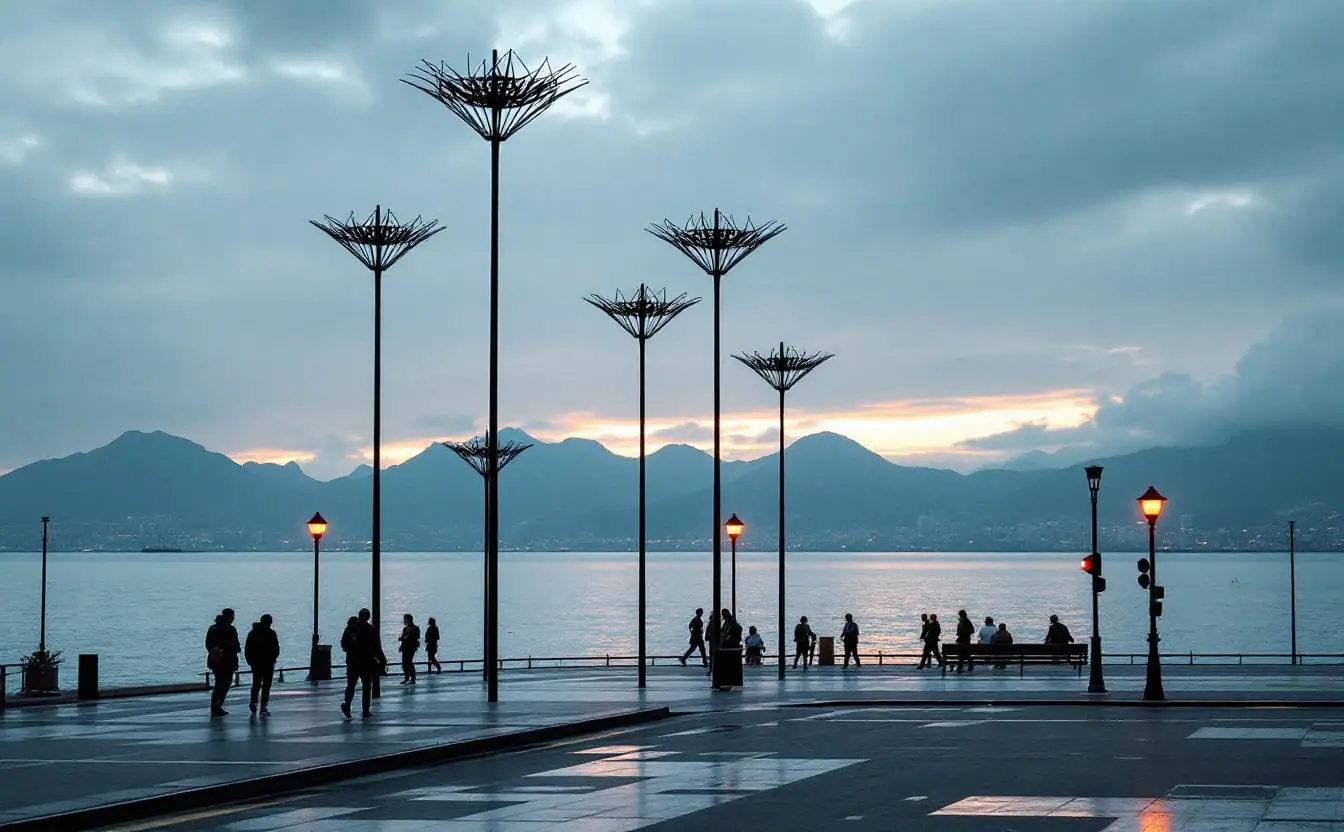
George Zongolopoulos's tall steel umbrellas, placed on the seafront in 1997 and moved to a platform over the water in 2013.
4 min walk · 0.3 km (0.2 mi)
Pavlos Vasileiadis's stainless steel sculpture, about four metres tall, standing among the themed gardens of the New Waterfront.
Your walk
- Stops
- 10
- Walking
- 5.4 km (3.4 mi), 1 h 12 min
- Looking
- 3 h 05 min
- Altogether
- 4 h 17 min
- Finish around
- 14:17
Distances are straight lines between stops times 1.3, a usual allowance for streets that don’t run where you want them to. Add time for coffee, crossings and the wall you didn’t plan on.
The route planner above shows the stops in walking order, top of the hill first. Untick any you want to skip and the planner redraws the route and recalculates distance and time; the notes below follow the same order. The whole walk runs downhill, from the old walls to the sea.
Street art in Thessaloniki is spread thinly across the centre and changes constantly, so this route sticks to what you can count on: one long-lived mural, Byzantine and Ottoman monuments, and the public sculpture along the seafront. Individual painted walls come and go; for what separates a tag from a commission, see our note on street art and graffiti.
The route
Ano Poli, the upper town, largely escaped the fire of 1917 that destroyed much of the centre, so the walk begins among older houses, steep lanes and the Byzantine walls. From the Trigonion Tower you follow the walls west, drop through the lanes past two churches on the UNESCO list, and come down to Hagios Demetrios at the top of the rebuilt centre.
From there the route swings west to Ladadika, the old warehouse quarter by the port, for the mural, then back to Aristotelous Square and down to the sea. The last stretch follows the promenade east past the White Tower onto the New Waterfront, designed by Prodromos Nikiforidis and Bernard Cuomo and finished in stages by 2014, where a string of themed gardens holds much of the city's modern sculpture. If you have done our Athens street art walk, this one is quieter and greener, with more sea.
The stops
Trigonion Tower
Start where the walls turn the corner at the top of the hill. The Trigonion Tower is a massive round artillery tower from the Ottoman period, built around an older Byzantine one, and the terrace beside it has one of the widest views in the city: roofs falling away to the Thermaic Gulf and, on clear days, Mount Olympus across the water. The Heptapyrgion fortress is a short way up the walls if you want more ramparts. Come early, before the haze of a warm day flattens the view.
Vlatadon Monastery
Follow the walls west to Vlatadon, a fourteenth-century monastery that is still in use. It is one of fifteen monuments in the city on the UNESCO World Heritage List as the early Christian and Byzantine monuments of Thessaloniki, and it sits high enough for the whole city to spread out below. In 2005 a lost treatise by the ancient physician Galen turned up in its library. Treat the courtyard as you would a church: quiet voices, covered shoulders and no photographs of monks or services.
Hosios David
A few minutes further west, this small late fifth-century church was the main church of the Latomou monastery. It served as a mosque in the Ottoman period and was reconsecrated in 1921. Its apse holds a celebrated early Christian mosaic of a young, beardless Christ within a circle of light, with symbols of the Evangelists around him. The church keeps short hours, so check before you go. If it is shut, walk the lanes nearby: some Ano Poli residents have commissioned muralists to paint their facades, finding that painted walls attract fewer tags.
Hagios Demetrios
Walk downhill to the basilica of the city's patron saint. A church has stood here since the fourth century, on the site of a Roman bath; the five-aisled building dates from a rebuilding in the seventh century, and the fire of 1917 gutted it before a long restoration. Look for the mosaic panels made before 730, which show Demetrius with the founders who restored the church and with children. The crypt below sits in the remains of the bath. This is a working church, busiest around the saint's feast on 26 October.
The Girl and the Phoenix
Head west to Polytechniou Street, on the edge of Ladadika, the old warehouse quarter by the port that now lives on tavernas and bars. On a tall side wall Faith47 painted a woman with her head bowed, holding the tail of a phoenix that DALeast built above her from thousands of painted shards like splintered metal. They made it in the early 2010s, when the city hosted a biennial of young artists from Europe and the Mediterranean. It is usually read as a statement against violence towards women. See it in daylight, from the opposite pavement.
Aristotelous Square
Walk south-east to the city's main square, designed by Ernest Hébrard in 1918 as part of his plan for the centre after the Great Fire, though most of it was built in the 1950s. The twelve buildings around it have been listed since 1950. Hébrard drew a monumental axis from here uphill towards the Roman Forum, and from the bronze Aristotle of 1990 you can still trace it. In the evening the square fills with people heading for the sea; at midday its stone gives little shade.
White Tower
Turn left along Nikis Avenue and follow the sea to the White Tower. The Ottomans built it after taking the city in 1430, probably on the site of an older Byzantine tower, to guard the eastern end of the sea walls. It was long a prison, was whitewashed after 1912 and became the symbol of the city. Inside, a museum of Thessaloniki's history climbs through six floors, and the top gives a view along the waterfront you are about to walk. Check opening hours before you go.
Alexander the Great statue
A few minutes on, Evangelos Moustakas's bronze Alexander rides Bucephalus. The statue is about 6 metres tall, 11 with its pedestal, and went up in 1973. On the monument's west wall a bronze relief of the Battle of Issus packs in 45 figures, and two rows of shields and long Macedonian pikes stand for the ordinary soldiers of the campaign. The smooth marble around it is a favourite with skateboarders in the evening, so keep an eye out when you step back for a photograph.
Umbrellas
Further along, at the level of City Hall, George Zongolopoulos's Umbrellas rise from a platform built out over the water: open steel umbrellas on tall, slender poles, hovering above the walkers. Zongolopoulos returned to the umbrella again and again from 1987, and this piece came to the seafront in 1997, when Thessaloniki was European Capital of Culture. It moved to its platform in 2013, once the waterfront works were done. Sunset draws a crowd for the light over the gulf; early morning is quieter.
Moon on the Shore
Finish a short way along at Moon on the Shore, a stainless steel sculpture about four metres tall by the Thessaloniki-born sculptor Pavlos Vasileiadis. It stands among the New Waterfront's themed gardens, which carry names such as the Garden of Sound and the Garden of the Sculptors. Look back from here at the line of the city curving round the bay to the White Tower. The promenade carries on east towards the Concert Hall if you want to keep walking.
Practical notes
Wear shoes with grip: Ano Poli is steep, with cobbles and steps, and waterfront paving is slippery when wet. The churches are places of worship, so cover shoulders and knees, keep quiet during services and check opening hours, which are short at Hosios David. In Ano Poli people live behind every wall. Photograph the painted facades, not the residents, and add nothing of your own, since some owners commission murals precisely to keep tags off. In winter the cold northerly wind locals call the Vardaris can make the seafront raw; in summer there is little shade on the promenade until the gardens. Cyclists and skateboarders share the waterfront, so keep to one side when you stop.
Further reading
Rick Steves Greece concentrates on Athens and the south, so take it for the wider trip rather than for this city. Gabriel Campanario's The Art of Urban Sketching and Stephanie Bower's The Urban Sketching Handbook suit a walk that ends on a bench facing the sea. For finding new walls on your own, see how to plan a self-guided street art walk.
These picks come from publisher details and published reviews rather than our own testing.
Questions
Where is the best street art in Thessaloniki?
The best-known mural is The Girl and the Phoenix on Polytechniou Street in Ladadika, which this walk includes. Beyond it, painted walls are scattered through the centre and Ano Poli and change often. Walk the side streets around the stops and look up.
Is the walk difficult?
It runs downhill, which helps, but the first stretch in Ano Poli is steep, with cobbles and steps. Take a taxi or a local bus up to the start rather than climbing. After Hagios Demetrios the ground is gentle all the way to the sea.
When is the best time to see the Umbrellas?
Late afternoon and sunset, when the light comes across the gulf and the steel catches it. The promenade is busiest then, so come in the early morning if you want the sculpture to yourself.
How long does the Thessaloniki walk take?
The planner shows distance and time for the stops you keep. Allow two to four hours with stops, and longer if you go inside the White Tower and the churches.