Atlas walk · Vienna
Vienna street art walk: Donaukanal walls, Wagner and Hundertwasser
Eleven stops down the Danube Canal from Spittelau to Landstraße: legal walls that never look the same twice, Otto Wagner's weir house, a memorial that asks you to stop, and Hundertwasser at both ends.

We earn a commission on some bookings and books. As an Amazon Associate I earn from qualifying purchases.
Start at Spittelau station (U4 and U6) and head for the canal path below the incinerator.
A working waste incinerator and heating plant that Hundertwasser reclad in colour and ceramics after a fire in 1987.
5 min walk · 0.4 km (0.2 mi)
Three angular blocks of the mid 2000s that weave over and around Otto Wagner's protected railway viaduct beside the canal.
11 min walk · 0.8 km (0.5 mi)
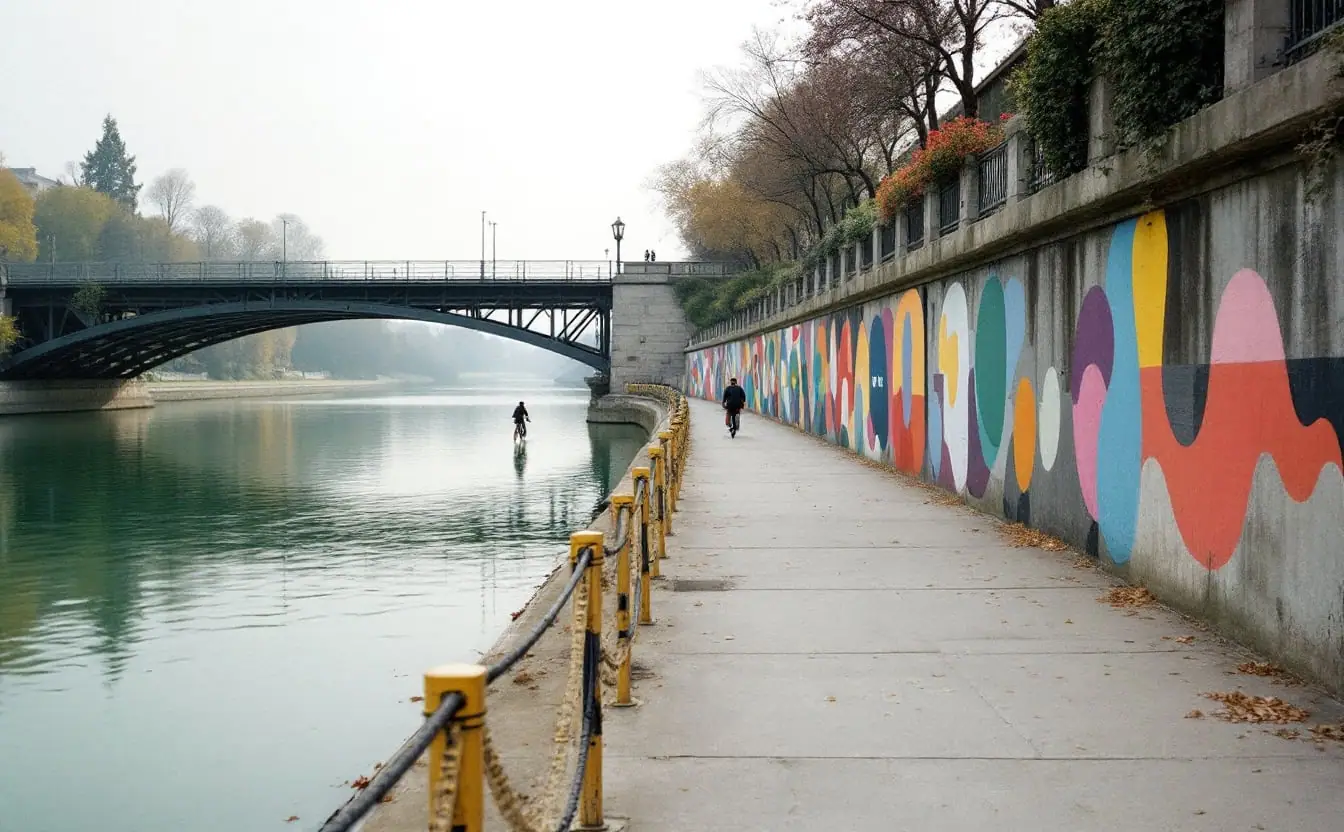
The first long run of painted embankment below street level, pieces and tags stacked in layers that never stay put for long.
10 min walk · 0.7 km (0.5 mi)
One of the city's legal walls, open to painters around the clock, where by custom fresh work is left alone.
9 min walk · 0.7 km (0.4 mi)
Legal walls on the ramp by the Augartenbrücke and around the Flex club, a long standing hall of fame for Vienna's writers.
3 min walk · 0.2 km (0.1 mi)
Wagner's weir house of 1904 to 1908: granite, marble panels and a band of blue tiles with white waves under the roof.
10 min walk · 0.7 km (0.5 mi)
Leopold Grausam's 1985 memorial to the victims of Nazi rule, facing the site of the Gestapo headquarters in the Hotel Métropole.
6 min walk · 0.5 km (0.3 mi)
The embankment between the Marienbrücke and the Schwedenbrücke, the canal's busiest stretch, painted wall after wall at water level.
6 min walk · 0.5 km (0.3 mi)
Max Fabiani's adult education house of 1910, with its observatory, on the corner where the Wien river joins the canal.
13 min walk · 0.9 km (0.6 mi)
Hundertwasser's museum, opened in 1991 in a converted Thonet furniture factory, with uneven floors and ceramic covered walls.
7 min walk · 0.5 km (0.3 mi)
Municipal housing built 1983 to 1985 to Hundertwasser's ideas, with uneven lines, planted terraces and a patchwork of colour.
Your walk
- Stops
- 11
- Walking
- 6.0 km (3.7 mi), 1 h 19 min
- Looking
- 2 h 35 min
- Altogether
- 3 h 54 min
- Finish around
- 13:54
Distances are straight lines between stops times 1.3, a usual allowance for streets that don’t run where you want them to. Add time for coffee, crossings and the wall you didn’t plan on.
The planner above lists eleven stops in walking order, from Spittelau station down the canal to the Hundertwasserhaus. Untick anything you want to skip and the route and its totals update. The canal path is flat and continuous, so the walk is easy to shorten: you can leave the water at almost any bridge. Allow two to four hours with stops.
The route
Vienna has no single mural district. What it has is the Donaukanal, the arm of the Danube that curves past the old city, with kilometres of embankment wall below street level. Since the city opened legal walls for painters, the canal has become the place where Viennese graffiti lives in public, layered, unglamorous and always changing. Most of it is graffiti in the strict sense, letters and names written for other writers, which is worth knowing before you judge it; the difference is explained in our piece on street art and graffiti.
The walk follows the city bank downstream, with one short crossing to see Otto Wagner's weir house, then leaves the water at the Urania and turns into Landstraße for two Hundertwasser buildings. Architecture and paint alternate, which suits the canal: it was engineered as infrastructure and then slowly claimed as public space. Individual pieces on the walls change constantly; the buildings do not.
The stops
Spittelau incinerator façade
Start with a rubbish plant. The waste incinerator at Spittelau opened in 1971 and still burns the city's waste to feed its district heating. After a fire on the night of 14 to 15 May 1987, Friedensreich Hundertwasser redesigned its entire outer skin, with the architect Peter Pelikan, in work finished in 1992. Coloured ceramics, broken lines and a big replica of the artist's own cap on a small tower turned a utility into a landmark. View it from the canal path; it is a working plant, not a gallery.
Zaha Hadid's housing over the Stadtbahn viaduct
A few minutes downstream on Spittelauer Lände, Zaha Hadid's housing from the mid 2000s threads three angular blocks over and around a protected railway viaduct by Otto Wagner. The arches below hold bars and shops; the flats ride above them like something caught in mid movement. Notice how the canal path, the road and the old viaduct all squeeze into one narrow strip, and how the building uses the air above the arches rather than fighting for ground. It is a lesson in building on leftovers.
Canal walls at the Friedensbrücke
From here the embankment walls start to fill up. Around the Friedensbrücke the concrete below street level carries layer on layer of pieces, tags and throw-ups, the full vocabulary of writing culture. Nothing here is meant to last, and nothing does. Read the walls as a timeline, with the freshest paint on top, and keep to the side of the path: it is shared with cyclists, and many ride it at commuting speed.
Legal wall at Roßauer Lände
Along the canal at Roßauer Lände is one of Vienna's legal walls, part of the city's Wienerwand programme for young painters. Anyone may paint here at any hour without registering, and the only rule is a courtesy: leave freshly painted work alone. On a dry weekend you may well find a crew at work. Watching is fine, and so is a polite question, but ask before you photograph faces. Writers are not exhibits.
Flex and the Augartenbrücke ramp
Further on, by the Augartenbrücke, the ramp down to the water and the walls around the Flex music club are legal walls too, and have long been treated by writers as a hall of fame. The attraction is density: piece over piece, colour stacked on colour like strata in a cutting. Spend a few minutes reading the edges where one painter has respected another's work, and where nobody did. Across the water you can already see the next stop.
Otto Wagner's Schützenhaus
Just downstream of the bridge sits the most refined small building on the canal. Otto Wagner designed the Schützenhaus for the Kaiserbad weir and lock, built from 1904 to 1908, to store the movable parts of the weir. Granite at the base, panels of marble above, and under the roof a wide band of blue glazed tiles patterned with white waves: function and ornament in one modest house. The weir itself was destroyed in the war. The building survives as a restaurant, and since 2020 the old lock island beside it has been planted and fitted with seats as the Schwimmende Gärten.
Memorial on Morzinplatz
Cross back to the city side at the Salztorbrücke. From 1938 to 1945 the Gestapo ran its Vienna headquarters from the former Hotel Métropole on Morzinplatz; the building was destroyed in 1945 and housing now stands on the site. Opposite, Leopold Grausam's memorial of 1985 places a bronze figure among roughly hewn stone blocks, under the words "Niemals vergessen", never forget. This is not a photo stop in the usual sense. Stand for a minute, read, then walk on.
Canal walls below Schwedenplatz
Back at water level, the embankment between the Marienbrücke and the Schwedenbrücke is the canal at its most crowded: summer bars, runners, boats and painted wall after painted wall. The paint is as layered as upstream, but the audience is bigger, so pieces here get seen, and covered, faster. Sit on the edge for a while. What lasts on this stretch is not any one painting but the habit of painting this concrete at all.
Urania
Where the Wien river runs into the canal, the Urania has stood since 1910. Max Fabiani, a pupil of Otto Wagner, designed this adult education house with a public observatory, and a puppet theatre has played here since 1950. Fabiani chose a historicist dress for a modern programme, and the building turns its corner like a ship's bow. It carries a civic idea Vienna still likes: learning belongs on a prominent corner, open to anyone who walks past.
KunstHausWien
Cross the mouth of the Wien river and follow the Weißgerberlände downstream, then turn into Untere Weißgerberstraße. The KunstHausWien opened in 1991 in a Thonet furniture factory of 1892, rebuilt by Peter Pelikan to Hundertwasser's ideas, with uneven floors, ceramic covered surfaces and plants indoors. It holds the only permanent exhibition of Hundertwasser's work, alongside changing shows by other artists. Check opening times before you go; even from the street, the façade alone justifies the detour.
Hundertwasserhaus
A short walk south, at the corner of Kegelgasse and Löwengasse, the Hundertwasserhaus was built from 1983 to 1985 as municipal housing, a Gemeindebau like the ones I described in Vienna's courtyards. Hundertwasser shaped it with the architect Josef Krawina and then Peter Pelikan, and Austria's Supreme Court later recognised Krawina as a co-author. Uneven lines, planted terraces and a patchwork of colour make it the walk's finale. People live here: look from the street and keep entrances clear.
Practical notes
- Most of the walls on this route are on the city bank and face north-east, so the best light on them is in the morning.
- The lower promenade is shared with cyclists and runners. Walk to one side, and look before you step back for a photo.
- Paint only on the legal walls. Spraying anywhere else, including bridge piers and the walls between the legal sections, is illegal.
- Never touch wet paint.
- The Morzinplatz memorial and the Hundertwasserhaus deserve quiet: one remembers victims, the other is home to its tenants.
- Check the KunstHausWien's opening times before you go. The canal walk itself needs no ticket.
- Compare notes with our Lisbon walk: Lisbon commissions murals for façades, while Vienna hands painters walls and leaves them to it.
Further reading
A pocket guide covers the old city you skirt along the canal. Subway Art, Martha Cooper and Henry Chalfant's record of painted New York trains, explains the letter based writing culture that fills the Donaukanal walls. Marc Taro Holmes's book is for anyone who wants to draw the Schützenhaus rather than photograph it.
These picks come from publisher details and published reviews rather than our own testing.
Questions
Where can you legally paint graffiti in Vienna?
On the city's legal walls, known as the Wienerwand. Along the Donaukanal they include the walls at Roßauer Lände, the ramp at the Augartenbrücke and the area around the Flex. They are open around the clock without registration, and by custom you leave freshly painted work alone.
When is the best time to walk the Donaukanal for street art?
A dry morning is best, when the light falls on the city bank walls and the path is quieter. Weekends bring more painters at the legal walls, which is the best chance to see work in progress.
Can you go inside the Hundertwasserhaus?
No. It is municipal housing with private flats, so you see it from Kegelgasse and Löwengasse. For Hundertwasser indoors, go to the KunstHausWien, a few minutes away on the route.
Do the paintings on the Donaukanal stay the same?
No, and that is the nature of the place. The legal walls are painted over constantly, so photos from a few months ago will already be out of date. The buildings on this route, from Wagner's Schützenhaus to the Hundertwasserhaus, are the fixed points.