Visiting the Spomeniks: Yugoslav Memorials With Care and Context
A practical guide to Yugoslav memorial sculpture at Tjentište, Kozara, Petrova Gora, Kadinjača and Jasenovac: what each one marks and how to visit well.

We earn a commission on some bookings and books. As an Amazon Associate I earn from qualifying purchases.
Most people meet the spomeniks as photographs: grey concrete shapes in empty landscapes, shot from below against a heavy sky and captioned as if they had landed from another planet. Stand in front of one and the caption falls apart. There are names cut into walls nearby, wreaths left from the last anniversary, and a valley or a forest where something desperate happened in the 1940s. The forms are strange. The reasons for them are not.
This guide covers five of the best-known memorials in three countries, what each one marks, and how to visit without treating a battlefield or a camp as a backdrop. It is written from Zagreb, which puts two of them within a day's drive and the rest within reach of a long weekend.
What the memorials commemorate
"Spomenik" simply means monument in the languages of the former Yugoslavia, and the word reached English mostly through photography, above all Jan Kempenaers's book of that name, published in 2010. The memorials themselves were built mainly between the 1960s and the 1980s. They commemorate the People's Liberation War of 1941 to 1945, when the Partisans led by Josip Broz Tito fought the German and Italian occupiers and their local allies, and they mourn the civilians killed in massacres and camps.
Many were chosen through competitions and designed by leading sculptors and architects of the time, among them Bogdan Bogdanović, Dušan Džamonja, Vojin Bakić and Miodrag Živković. After Yugoslavia's break with Stalin in 1948 the country had moved away from Soviet-style socialist realism, and abstraction gave designers a way to speak about loss and resistance without heroic soldiers in bronze. It also suited a federation of many nations and faiths: a split rock or an opening flower can be read by anyone who arrives. They were made to last for ever, the opposite of the short-lived works that now fill city squares for a few weeks at a time.
After the wars of the 1990s, many memorials were neglected, damaged or removed, especially where the new states turned against the Yugoslav past. Others are still maintained and still host anniversary gatherings of veterans' and anti-fascist associations and local families. International interest grew again with the Museum of Modern Art's 2018 exhibition on Yugoslav architecture, Toward a Concrete Utopia, and brought new visitors. It also brought a habit of photographing the monuments without reading them. More on memorials and sculpture in public space is gathered in the public art strand.
Five memorials and what they mark
Tjentište: the Battle of the Sutjeska
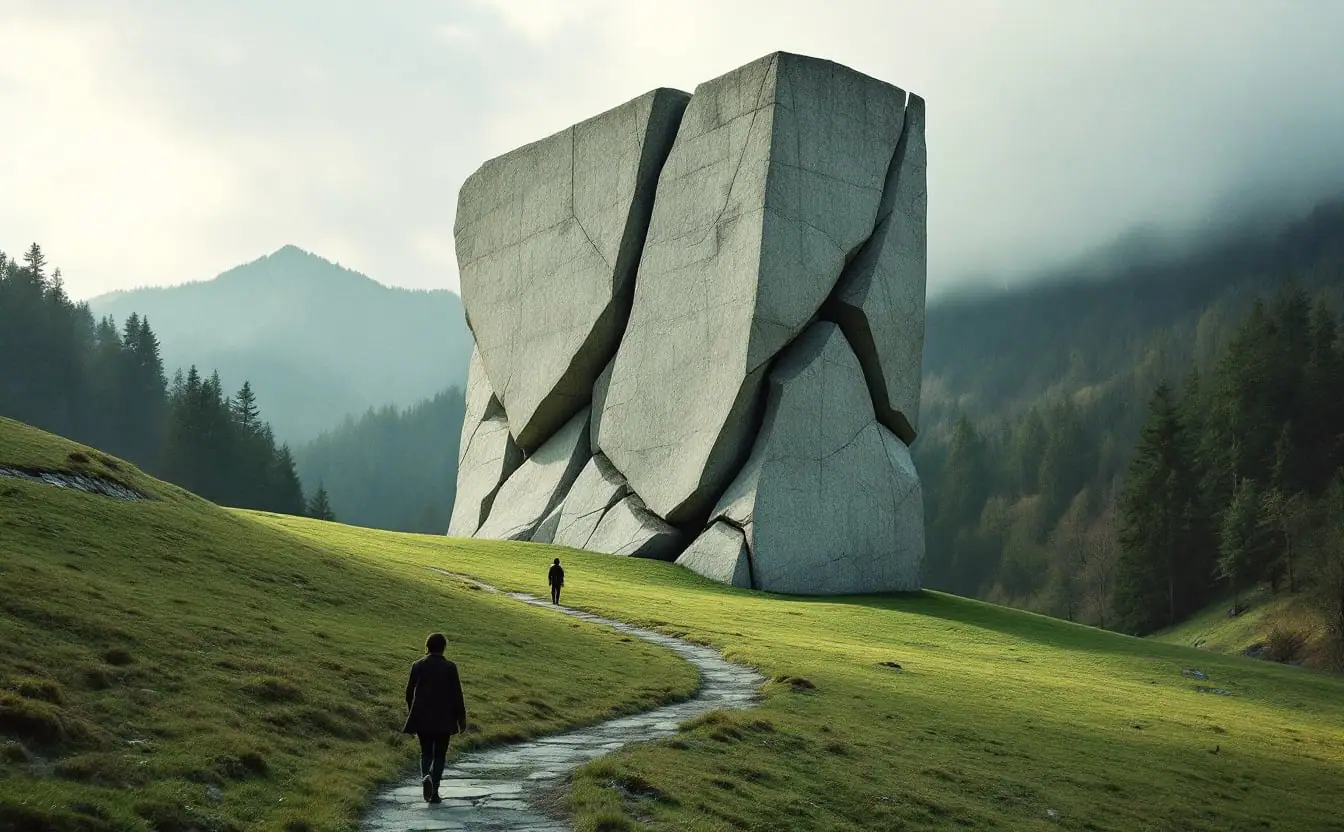
In May and June 1943, German-led Axis forces surrounded the main Partisan army and its wounded in the mountains around the Sutjeska river. The Partisans broke out at enormous cost, and Tito himself was wounded. Miodrag Živković's monument, unveiled in 1971, is a pair of huge faceted concrete forms that rise from the hillside like a rock split in two, with a path leading between them. From the valley floor it reads as a single gesture; close up, you walk through the crack.
The park around it is one of the wildest corners of the region, with the old-growth Perućica forest and Maglić, the highest peak in Bosnia and Herzegovina. The memorial stands beside the road between Foča and Gacko, so it is easy to treat as a quick stop on the way somewhere else. Give it a whole day instead.
Kozara: the monument at Mrakovica
In the summer of 1942 Axis forces encircled Mount Kozara, in north-western Bosnia, to destroy the Partisans and the villages that supported them. Fighters and civilians tried to break out together. Many thousands died, and many thousands more civilians were deported to camps, Jasenovac among them. Dušan Džamonja's monument from 1972, at Mrakovica in the Kozara National Park above Prijedor, is a tall cylinder of concrete ribs with narrow gaps between them; you can step inside, and the daylight comes through in thin vertical bars. A long memorial wall nearby carries the names of the dead.
Petrova Gora: the uprising of Kordun and Banija
Petrova Gora is a wooded ridge in Croatia near Vojnić, south of Karlovac. During the war its forest hid a Partisan hospital, and the surrounding regions of Kordun and Banija saw mass killings of civilians, mostly Serbs, by the Ustaše. Vojin Bakić's memorial to the uprising of the people of these two regions, finished in 1981, stands on the summit: a swelling, folded tower of concrete once clad in stainless steel, built to house a museum. After the war of the 1990s it was abandoned, and most of the steel was stripped off for scrap.
What remains is still astonishing, and plainly unsafe: loose panels, broken glass, open shafts and stairwells. Look from outside, keep children close, and do not go in. Its future has been argued over for years.
Kadinjača: the stand of the Workers' Battalion
In the autumn of 1941 the Partisans held a liberated territory around Užice in western Serbia, remembered as the Republic of Užice. When German forces moved in to crush it at the end of November, the Workers' Battalion of the Užice Partisan Detachment stayed on the hill at Kadinjača to cover the retreat, and almost all of its fighters were killed. The memorial complex by the sculptor Miodrag Živković and the architect Aleksandar Đokić, completed in 1979, leads you up a path through a sequence of pale concrete forms to an open plateau with long views over the hills. It is one of the easier sites to reach, just off the road west of Užice towards Bajina Bašta.
Jasenovac: the Stone Flower
Jasenovac, in Croatia on the Sava close to the border with Bosnia and Herzegovina, was the largest camp system of the Ustaše regime of the Independent State of Croatia, which ran it from 1941 to 1945. Serbs, Jews and Roma were murdered there in great numbers, along with anti-fascist Croats, Muslims and others. Bogdan Bogdanović's Stone Flower, completed in 1966, opens in concrete over the meadow where the camp stood, and the approach is a path laid with railway sleepers. Shallow mounds and hollows in the grass mark the outline of the former camp. Across the river, in Bosnia and Herzegovina, Donja Gradina was part of the same complex and has its own memorial.
This is a place of mourning before it is anything else. Treat it as you would a cemetery.
How to visit well
Read before you go. A page of history about the battle or the camp changes what you see, and the small museums and memorial houses at some sites keep irregular hours, so you cannot count on them to fill the gaps. Most of these places need a car. Mountain roads are narrow, fuel stations are few, and the phone signal comes and goes, so download maps in advance. The travel strand has more on getting around the region.
Watch the calendar. Many memorials hold commemorations on the anniversaries of battles, uprisings or the closing of camps. If you arrive during one, keep your distance, keep your voice down and do not photograph mourners at close range. Standing quietly at the back is always acceptable.
Behave as you would at a war grave, because often you are at one. Do not climb the sculptures, do not stage playful photographs on them, and take your litter with you. Drone flights over national parks and memorial sites usually need permission, so ask rather than assume. Above all, remember that these memorials belong to living communities whose memories of the 1940s and the 1990s do not always agree. Listen more than you talk.
Questions people ask
Are all the spomeniks in one country?
No. They are spread across the former Yugoslav republics, now Slovenia, Croatia, Bosnia and Herzegovina, Serbia, Montenegro and North Macedonia, as well as Kosovo. A single trip can only take in a handful, so choose by region rather than by a list of famous shapes.
Can I go inside or climb them?
Some were designed to be entered, such as the cylinder at Kozara or the passage at Tjentište. Climbing is another matter: it damages surfaces, it is often dangerous, and at many sites the dead are buried close by. At Petrova Gora, stay out of the building entirely.
Is it all right to photograph them?
Yes. Photographs are a large part of how these works reached a wider audience in the first place. Put the camera down during ceremonies, ask before photographing anyone laying flowers, and caption your pictures with the place and what it commemorates rather than a line about alien spaceships.
Do I need a guide?
Not usually, but a local guide or a well-informed driver adds a great deal, especially at Kozara and Tjentište, where the battles moved across whole mountains. Local tourist offices and park offices can often suggest someone.
When is the best time to go?
Late spring to early autumn. The mountain sites can hold snow well into spring, and summer afternoons bring storms. Autumn is the photographers' favourite, with low light on the concrete and the beech forests turning.
Are the memorials political?
They commemorate resistance to fascism and the civilian victims of war crimes. In the region they are also tied up with arguments about Yugoslavia, the wars of the 1990s and present-day politics. A visitor does not have to settle those arguments. It is enough to know whom each place mourns, and to act accordingly.
A day from Zagreb
If you have one day, start early at Jasenovac while the meadow is quiet. Walk out along the sleepers to the Flower, then spend time with the names in the museum before you drive west through Banija. Reach Petrova Gora in the afternoon, park at the edge of the clearing, and look at the tower with its steel skin gone and its concrete ribs showing, the forest pressing in on every side.