Urban sketching supplies: a kit that fits in a coat pocket
A pocket kit for urban sketching: a hardback sketchbook, waterproof fineliners, a small watercolour box and a water brush, and why carrying less helps.

We earn a commission on some bookings and books. As an Amazon Associate I earn from qualifying purchases.
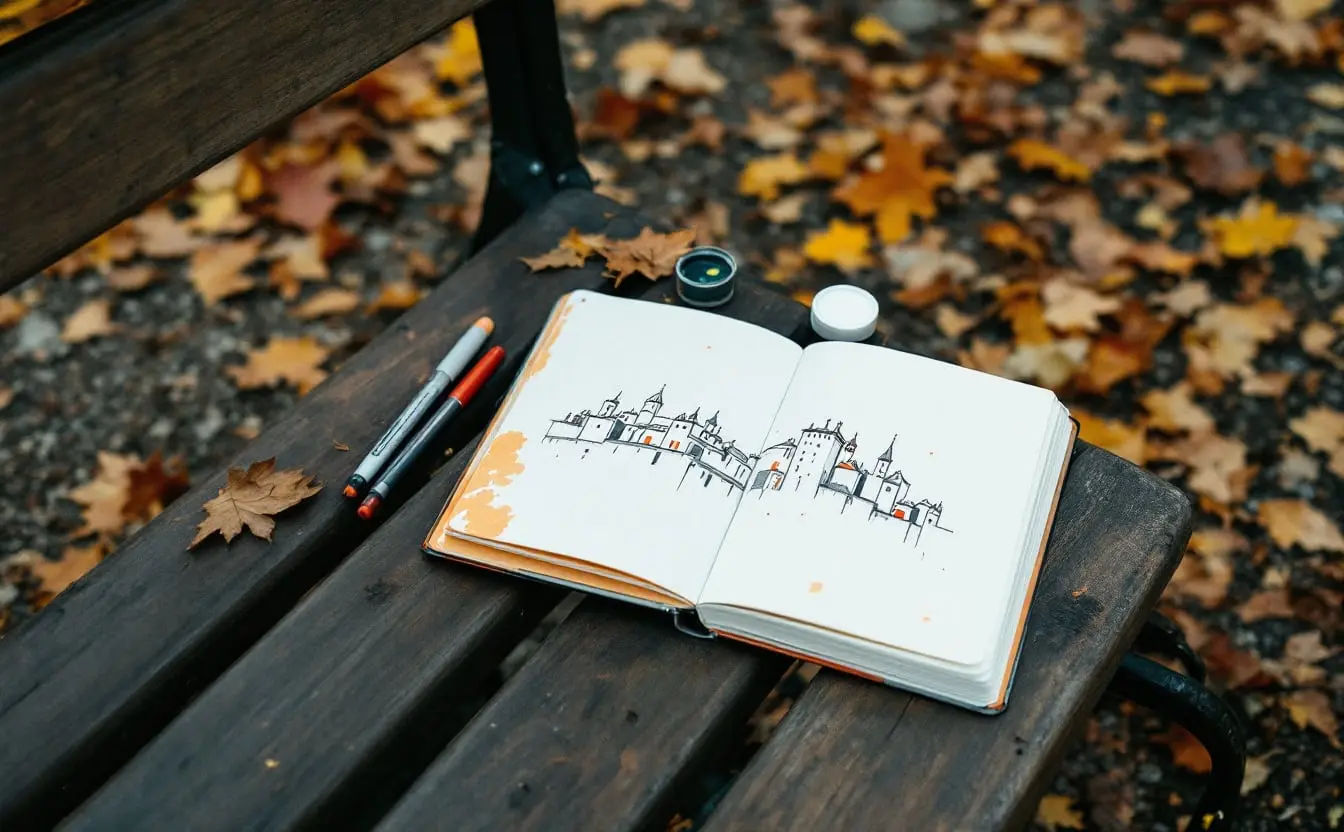
Most people who give up urban sketching do not give up drawing. They give up carrying. The first rush of enthusiasm buys a canvas bag, a folding easel, two dozen tubes of paint and a sketchbook the size of a tea tray, and within a month the bag lives in the hall and the drawings have stopped. In the drawing afternoons I have helped run for neighbours, the pages that actually get made come from whatever was already in someone's coat when the tram stopped.
So this is a short list built around one rule: everything fits in two coat pockets, or in one small bag you would carry anyway. It is written in autumn, when the light is low and the cafés still put a few tables out on sunny afternoons, but the kit works in any season. Nothing here needs a studio, a table or a jar of water.
The pocket rule
Three tests decide whether something belongs. You should be able to start drawing within a minute of deciding to. You should be able to work standing up, with the book held in one hand. And you should be able to pack everything away in the time it takes a bus to pull in. Anything that fails one of those tests stays at home, however good it is.
The rule has a second benefit, which is fewer choices. With twelve pens and forty colours you spend the first ten minutes deciding. With two pens and a small box you spend them drawing, and the drawing is the point.
Paper first: a bound book
Loose sheets blow away and crease in a bag. A bound sketchbook keeps the pages in order, and that matters more than beginners expect: flicking back through a month of awkward drawings and finding that the latest ones are less awkward is the best encouragement there is. A hard cover also gives you a desk wherever you happen to be standing.
The paper decides what else you can carry. Thin cartridge paper is fine for pencil and pen but cockles as soon as water touches it. Proper watercolour paper takes heavy washes but makes a thick, slow book. In between sit sketchbooks of heavier plain paper made for ink and pencil, where a light touch of colour is possible and a soaking wet sky is not.
The Moleskine Art Plus sketchbook in the large size is one of those in-between books: a hardback of heavier plain paper, made first for pen, pencil and other dry media, with a stiff cover meant for daily carrying. Opened flat it gives a wide double page, which is useful for a street seen end to end. It suits someone who draws mainly in line and adds a little colour. If you already know you want to paint broad, wet skies, a dedicated watercolour book is the better choice.
Lines: pens that do not run
Most urban sketches start with a line. A pencil is perfectly good for that, and many people begin with one, but ink has two advantages outdoors. It does not smudge in a pocket, and it stops you rubbing out. The second sounds like a drawback, yet it is the quickest teacher you will meet, because a wrong line stays on the page and you learn to look harder before making the next one.
The ink needs to be waterproof once dry, or the first wash of colour will turn your lines into grey clouds. Pigment fineliners are the usual answer. Sakura's Pigma Micron pens use archival pigment ink and come in a range of nib widths, so a set of six lets you draw the nearby tram shelter in a thick line and the buildings behind it in a thin one, which on its own gives a drawing depth. They suit anyone who enjoys line work, and they can be replaced one at a time when a nib wears flat. Give the ink a minute before any water goes near it.
Colour: a box the size of a phone
Watercolour is the urban sketcher's colour because it is light, dries quickly and needs nothing but water. For a pocket kit that means pans, small blocks of dried paint, rather than tubes. A pocket box holds a row of half pans with a mixing palette in the lid, and the whole thing folds shut with a click.
Winsor & Newton's Cotman Sketchers' Pocket Box is a common starting point: a small box of the company's student-grade Cotman colours in half pans, with a built-in palette, light enough to stay in a pocket all day. It suits beginners who want to add colour without first learning the names of pigments. Student ranges usually carry less pigment than artists' quality paints, so washes can look a little paler. Half pans are a standard size, though, so single colours can be swapped for others later as your preferences settle.
Water without a jar
The jar is where most outdoor painting kits fall apart. You need somewhere to stand it, it spills, and on a crowded pavement it is a nuisance to everyone. A water brush solves the problem: a synthetic brush tip on a plastic barrel that you fill with water, so a gentle squeeze wets the brush and a wipe on a tissue cleans it between colours.
Pentel's Aquash brushes are among the best known, and the set of four comes with tips of different sizes, from a fine point for railings and window frames to a broader one for skies. They suit anyone painting standing up or squeezed into a doorway. They are less good at laying a large, even wash than a traditional brush and a jar, which is a fair trade for something that lives in a pocket. Fill them at home, and a small bottle of water in the bag covers a refill.
One book for the evenings
Kit is the easy part. Seeing is harder, and a good book on drawing outdoors saves years of working it out alone. Marc Taro Holmes's The Urban Sketcher: Techniques for Seeing and Drawing on Location is a practical course in exactly the kind of drawing this kit is for: a quick line, a wash of colour, and finishing before the light or the weather changes. It suits someone who has filled a few pages and wants a method rather than more inspiration. It stays at home; the pockets are for drawing.
These picks come from makers' and publishers' details and published reviews rather than our own testing.
What else goes in the pockets
The small things are what rescue an outing. Run through this list before the first trip, then forget about it:
- Two bulldog clips or a thick rubber band, to hold the pages open in wind.
- A folded paper towel or a small cotton rag, for wiping brushes and blotting a wash that went too far.
- A pencil and a small eraser, for anyone not ready to start in ink.
- A plastic bag or a square of foam to sit on when benches are wet.
- A small bottle of water for refilling the brushes.
- Fingerless gloves from November onwards.
- A spare pen, because nibs always give up far from home.
Kit by kind of outing
Not every outing needs everything. A tram ride wants the lightest possible version, a free Saturday can take the lot, and some places have rules of their own.
| Outing | Take | Leave at home |
|---|---|---|
| A tram or bus ride | Sketchbook and one pen | Paint box and water brushes |
| A lunch break on a bench | Sketchbook, two pens, paint box, one water brush | Spare clips and the bottle |
| A free Saturday on foot | The whole kit and the bottle | Nothing, but add something to eat |
| A museum or library | Sketchbook and pencil; ask at the desk about pens | Paint and water brushes |
| A wet day | Sketchbook and pen, drawn from under cover | Paint, unless you like what rain does to it |
Where to try it first
The best first spot is a bench with a view and something to lean against. In Bucharest I would send a beginner to the lake in Cișmigiu, where there is always a free bench and plenty to draw: water, old trees, people walking dogs. Another good choice is the courtyard of Stavropoleos church in the old town, small and quiet, with carved stone to study, though it is a working church, so draw quietly and keep out of the way of services. On wet days the glass roof of the Macca-Villacrosse passage gives shelter, curving café fronts and a steady flow of people. These places and others belong to a longer walk through Bucharest's cultural spaces, and the city routes in the Atlas make good sketching days elsewhere.
If you would rather begin in company, many cities have urban sketching groups that meet at a weekend, draw one place together for an hour or two and lay their books out side by side at the end. Anyone organising a drawing afternoon for neighbours can borrow the same logic: clipboards, a box of pigment pens, no water. The practical side of doing that outdoors is covered in the guide to running an art workshop in a public park, and more writing on looking at cities sits in the culture strand.
Pack the kit tonight and put it in the coat you will wear tomorrow. Your first drawing will probably be the seat in front of you on the tram, with somebody's hat over the top of it, and that is a perfectly good first page.