Running an art workshop in a public park: a practical checklist
A practical checklist for running an art workshop in a public park, covering permission, materials, weather, children, access, clearing up and photo consent.

We earn a commission on some bookings and books. As an Amazon Associate I earn from qualifying purchases.
Most park workshops that go wrong do so in ordinary ways. The paper blows away, one sheet at a time, until a row of children is chasing drawings across the grass and the parents are chasing the children. The nearest toilet turns out to be locked. A warden arrives, politely, to ask who gave permission for the gazebo.
None of this takes a large budget to prevent. It takes a list, made early, and someone who reads it the night before. What follows is that list, with notes on why each item is there. It assumes a small, free, drop-in session for a few dozen people at most, run by a residents' group, a teacher, a library or an artist. Anything bigger, with a stage or amplified sound, belongs with planning a festival in public space.
Late autumn, with the parks emptying, is a good moment to start planning a session for spring, because permission nearly always takes longer than people expect. Other pieces in the participation and community strand deal with the why. This one is about folding tables.
Start with the ground
Walk the park on the same weekday and at the same hour you plan to hold the session. A lawn that is empty on a Tuesday morning can be a football pitch on Saturday afternoon. Note where the sun falls, where the wind comes through, and where dogs are let off the lead.
You are looking for a flat, firm patch away from cycle routes and the queue for the swings, close enough to a toilet and a tap to be useful. In Bucharest, where summer afternoons are fiercely hot, I would choose deep shade over a nicer view every time. In spring and autumn, shelter from wind matters more than sun.
Look for an indoor fallback within a short walk: a library, a community centre, a school hall, a covered space at the park's edge. Ask before you need it, not on the day.
Permission, in writing
Parks belong to someone. In most cities that means a municipal parks department or a company owned by the city. In Bucharest some parks are run at city level and others by the sector halls, so the first job is finding out which body manages yours and who answers its phone.
A group of people sitting on the grass with sketchbooks rarely needs permission. Tables, gazebos, amplified sound, food, selling anything and fixing anything to a tree or railing usually do, and each may be a separate request. Some authorities also ask for public liability insurance. A school, library or residents' association may already hold a policy that can cover the session, which is far cheaper than buying one.
Get the answer in writing, print it, and carry it on the day with the date, the hours and the exact area marked. Then tell the park staff or wardens you are coming. Most problems on the day start with someone in a uniform who was not told.
Materials that behave outdoors
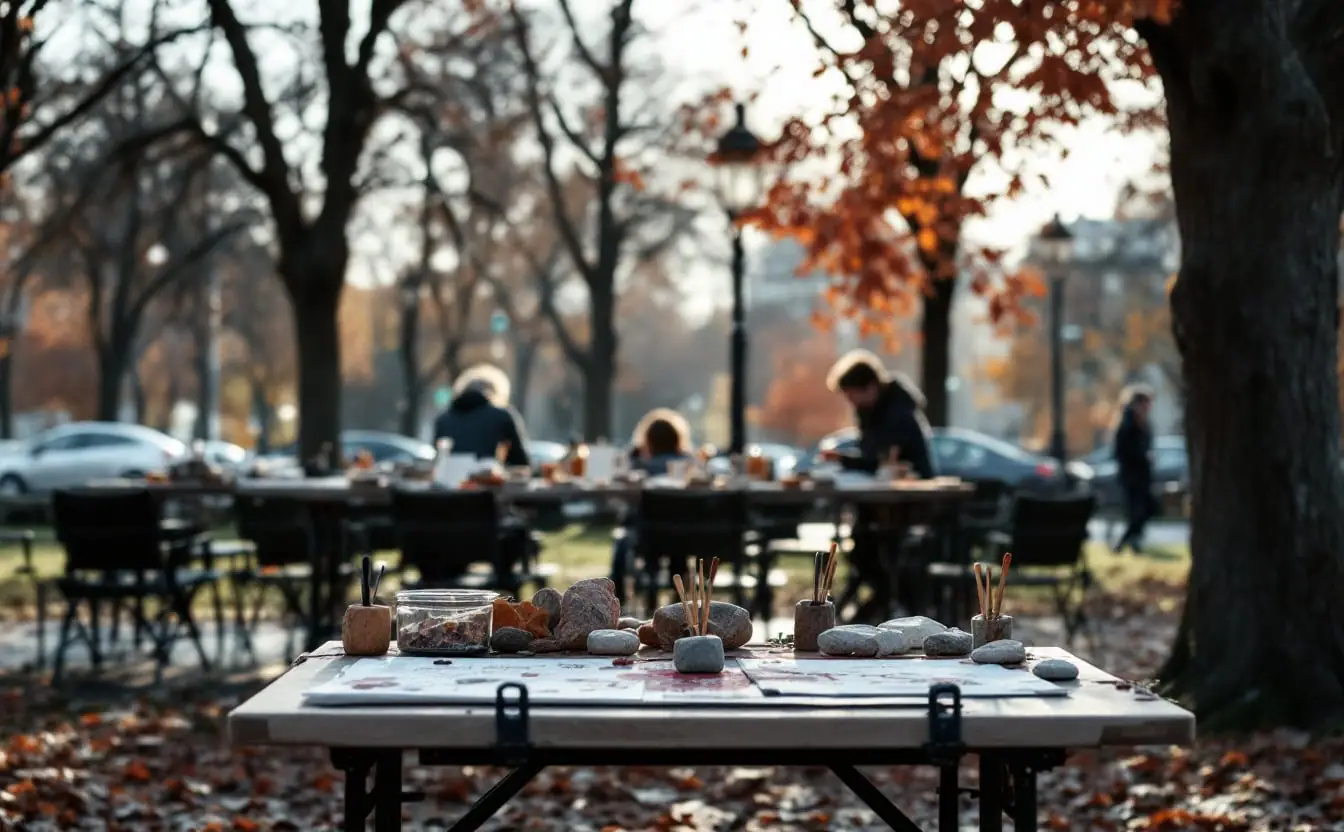
Outdoors, every material has three enemies: wind, damp and gravity. Paper needs weight. Bring clipboards, bulldog clips and a bag of smooth stones, and use heavier paper than you would indoors, because thin sheets curl in damp air.
Paint should be water-based and washable. For small children, buy paints sold for them, with conformity to the EN 71 toy safety standard stated on the pack; finger paints have their own part of that standard. Leave aerosols and solvents at home, and never bring glitter. It stays in the grass for good.
Air-drying clay is easier than anything that needs a kiln or an oven. Chalk on paths is lovely and also, in some parks, counts as marking public property, so ask first. Fallen leaves, twigs and seed heads are fair material; picking living plants is not.
Rinse water is the item people forget. It should go home with you in a lidded bucket, not into a storm drain, a flowerbed or the lake. Put a ground sheet under the painting table and you will save the grass and your argument with the parks office.
A weather plan that is a plan
Decide two things before you announce the session. First, what happens if the weather turns: a rain date published with the original date, or the indoor fallback booked and named. Second, when you decide and how you tell people. Pick a fixed hour, and use the same channel you used to invite them, whether that is a building noticeboard, a school group chat or a library newsletter.
Wind is the real danger. A gazebo without weights on every leg is a sail, and pegs alone will not hold it on dry ground. If gusts pick up, take it down; nobody will mind.
Heat calls for shade, water, sun cream and a shorter session away from midday. Cold calls for big brushes and crayons rather than fine work, since stiff fingers cannot manage small detail, and for ending earlier than planned without apology.
Children
Write one rule on every invitation and say it again at the table: children stay with their adult. A drop-in workshop is not childcare, and pretending it is puts the organisers in a position they are not set up for.
Agree a meeting point for a lost child, and decide in advance who goes looking and who stays put. Bring a first aid kit and make sure at least one person knows how to use it. Ask about allergies before handing anything out: latex, food colourings, nuts in the biscuits. Children get blunt-ended scissors; craft knives stay with adults.
Groups that work with children regularly should have a safeguarding policy, and depending on the country, volunteers may need background checks. Find out the local rules once and write them down for the next person.
Access for everyone who turns up
Check the route from the nearest bus or tram stop for steps and broken paving. Grass after rain stops wheelchairs and buggies completely, so put at least one table on a hard path. Make sure one table is high enough for someone to roll under, and bring chairs: older residents may happily spend an hour making something but not standing up.
Set up a quiet corner away from the busiest table. Show instructions as well as saying them, and if the neighbourhood speaks several languages, find a volunteer who speaks the second one. Brushes with thick handles and chunky crayons help small hands and stiff ones alike. Avoid clashing with school pick-up, market day or the main religious service of the week.
Photographs and consent
A photograph of an identifiable person is personal data under European rules, and a photograph of a child should have a parent's written permission before it goes anywhere public. The easiest system is visible: announce at the start that pictures are being taken and what for, and hand out a coloured sticker to anyone who would rather not appear. Photograph hands and work by default and faces only with a clear yes.
Keep consent forms somewhere safe and delete the pictures you do not use. Let people take their work home. If you want to keep pieces for a display, say so before anyone starts, and say when they will come back. The wider question of who owns what a group makes is covered in participatory art explained.
Clearing up
Budget half an hour, and sweep a wider area than you used. Look for the small things: bottle tops, clips, crayon stubs, the lid of a glue stick. Lift the ground sheet carefully, fold it inwards and take the rinse water. Return what you borrowed on the same day. A photograph of the clean site as you leave costs nothing and answers any later question from the parks office.
The checklist
Six weeks or more before
- Find out who manages the park and get a named contact
- Visit at the same weekday and hour as the planned session
- Request written permission for the area, the hours and any tables, gazebos, food or sound
- Confirm insurance and what it covers
- Book an indoor fallback or choose a rain date
The week before
- Publish the date, the fallback and the rule that children stay with their adult
- Recruit enough helpers, including one with first aid and one for the second language
- Buy washable, water-based materials; nothing aerosol, solvent or glitter
- Prepare photo consent forms and coloured opt-out stickers
- Fix the hour for the weather decision and the channel you will use
On the day
- Printed permission in a bag, wardens told
- Clips, clipboards and stones; weights for every gazebo leg
- Ground sheet, lidded rinse bucket, water, soap or wipes, bin bags
- One table on a hard surface, one table high enough for a wheelchair, chairs, a quiet corner
- Meeting point for lost children agreed and announced
- Allergies asked about before materials go out
Afterwards
- Wider area swept, rinse water taken away, borrowed things returned
- Photograph of the clean site
- Unused photographs deleted, consent forms filed
- A short note to the parks office saying thank you and asking about next time
Most of this list is common sense, written down so that it actually happens. If you take one item from it, take the clips. Bring a dozen more than you think you need, and keep them in a jar on the table where the children can reach them, because the first child to pin down a neighbour's drawing in a gust has understood the whole point of the afternoon.