Leftover spaces and tactical urbanism: what small street fixes teach
Parklets, painted plazas and pop-up chairs: how tactical urbanism reclaims leftover street corners, what Barcelona scaled up, and the questions it raises.

We earn a commission on some bookings and books. As an Amazon Associate I earn from qualifying purchases.
Every city has them. The triangle of asphalt where two streets meet at an awkward angle, the strip of gravel beside a car park, the slip road nobody needs any more, the wide corner where cars park illegally because nobody has decided what else it is for. Planners even have a dry acronym for them, SLOAP: space left over after planning. They are the parts of a city that the drawings forget.
Over the last two decades, a good deal of the most interesting work on streets has happened on exactly these scraps. A few planters, a coat of paint, some movable chairs, and a corner that was a parking problem becomes a place to sit. The approach has a name, tactical urbanism, and a whole vocabulary of parklets, painted plazas and pilots. I like it a great deal. I also think it raises questions that the cheerful opening-day photographs leave out.
Where the idea came from
The label was popularised by the American planners Mike Lydon and Anthony Garcia, whose book on the subject appeared in 2015 with the subtitle Short-term Action for Long-term Change. That phrase is still the best summary of the method. The practices themselves are older than the name.
In 2005 a San Francisco studio called Rebar fed a parking meter and turned a single parking space into a small park for a few hours. The stunt grew into PARK(ing) Day, repeated in cities around the world every September. San Francisco later turned the idea into policy through its Pavement to Parks programme, which gave us the parklet: a platform the size of a parking bay or two, with seating and planting, raised to pavement level in the roadway.
New York pushed the method to a bigger scale. In 2009 the city closed parts of Broadway around Times Square to traffic using paint, temporary barriers and cheap folding chairs, and presented it as a trial. People sat down in the road in large numbers. The trial became permanent, and a full reconstruction in stone followed some years later. The chairs did most of the arguing.
None of this came from nowhere. In the 1970s the writer and urbanist William H. Whyte filmed and counted people in small New York plazas and showed how much they valued movable chairs, sun, food and something to watch. Tactical urbanism took observations like his and turned them into a way of getting change past a cautious city hall: build it cheaply, watch what happens, keep what works.
The scaled-up version: Barcelona's superblocks
The most ambitious descendant is the superblock, superilla in Catalan. Barcelona's Eixample, the nineteenth-century extension planned by Ildefons Cerdà, is a grid of near-identical blocks with chamfered corners. The superblock idea, developed by the urban ecologist Salvador Rueda, groups several of those blocks together and pushes through traffic to the edges, so the inner streets can be slowed down and handed back to people on foot.
When the city first tried it in Poblenou in 2016, it worked tactically. The first version was paint on asphalt, picnic tables, planters and play markings, put down quickly.
The reaction was mixed, and some residents protested about traffic and about not having been asked. Later schemes, first in Sant Antoni and then along green axes through the Eixample such as Consell de Cent, were designed and built properly, with new paving, trees and benches. The quick version made the argument. The slow version made the place.
Other cities followed with their own mixtures. Milan's Piazze Aperte programme, launched in 2018, turned road junctions into small squares with paint, benches, planters and table tennis tables, and some of them have since been made permanent. Vienna, my own city, has its versions too. Mariahilfer Straße became a pedestrian and shared-space street after a residents' vote in 2014, the city funds small resident-led seating and planting projects in parking spaces through a scheme called the Grätzloase, and in Favoriten it has tested a neighbourhood-scale superblock of its own, the Supergrätzl.
A short field guide to small fixes
Most tactical projects fall into a handful of types. Each has its own strengths, and each fails in its own way.
Parklets
The easiest to understand: one or two parking spaces become a timber platform with seats and plants. Some belong to cafés and work as terraces. The more interesting ones are open to anyone, with no obligation to buy a coffee. A good parklet has a clear, solid edge towards the traffic, a level threshold from the pavement, and a named person or group responsible for the watering can.
Painted plazas
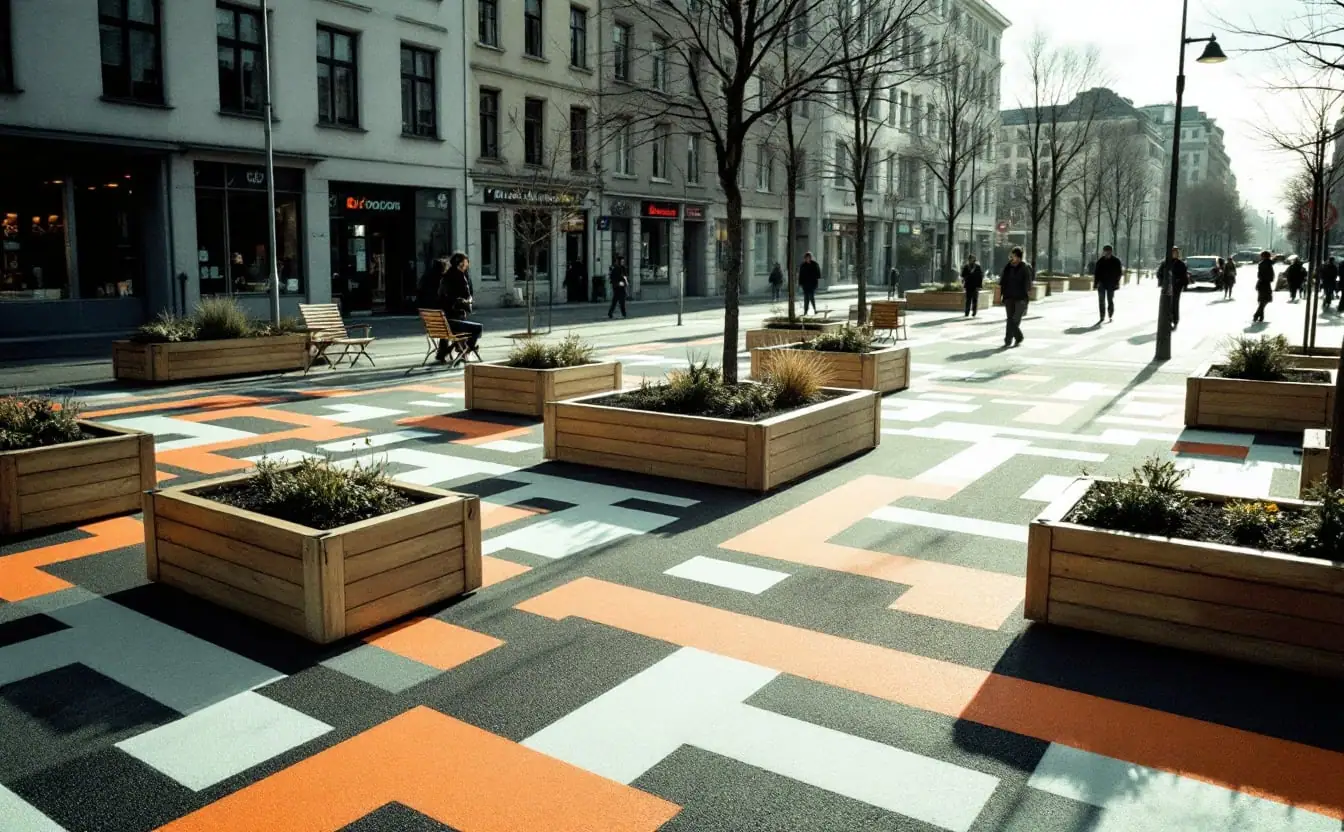
Colour on asphalt claims a space for people. The paint does two jobs at once: it tells drivers the rules have changed and it tells pedestrians they are allowed to stay. Artists are often involved, which is where tactical urbanism meets public art, and the same questions about authorship and upkeep apply as in the making of a large mural.
The paint also has to be suitable for roads, with enough grip for wet days, or the brightest corner in the district becomes the most slippery one. Paint wears quickly. That is its strength and its weakness: cheap to try, cheap to abandon.
Pop-up seating and timed closures
Movable chairs, benches fixed to concrete blocks, a street closed every Sunday or every school morning. School streets, shut to cars at the start and end of the school day, have spread across many European cities and are one of the clearest wins of the whole method, partly because the people who benefit are so easy to see.
Leftover land
The verge, the corner, the empty lot behind a fence. Here the line between tactical urbanism and guerrilla gardening is thin, and so is the line between permission and forgiveness. Some of the best small places I know began as someone's unofficial bench and a few pots, later adopted by the district.
Why do these scraps exist at all? Mostly because roads were drawn for turning circles and sight lines rather than for people. Widen a junction so that a lorry can turn without slowing and you create a wedge of asphalt nobody walks on. Push a new road through an old street pattern and the triangles left at each end belong to no one in particular. Reclaiming them is less a design trick than a correction.
The questions they raise
The photographs from the opening week always look good. The questions arrive later, and they are worth asking before the paint goes down.
Who looks after it?
This is the weakest point of most tactical projects. Planters need water every day in a hot summer, paint needs renewing, benches get broken and need replacing. If maintenance belongs to nobody, the project decays in public and becomes an argument against the next one. The good schemes name a responsible party from the start, whether a council department, a local business or a residents' group with a small budget of its own.
Who was asked?
Speed is both the selling point and the problem. A pilot that appears overnight can feel like an imposition, especially to people who depend on a car or on deliveries, or who were simply not in the circle that proposed it. Consultation after the fact is not the same thing as consultation before. The difference between real involvement and a ribbon-cutting is covered in more depth in this guide to participatory art, and most of its tests apply to streets as well.
Is it accessible?
Paint has no edge. A blind pedestrian who relies on a kerb or on tactile paving may not know where a painted plaza ends and the traffic lane begins. Platforms need ramps, and movable furniture has a habit of drifting into the line of a walking route. Accessibility belongs in the cheap version from day one, not saved up for the permanent rebuild.
Does it push rents up?
The critique is that pleasant streets attract money and displace the people who asked for them. The evidence is mixed and very local, and a single parklet is rarely the cause of anything on its own. But if new pilots only ever appear in neighbourhoods that are already getting richer, that tells you something about who has the time, the contacts and the confidence to ask.
When should temporary become permanent?
When the use is clear. A trial that stays busy through different seasons and weathers deserves stone, trees and proper drainage. One that is empty after the first month should be removed without embarrassment. The worst outcome is the permanent temporary: faded paint, dead planters and a promise of consultation that never came.
What I look for on a February afternoon
When I pass a new pilot, I check three things. Is there shade or shelter? Is there somewhere to sit without buying anything? And has anyone come back to water, sweep or repair since the opening?
Those three answers tell me more than any press release about whether a project is a place or a photograph. The wider argument about who shapes the street runs through the whole participation and community strand.
The real test is a grey weekday in winter, not a sunny Saturday in June. Go to the corner on a cold afternoon. If an older couple are sitting there in their coats, sharing a flask of tea and watching the traffic go round them, it worked.