Artistic activism and the city: when art takes a side in the street
Critical Mass rides, guerrilla gardens, occupied theatres and silent protests: how art takes a side in public space, the ethics involved and what lasts.

We earn a commission on some bookings and books. As an Amazon Associate I earn from qualifying purchases.
The ride gathers at dusk on the last Friday of the month. Nobody is in charge, and there is no route until the front of the group picks one. For an hour or two a crowd of bicycles fills a lane that normally belongs to cars, bells ringing, moving at the pace of the slowest rider. Then it thins out at a park or a bar and the traffic closes behind it like water.
That is Critical Mass, which began in San Francisco in September 1992 and spread to cities around the world. Many riders would not call it art. But it has everything that makes a public action memorable: a clear image, a form anyone can repeat, a little joy, and an argument about who the street is for. This piece is about that territory, where art takes a side in the city, and about the harder questions of ethics and of what survives once the crowd goes home.
Writing from Athens, I meet these questions most weeks. A city that has lived through crisis, mass protest and a great deal of improvised civic life treats its streets as a place to argue in public, and its artists have rarely stayed out of the argument.
Riding as a demonstration
Critical Mass describes itself less as an organisation than as a coincidence that happens on schedule. There is no membership and no leader, which makes it hard to ban and easy to copy. The ride is the message: if enough people on bicycles travel together, the street becomes, for an evening, a place where cycling feels safe.
The form has limits. Drivers held up for twenty minutes rarely go home converted, and in some cities police have treated the rides as unauthorised marches. Still, the picture of a street full of bicycles has a way of turning up in planning debates. Plenty of cycling campaigners who would never call themselves artists now think in images: a painted lane, a white ghost bike chained where a rider died, a ride timed for the evening light.
Planting without permission
Guerrilla gardening has a well-known origin story. In New York in 1973, Liz Christy and a group calling themselves the Green Guerillas began throwing seed bombs over the fences of vacant lots on the Lower East Side, and planted a garden on an abandoned lot at the corner of Bowery and Houston Street that later took her name. The appeal is obvious. A sunflower in a tree pit or a planter on a broken pavement is an argument that makes itself: look what this place could be.
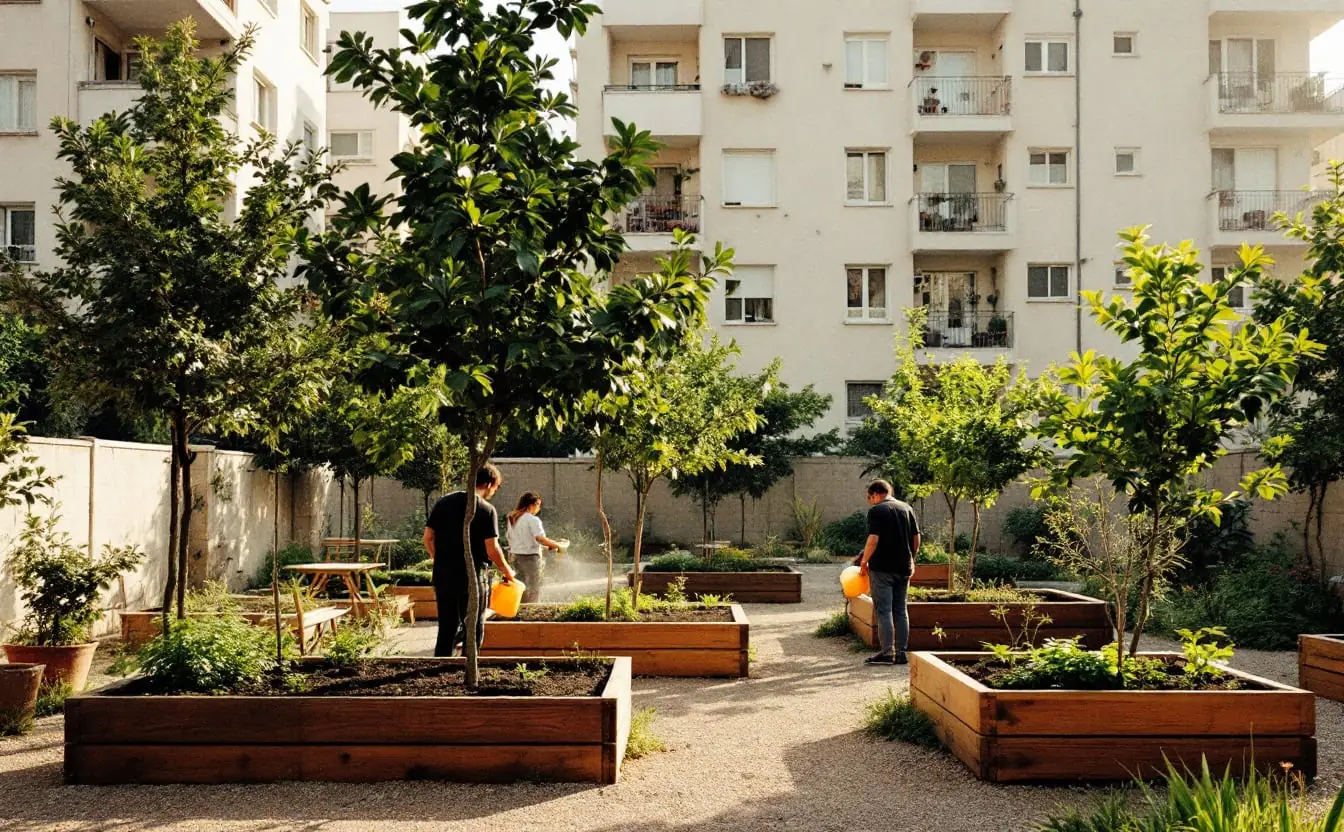
Athens has its own example in Navarinou Park in Exarchia, a fenced car park that residents opened up and planted in 2009, and which was then run for years through open assemblies and volunteer rotas. It is a modest place of a few trees, handmade benches and planted beds. Its interest lies less in the night of planting than in the maintenance afterwards. Anyone can plant a tree in a night; keeping a park open, clean and shared for years without a landlord's blessing is the harder and more political act. I walked the walls of the same neighbourhood in a piece on Athens street art and empty buildings.
A cousin of this tradition is Park(ing) Day, which began in San Francisco in 2005 when a design studio fed a parking meter and turned the space into a tiny park for a couple of hours. The gesture was absorbed into planning practice remarkably quickly, as the piece on tactical urbanism and leftover spaces describes. That speed tells you something: a provocation that is pleasant enough can become a policy tool within a few years, with or without the people who first thought of it.
Occupying the stage
Theatres are a natural target for artistic activism. They are public rooms built for assembly, and an empty one feels like an insult to the people trained to fill it. In May 1968, students and others occupied the Théâtre de l'Odéon in Paris and turned it into a round-the-clock open debate. In June 2011, actors, technicians and other arts workers occupied the Teatro Valle in Rome, the city's oldest working theatre, after the state body that ran it had been abolished. They programmed it themselves for three years and drafted a statute for running it as a commons before leaving in 2014.
In November 2011, a collective of performers occupied Embros, a theatre in Psyrri that had stood unused for several years, and opened it for performances, workshops and assemblies. Its status has been contested ever since. That is a common fate for occupied buildings: they tend to win the argument about use and lose, or never settle, the argument about ownership.
The body as the work
Some of the most remembered actions need no building at all. In 1990s London, Reclaim the Streets turned roads into street parties. At one, on a West London motorway in 1996, people hidden under the skirts of giant costumed figures drilled into the tarmac and planted saplings while the sound system played. In New York in the late 1980s, ACT UP's die-ins laid bodies across floors and pavements to make the AIDS crisis impossible to step around, and the graphics made alongside them are still reproduced and studied.
In June 2013, during the protests over Gezi Park in Istanbul, a performance artist stood silently in Taksim Square for hours, facing the Atatürk Cultural Centre. Others joined him, standing still in squares across Turkey. The action asked for nothing out loud and broke no obvious rule, which made it hard to police and easy to copy.
Not every performance protest has been welcome. When climate activists threw soup at the glass protecting Van Gogh's Sunflowers in London's National Gallery in October 2022, the painting was unharmed, but most of the debate that followed was about the method rather than the message. That is the recurring risk of a striking image: people end up discussing the image.
The ethics of taking a side
Artistic activism borrows from both art and politics, and it inherits the ethical problems of both. The art world's problem is authorship: who gets the credit, the grant and the name in the catalogue. The street's problem is risk: who gets arrested, fined or photographed, and who goes home to a safe flat afterwards. The worst actions put the visible, dangerous part on the people with the least protection and the credit on the people with the most.
There is also the matter of borrowing. Developers, brands and city marketing departments have all learned to dress up in activist clothes, from sponsored planters to art shows staged in buildings about to be redeveloped, a practice critics call artwashing. The line between taking part and being used is the same one worth looking for in any participatory art project. Before joining or staging an action in public space, I run through a short checklist:
- Who lives or works here, and have they been asked, or at least told?
- Who carries the legal risk, and do they know it and accept it?
- Will anyone be photographed who could be harmed by being recognised?
- What happens to the space afterwards, and who cleans up?
- Is the demand clear to someone who sees a single photograph?
- If the action later becomes a commission, an exhibition or a book, who is credited and who is paid?
- Could the same point be made in a way that leaves the place better used rather than merely marked?
A short FAQ
Is artistic activism legal?
Some of it is, much of it sits in a grey zone, and some of it plainly is not. A ride on a public road, a silent stand in a square or a planted tree pit may be tolerated one year and policed the next. Check the local rules on assemblies and on altering public property, and assume the consequences will fall hardest on anyone without secure papers or a lawyer to call.
How is it different from ordinary protest?
Mostly in the attention paid to form. An action designed as an image, a rhythm or a small working world (a garden, a stage, a ride) tends to be remembered, copied and adapted. A protest without a form can still matter enormously. It is simply harder to repeat.
Does it change anything?
Sometimes, and rarely on its own. The successes usually pair an action with patient, dull work: petitions, council meetings, legal challenges and people who turn up week after week. The action makes the issue visible, and the dull work makes it stick.
How do I take part without taking over?
Join something that already exists before inventing your own. Do the unglamorous jobs, such as watering, sweeping and carrying chairs, and leave the photographs to people from the neighbourhood. If you are an artist, ask whether the action needs your name on it at all.
What lasts
Looking back across these examples, the lasting parts are rarely the dramatic ones. The motorway went back to traffic. What carried on were forms other people could pick up: a monthly ride, a seed bomb, a statute for running a theatre as a commons, a way of standing still. Sometimes places last too, a garden on a New York corner or a small park in Exarchia, kept going by people who turned up long after the cameras left. There is more on this ground in the participation and community strand.
That is the test I would apply to any action that claims the city as its stage. Ask who will be there in August, when the photographs have been posted and the beds are dry. If the answer is a rota pinned to the gate and a hose long enough to reach the far corner, take it seriously.