Participatory art explained: telling real involvement from decoration
What participatory art is and is not, and how to tell genuine involvement from decoration, with a ladder and questions on credit, consent and ownership.

We earn a commission on some bookings and books. As an Amazon Associate I earn from qualifying purchases.
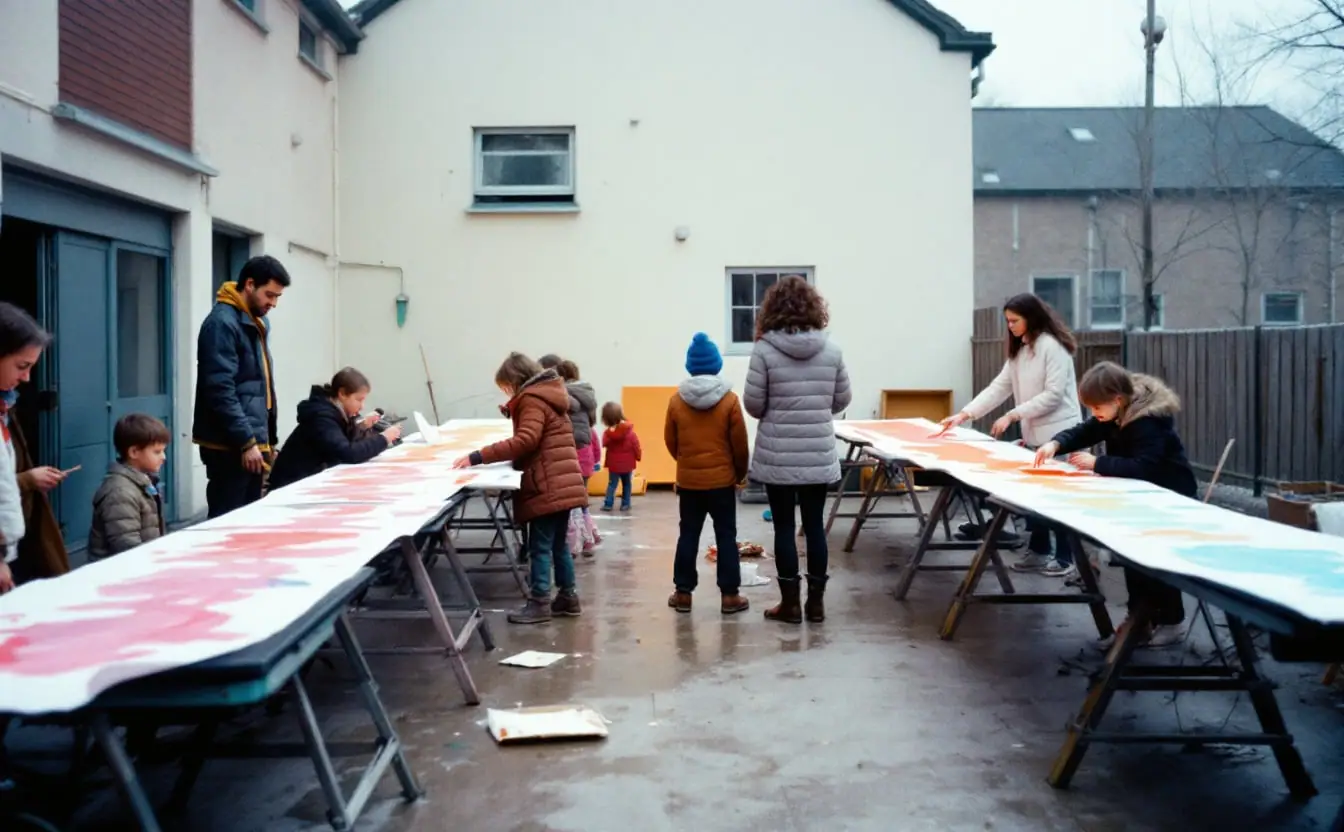
The wall was already drawn when the residents arrived. Someone had sketched the outlines in pencil the week before: a tree, a tram, a row of blocks, a sun with stubby rays. The people who lived in those blocks were handed brushes and small pots and told which shapes to fill. Two hours later there was a cheerful mural, a stack of photographs and a press release about a participatory artwork made with the community.
I have watched versions of that afternoon in Bucharest and elsewhere, and I have nothing against cheerful murals. But the residents chose nothing: not the wall, the subject, the colours or the artist. They supplied hands, which is an honest thing to ask for, as long as it is called by its name.
Participatory art is one of the most used labels in public art funding and one of the least examined. What follows tries to give it edges: where the idea came from, what it leaves out, and the questions about authorship, consent and ownership that separate a collaboration from a photo opportunity. Most of what I write for the participation and community strand comes back to those three questions.
Where the idea comes from
Artists have always drawn other people into their work, but the modern vocabulary has a few clear sources. Joseph Beuys spoke of "social sculpture", the idea that society itself could be shaped like a material. His 7000 Oaks, begun at documenta 7 in Kassel in 1982, set out to plant trees across the city, each paired with a basalt stone. The last tree went in at the next documenta in 1987, after his death.
In the 1990s the American artist Suzanne Lacy and others gathered socially engaged work under the name "new genre public art", in the book Mapping the Terrain (1995). The French curator Nicolas Bourriaud wrote about "relational aesthetics" in 1998, art whose material was human encounter: meals, conversations, shared time. Grant Kester's Conversation Pieces (2004) made the case for art built on long dialogue with a community.
Then the critic Claire Bishop, in Artificial Hells (2012), pushed back, worried that the ethics of a project had begun to replace any judgement of it as art. That matters on the ground, because "participatory" is not automatically a compliment. Some celebrated participatory works are deeply uncomfortable, and some of the most comfortable ones are empty.
What it is not
A few things often travel under the label without earning it, and interactive art is the first. A sculpture that lights up when you step on a pad, or a wall where passers-by finish a printed sentence in chalk, invites a response. The response is real, but nothing you do changes the shape of the work.
Outreach is the second. A museum that runs a drawing table beside a finished bronze is doing education, which is valuable. The people at the table still have no say over the bronze.
The third is the crowd as material. Large performances sometimes need hundreds of bodies to fill a square or form a pattern seen from above. The volunteers are present, often delighted, and entirely interchangeable. That can be fine work, but it is choreography.
The fourth is the one from the opening. Its name comes from the children's rights researcher Roger Hart.
A ladder to take to an opening
In 1969 the American planner Sherry Arnstein published "A Ladder of Citizen Participation", written about urban renewal and anti-poverty programmes in the United States. It has eight rungs, from manipulation at the bottom to citizen control at the top, grouped into three bands: non-participation, tokenism and citizen power. Her point was blunt. Being consulted is not the same as having power, and institutions are skilled at making the first look like the second.
In 1992 Hart adapted the ladder for children's participation in an essay for UNICEF. His lowest three rungs are manipulation, decoration and tokenism. Decoration, in his sense, is when children wear the T-shirts and sing the songs at an event whose purpose they had no part in shaping. Swap "children" for "residents" and you have the pencil-outlined mural.
Neither ladder was written about art, and both have been criticised for implying that the top rung is always the goal. An artist with a strong idea may keep authorship and still treat people fairly. But the rungs give you a vocabulary, and the table translates them into what you might see.
| What you see | Roughly where it sits | The question to ask |
|---|---|---|
| Residents fill in shapes the artist drew | Decoration | Did anyone outside the team choose the image, the place or the colours? |
| A survey or a wishing wall before the commission | Consultation | Can anyone point to something that changed because of the answers? |
| A residents' panel that comments on three shortlisted designs | Placation | Could the panel reject all three? |
| Workshop stories and drawings end up in the final work, credited | Partnership | Who chose which contributions were used, and were the contributors told? |
| A group sets the brief, hires the artist and holds part of the budget | Delegated power | Who signs the contract, and who answers if it goes wrong? |
| Residents start, run and own the project, with artists as hired help | Citizen control | What happens to it when the grant ends? |
Most good projects sit in the middle and move during their life. They grow into partnership as trust builds, or slide back down when a deadline arrives.
Authorship: whose name goes on the label
The quickest test of a participatory project is the label. Look at how the work is credited on the wall and in the leaflet. "By X with residents of Y" is common and at least honest about the hierarchy. A list of every participant's name is generous, but only if each of them agreed to be named. For some people, in some neighbourhoods, a public name is a risk.
Single authorship is not a problem in itself. Jeremy Deller's The Battle of Orgreave (2001) restaged a violent 1984 confrontation between striking miners and police in South Yorkshire, with former miners among the participants, some of whom had been there in 1984. It was Deller's work, produced by Artangel and filmed by Mike Figgis, and nobody pretended otherwise. Its force came from that clarity: an artist taking responsibility for a difficult idea, and participants bringing something no actor could.
Antony Gormley's One & Other, on the Fourth Plinth in Trafalgar Square in 2009, put 2,400 members of the public on the plinth for an hour each over 100 days, chosen by ballot. Gormley set the frame and each person filled their hour as they liked. The authorship is split, and that is what makes it interesting.
Where authorship goes wrong is when it is hidden. A project that tells its funders the work was co-created and then credits only the artist in the catalogue has taken something. So has a project that turns residents' stories into an installation without telling them which stories were used.
Consent is more than a signature
Every participatory project collects something: time, stories, faces, sometimes handwriting or children's drawings. Consent for each is a separate question, and a single form signed at the door covers much less than organisers tend to think.
Photographs are the obvious case. In the European Union a photograph of an identifiable person is personal data, and publishing it needs a lawful basis, which for community projects usually means consent. For children it comes from a parent or guardian, and a careful project asks again before an image goes into anything permanent.
Stories are harder. A woman who mentions her late husband during a workshop has not agreed to see that memory printed on a hoarding. Good practice is simple and slow: show people how their contribution will appear, in the place it will appear, before it goes up, and let them withdraw without giving a reason. Offer translation where the street speaks more than one language, and never treat silence as agreement.
Then there is money. Participants give hours that the artist, the producer and the photographer are paid for. Some projects pay a fee or cover travel and childcare; others offer food, materials, a skill or a share of any sales. None of these is automatically right, but a project that has never discussed it has usually not asked who carries the cost.
Who keeps the work
The last question is the one most often skipped, because it arrives after the opening, when the funding has stopped. Thomas Hirschhorn's Gramsci Monument, built in 2013 among the towers of Forest Houses, a public housing estate in the Bronx, was made with residents who were paid to build and run it through the summer. It held a library, a radio station, a newspaper and lectures. Then it was taken down, as planned from the start. The ending was honest: nobody was left with a plywood structure to maintain.
At the other end, the collective Assemble won the Turner Prize in 2015 for its work with the Granby Four Streets Community Land Trust in Liverpool, where residents had spent years saving a few streets of terraced houses from demolition. The houses were repaired and people live in them. A workshop set up alongside made tiles, door handles and fireplaces, some from demolition rubble. That project left something residents own and control.
Most projects sit between those two, and the questions are practical. Who owns the object: the artist, the housing association, the council, the residents? Who pays to clean it or deal with tags? If the work is sold, toured or printed on a postcard, does anyone in the neighbourhood hear about it? The hands-on side of running an art workshop in a public park is where most of these choices are made, long before anyone recognises them as choices.
A temporary work that leaves a clear memory and a few new skills can be a better legacy than a permanent mural nobody feels entitled to touch. Temporary art in city squares raises the same problem from the other side.
A short FAQ
Is a mural painted by schoolchildren participatory art?
Sometimes. If the children chose the theme, argued about the design and saw their ideas survive, yes. If they coloured in an adult's drawing, it was a pleasant afternoon and the result is a decorated wall.
What should I look for with ten minutes at an opening?
Find someone who took part and is not on the team, and ask what they decided. If the answer is a specific choice (the colour of the doors, the route of the procession, the line of text that was cut) the project is probably higher on the ladder than its press release admits. If the answer is a shrug and a nod towards the pencil lines, you already know where it sits.