Listening to the city: soundwalks, radio art and field recording
From R. Murray Schafer and Hildegard Westerkamp to radio art and field recording, with a step by step method for leading a soundwalk in your own streets.
We earn a commission on some bookings and books. As an Amazon Associate I earn from qualifying purchases.
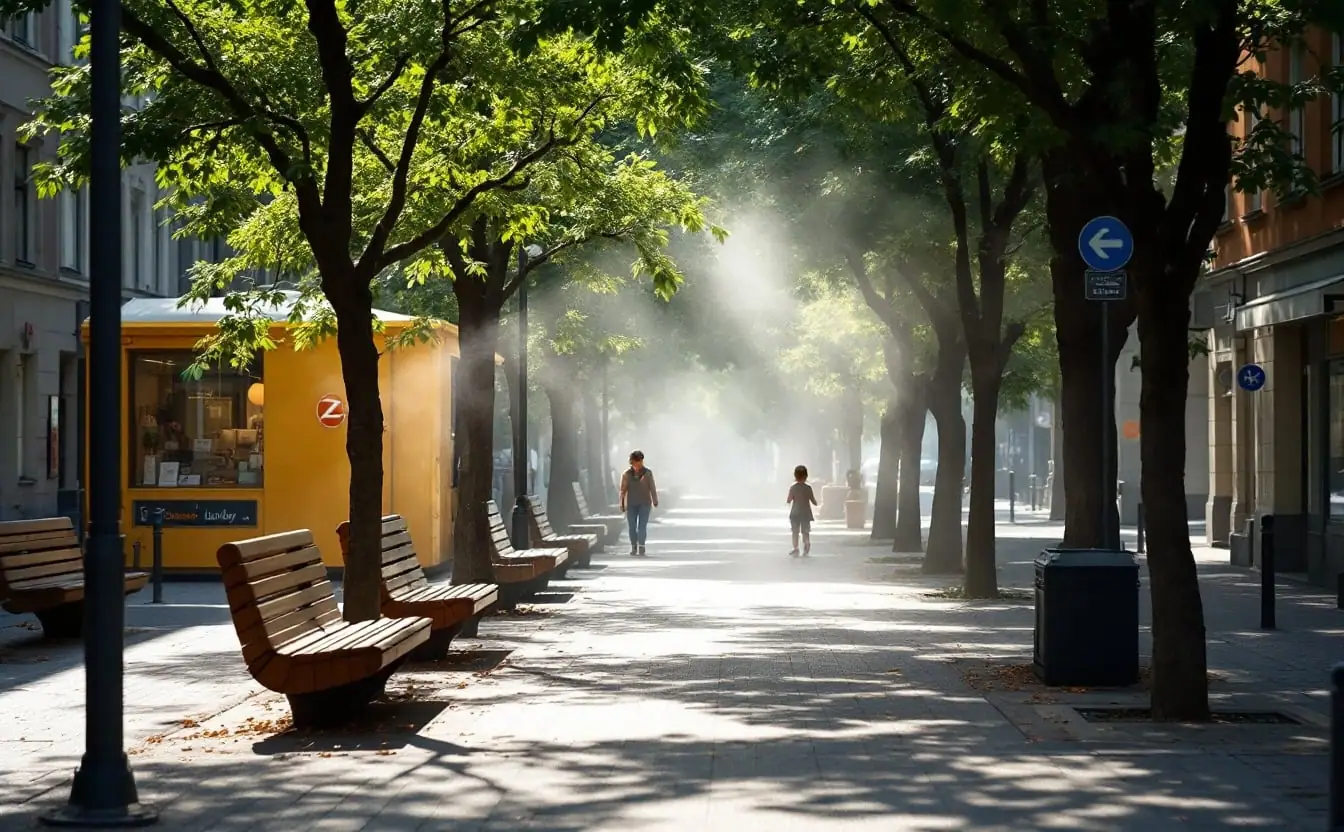
Stand at a tram stop in Essen on a wet November evening and close your eyes for a minute. The first thing you hear is whatever is loudest: a bell, the hiss of tyres on wet asphalt. Then the layers arrive: a shop door opening and shutting, and behind the buildings the low, continuous roar of the motorway that you stopped noticing years ago, if you live here. A church bell, two people laughing on a balcony, and somewhere, even now, a leaf blower.
Paying attention like this has a name, a set of practices and a history of about half a century. It needs no equipment beyond your ears. What follows is where the soundwalk came from, how radio became a place for art about listening, how to record without becoming a bore about microphones, and a method for leading a soundwalk of your own.
The soundscape idea
In the late 1960s and early 1970s the Canadian composer R. Murray Schafer set up the World Soundscape Project at Simon Fraser University in Vancouver, with a small group of composers and researchers who recorded and described the sounds of places as carefully as geographers describe their shape. His book The Tuning of the World, published in 1977, gave the field its vocabulary.
Three of his terms are still useful on any street. Keynote sounds are the background that everything else sits on, such as traffic hum or the wind in a particular valley; you rarely notice them until they stop. Sound signals are the foreground sounds meant to be noticed: bells, horns, sirens, a tram's warning. Soundmarks are sounds that belong to one place the way a landmark does, a particular foghorn, a market cry, a carillon.
Schafer also wrote about hi-fi soundscapes, where single sounds carry clearly over distance, and lo-fi ones, where everything blurs into a mass. He had strong views. Much of modern urban noise struck him as pollution, and his writing can sound nostalgic for quieter rural places, a position later writers have argued with. You do not have to share his taste to use his tools. A keynote is a keynote, liked or not.
Walking to listen
The person who did most to turn the idea into a practice was Hildegard Westerkamp, a German-born composer who joined the World Soundscape Project in Vancouver. In the 1970s she wrote about soundwalking and presented a radio programme of that name on Vancouver Co-operative Radio, taking listeners out into the soundscapes of the city and its surroundings. Her definition is disarmingly simple: a soundwalk is any outing whose main purpose is to listen.
Her composition Kits Beach Soundwalk (1989) begins with a recording on a Vancouver beach and then uses the studio to filter out the city's drone, until the tiny clicking of barnacles comes forward. It is a short lesson in how far attention can be trained, and in how much a city hides under its keynote.
Other artists took the walk in different directions. The American percussionist Max Neuhaus led groups through New York in 1966 under the title LISTEN, and in 1977 installed an unmarked sound work beneath a grating on a traffic island in Times Square, which passers-by can easily take for machinery. Janet Cardiff made audio walks that you follow on headphones, mixing her recorded voice and footsteps with the real street; The Missing Voice (Case Study B) started from a library in London's Whitechapel in 1999. Christina Kubisch's Electrical Walks, begun in the early 2000s, give people headphones that pick up electromagnetic fields, so that security gates, cash machines and lighting systems hum and crackle in a city they thought they knew.
Radio as a public space
Radio was the first medium to carry the sounds of a city into other people's rooms, and artists saw the possibilities early. In 1930 the German filmmaker Walter Ruttmann made Weekend, a montage of a working week ending and a weekend passing, recorded on the optical soundtrack of film stock and broadcast as a piece for the ear alone. In 1951 John Cage wrote Imaginary Landscape No. 4 for twelve radios, two performers at each, so that whatever happened to be on air became the material of the piece.
German public broadcasters kept up the long tradition of the Hörspiel, the radio play, and stretched it into acoustic art with no plot at all. In Austria the public broadcaster ORF launched Kunstradio on its Ö1 channel in 1987 as a regular slot for radio art. In London, Resonance FM began broadcasting in 2002 as an arts station, with programmes made by artists and musicians.
What these share is a view of radio as a public space rather than a delivery pipe. A soundwalk on air puts thousands of private kitchens on the same street at once. Community and free radio stations remain the easiest place to try it: half an hour of one neighbourhood's sounds, barely edited, with a short spoken introduction, is the kind of programme they exist for. Broadcasting outdoors on your own small transmitter is another matter, since most European countries require a licence to broadcast on FM. Artists working outside tend to use headphones, a speaker placed with permission, or a recording that people download before they set out.
What the Ruhr taught me to hear
Where I live, the keynote is the motorway. The A40, the Ruhrschnellweg, runs straight through Essen and its neighbours, and on still nights you can hear it far into residential streets. On a Sunday in July 2010, during the European Capital of Culture year, the motorway was closed between Duisburg and Dortmund and covered with a single long line of tables for an event called Still-Leben. It is the nearest thing the region has had to a city-scale experiment in removing a keynote, and it is a good question to carry on any walk here: what would this street sound like without the thing you no longer hear?
The old industrial sites reward listening too. The emptied gas holder in Oberhausen has a very long echo. The concrete ore bunkers at Duisburg-Nord swallow sound and then hand it back from odd angles, and the gravel at Zollverein records every footstep. I have suggested routes through all three in a cultural itinerary across the Ruhr, and they work as well with your eyes half closed.
Recording without the gear talk
You do not need special equipment to start. A recent phone records clean enough sound for a listening diary, especially on a quiet street. Wind is the enemy, so shelter the microphone with your body or a small foam or fur cover, and hold still, because handling noise travels straight into the recording. Record for at least three minutes without stopping, since the interesting sounds rarely arrive on cue.
Say the place, date and time into the recorder at the start, or write them down at once. A folder of files called "Recording 47" is nobody's archive. If you want to go further, a handheld recorder with two built-in microphones and a pair of closed headphones will carry you a long way. Listen through the headphones while you record, and you will hear what your ears were filtering out, which is the point.
Then the ethics. Recording a street is not the same as recording the people on it. In Germany, recording someone's privately spoken words without consent can be a criminal offence, and most countries protect private conversation in some way. Keep away from conversations you can understand, never follow anyone, take particular care around children, and do not publish a recording in which a voice could be identified unless its owner agreed. On private property, which includes most shopping centres and many stations, ask first.
A soundwalk you can lead
This method works for a group of friends, a class or a neighbourhood association, and it costs nothing but an hour. Lead it once and you will start hearing your own street differently.
- Choose a route of 30 to 60 minutes that crosses at least three kinds of space: a main road, a courtyard or park, a passage or stairwell, and water if you have it. Edges are where the sound changes.
- Walk it alone first, at the same hour and on the same day of the week you plan to lead it. Mark five to eight stopping points where something happens to the sound: a doorway, an underpass, a corner where the traffic drops away.
- Check the route for safety and access. Stops should be out of the pavement's main flow and away from kerbs, and every flight of steps needs an alternative so that wheelchair users can come the whole way.
- Brief the group before setting off. Silence from start to finish, phones off, a loose line, the leader at the front raising a hand to stop and lowering it to move on, and a second person walking at the back.
- Begin with what Schafer called ear cleaning: two minutes standing still, eyes closed if people feel safe doing so. Ask everyone to count the sounds they hear on their fingers, and to notice the nearest, the farthest and the one they noticed last.
- At each stop, listen for a minute or two. Between stops, give one simple instruction: follow your own footsteps as the surface changes, listen only to sounds above head height, or pick one sound and follow it until it disappears.
- Use thresholds. Stop just before and just after a gateway, a tunnel or a park entrance, so people hear the change rather than imagine it.
- End somewhere people can sit, and only then let them talk. Ask what surprised them, which sounds they would keep and which they would remove, and what they now think the keynote of the neighbourhood is.
- Hand out paper and ask everyone to draw a sound map: the route as a line, sounds as symbols, loud ones large. The maps never agree, which is the interesting part.
- Walk the same route in another season. A street in November, with wet leaves and closed windows, is not the one you walked in June.
People with hearing loss can take part as well. The vibration of a bridge underfoot, the push of air in a passage, the rhythm of traffic lights: a soundwalk trains attention, and attention does not live only in the ears. A group walk is also one of the simplest forms of participatory art, since the participants make the work by paying attention and nobody leaves with an object. There is more on performance, listening and the arts in the culture section.
Start tomorrow, at the crossing you use every day. Stand still for two minutes before the lights change, and count.