From pithead to stage: a cultural itinerary across the Ruhr
Zollverein, the Gasometer Oberhausen, Landschaftspark Duisburg-Nord and the Ruhrtriennale: a practical three-day route through the Ruhr's industrial culture.

We earn a commission on some bookings and books. As an Amazon Associate I earn from qualifying purchases.
The first view most people get of the Ruhr is from a train window: brick terraces, rail sidings, allotment gardens, a long green hill that turns out to be a heap of mining spoil. Nothing announces itself. Duisburg runs into Oberhausen, Oberhausen into Essen, Essen into Bochum, and the region keeps its best rooms behind old factory gates.
Those rooms are why you come. Over three decades the collieries, coking plants, gas holders and steelworks that powered West Germany's post-war economy have become museums, concert halls, parks, a diving pool and climbing walls. A few of the conversions are famous far beyond Germany. Others are known mostly to the people who walk their dogs there. I live in Essen, and what follows is the route I give friends who arrive in late summer with three days, a rail pass and an appetite for very large rusting things.
How the plant became a stage
None of this happened by accident. From 1989 to 1999 the Internationale Bauausstellung Emscher Park, a ten-year building exhibition backed by the state of North Rhine-Westphalia, worked along the polluted Emscher valley on a premise that sounded perverse at the time: keep the industrial structures, clean the ground around them and give them new uses instead of knocking them down. Landschaftspark Duisburg-Nord and the Gasometer Oberhausen both came out of that decade.
The Route der Industriekultur, the Industrial Heritage Trail, now ties dozens of sites into one network you can follow by car, bike or train. In 2010 Essen carried the title of European Capital of Culture on behalf of the whole Ruhr, and the notion that a colliery could be a cultural destination stopped sounding eccentric. Germany's last hard coal mine, Prosper-Haniel in Bottrop, closed at the end of 2018. Everything on this route is heritage now. There is no working pit left to compare it with.
Day one: Zollverein in Essen
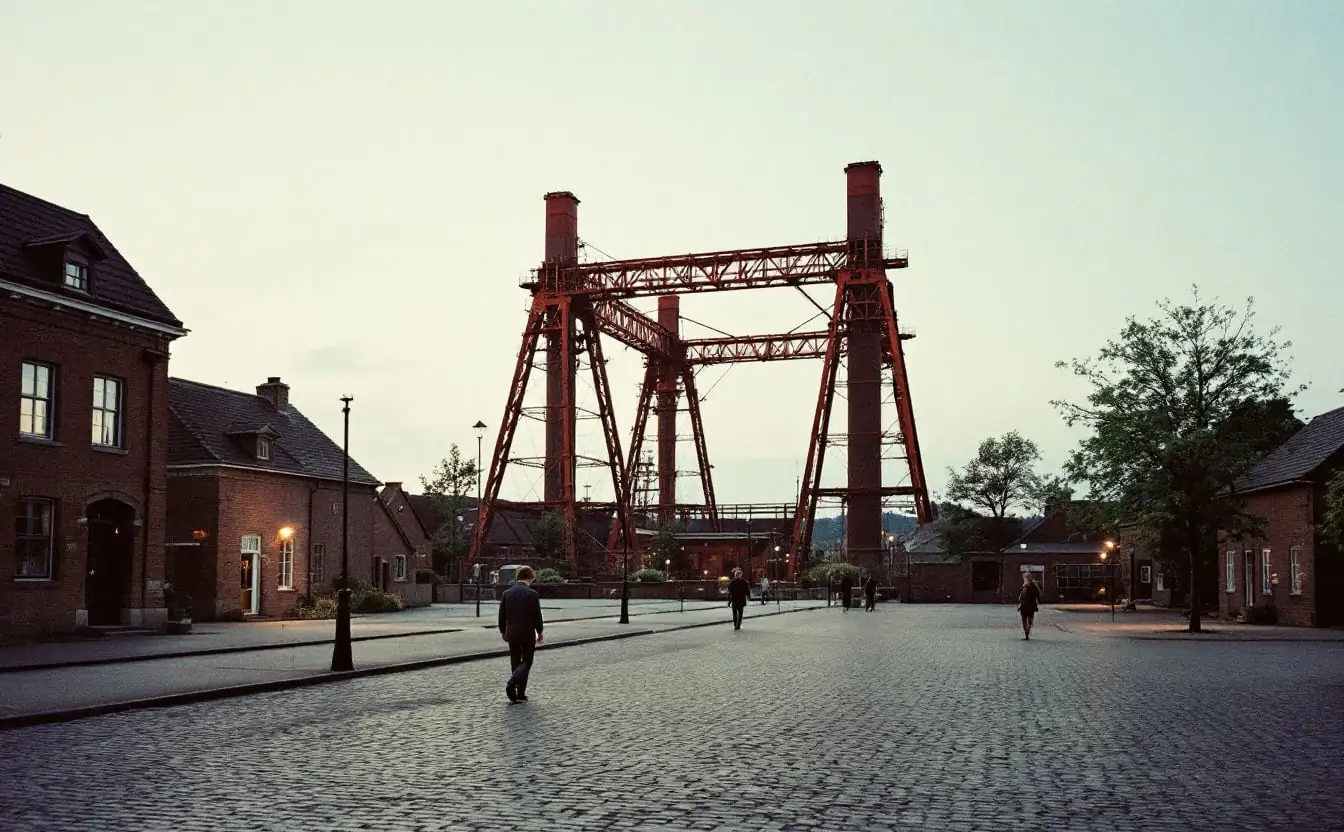
Start where the postcards start. Tram 107 runs north from Essen Hauptbahnhof to the Zollverein stop, and you step out beside the double-trestle headframe of Shaft XII, the red steel frame that has become the region's shorthand for itself. Fritz Schupp and Martin Kremmer designed the shaft and its buildings, which went into operation in 1932. The halls are plain cubes of steel frame filled in with brick, and their debt to the Bauhaus is obvious once you look for it. Mining stopped in 1986, the coking plant next door shut in 1993, and UNESCO inscribed the whole complex as a World Heritage Site in 2001.
The Ruhr Museum fills the former coal washery. You enter by a long escalator inside a tube lit orange, which climbs the outside of the building to the level where coal once arrived for sorting. From there the permanent exhibition leads you down through the building and through the region's geology and social history, with bunkers and machinery left in place around the displays. Allow a good half day. Afterwards, if the sky is clear, go up to the roof of the washery for the view over the site and out to the spoil heaps.
The other buildings reward a slower walk. The old boiler house holds the Red Dot Design Museum, where award-winning product design sits among the boilers and steel gangways. The former pithead baths now hold PACT Zollverein, a centre for contemporary dance and performance. Across the grounds stands a concrete cube by the Japanese practice SANAA, completed in 2006 and punched with square windows of different sizes, as if someone had tested a theory of light on it.
Then walk east to the coking plant, Kokerei Zollverein, where the coke ovens stand in a black row so long that the far end blurs in summer haze. In summer a swimming pool made by artists from shipping containers sits on the old works ground; in winter a stretch beside the ovens becomes an ice rink. The salt store holds Ilya and Emilia Kabakov's installation The Palace of Projects, a spiral of rooms full of proposals for improving the world.
Wear shoes for gravel, cobbles and steel grating. The distance from the headframe to the far end of the coking plant is a proper walk, and there is little shade.
Day two: the Gasometer and Duisburg-Nord
Begin in Oberhausen. From the Hauptbahnhof, trams and buses run on their own track to the Neue Mitte, where the Gasometer stands beside the Rhine-Herne Canal, facing an enormous shopping centre. The gas holder was built from 1927 to 1929 to store blast furnace gas for the local ironworks and rises about 117 metres. It reopened as an exhibition hall in 1994, one of the flagship projects of the Emscher Park years.
Inside, the empty drum is the exhibit as much as anything hung in it. Christo and Jeanne-Claude stacked thousands of oil barrels into The Wall here in 1999, and Christo came back in 2013 with Big Air Package, an inflated fabric envelope that filled the space so that visitors walked inside it. Exhibitions change, so check what is on before you go. Whatever the show, take the glass lift up through the drum and walk out on the roof, where the whole western Ruhr lies flat around you. If the hall is quiet, clap once and listen: the echo takes a remarkably long time to die, a good place to start listening to the city rather than just looking at it.
In the afternoon, take a train to Duisburg and tram 903 from the Hauptbahnhof to Landschaftspark Duisburg-Nord. The blast furnaces of the Meiderich ironworks went cold in 1985. The landscape architect Peter Latz and his practice, Latz + Partner, designed the park that opened in 1994. Their method was restraint. The structures stayed, birches were allowed to colonise the rubble, the old ore bunkers became walled gardens and climbing walls run by the German Alpine Club, and the gas holder was filled with water and turned into a diving centre.
Climb blast furnace 5 while it is still light. The stairs are open steel, and you can see the ground through the treads most of the way up. At the top the view runs from the Rhine harbours to the next town's chimneys. This is a public park, not a museum, and after dark Jonathan Park's light installation turns the furnaces and pipework red, green and blue. The Kraftzentrale, the plant's old power station hall, is used for concerts and for productions of the Ruhrtriennale, which brings us to day three.
Day three: Bochum and the Ruhrtriennale
The Jahrhunderthalle in Bochum began life in 1902 as an exhibition hall for a steel company at the industrial and trade exhibition in Düsseldorf. It was then taken apart, rebuilt in Bochum and used as a gas power station for the steelworks. Today it is the main venue of the Ruhrtriennale, set in the Westpark, a stretch of former steelworks land laid out with paths, terraces and lawns.
The festival was founded in 2002, with the Belgian opera impresario Gerard Mortier as its first artistic director. The name refers to the three-year terms of each director rather than to how often it happens: there is a festival every late summer, spread across halls in cities including Bochum, Duisburg, Essen and Gladbeck, with music theatre, drama, dance, concerts and installations made for these huge rooms. The 2024 to 2026 cycle is led by Ivo van Hove, the Belgian theatre director.
Book the large productions early. Read each listing for the language and whether there are surtitles. Arrive in good time to walk around the hall before you sit down, because the building is half the performance. Bring a layer as well: the halls hold the heat of an August day, and the walk back to the station at night can be cool.
With a free morning in Bochum, visit the Deutsches Bergbau-Museum, easy to spot by the headframe on its roof; its demonstration mine is as close as a visitor can now get to underground work in the Ruhr. Staging events outdoors rather than in a sealed hall is another problem altogether, as anyone planning a festival in open public space soon finds out.
Evenings on the spoil heaps
The spoil heaps, the Halden, are the Ruhr's hills, and several now carry large landmark works that are best seen at sunset. On a heap in Bottrop the Tetraeder, a steel tetrahedron completed in 1995, lets you climb up through open stairs to platforms hanging in the frame. In Duisburg, Heike Mutter and Ulrich Genth's Tiger & Turtle, Magic Mountain, opened in 2011, is a walkable sculpture shaped like a roller coaster: you can follow the track up and over its curves, but not round the loop. On Halde Hoheward, between Herten and Recklinghausen, two huge steel arches of a horizon observatory stand over the summit plateau.
These are open, exposed places. Take a torch for the way down, check your last connection back, and expect wind at the top even on a still evening in town.
Getting around and pacing yourself
Regional trains link Duisburg, Essen, Bochum and Dortmund through the day, and local trams and buses belong to one transport association, so a single ticket can carry you across city boundaries. The Deutschlandticket, Germany's monthly pass, covers local and regional transport across the country. Essen and Bochum make the most convenient bases.
Plan one large site for each half day, no more. Many of these places are outdoors and exposed, with steel stairs, gravel and very little shade, and August afternoons can be hot. Carry water. There are more city routes in the travel section, several of them further south and east.
Practical questions
Do I need a car?
No. Every main site on this route is reachable by train and tram. A car helps for the spoil heaps at dusk, when the last bus back can be a long wait away.
Is this a good trip with children?
Mostly, yes. Open steel stairs and gratings thrill some children and frighten others. Duisburg-Nord has space to run and climb, and the summer pool at Zollverein is a good reward after a museum morning.
When should I come?
Late summer gives you the Ruhrtriennale and long evenings at Duisburg-Nord. Winter brings the ice rink at the coking plant and early darkness, which flatters the light installations. Spring is quieter, and the birches in the old works are at their best.
Can I still go underground?
Not into a working mine; the last one closed in 2018. The Bochum demonstration mine is the nearest substitute.
If you only have one evening, make it Duisburg-Nord. Take the tram there an hour before sunset, climb blast furnace 5 while the light lasts, then stand on the Piazza Metallica, a square of heavy iron plates from the old casting house, as the coloured lamps come up through the pipework above you.