Planning a festival in public space: permits, crowds and neighbours
A practical guide to planning a festival in a square, street or park: permits, crowd safety, noise and neighbours, toilets and water, access, and a timeline.

We earn a commission on some bookings and books. As an Amazon Associate I earn from qualifying purchases.
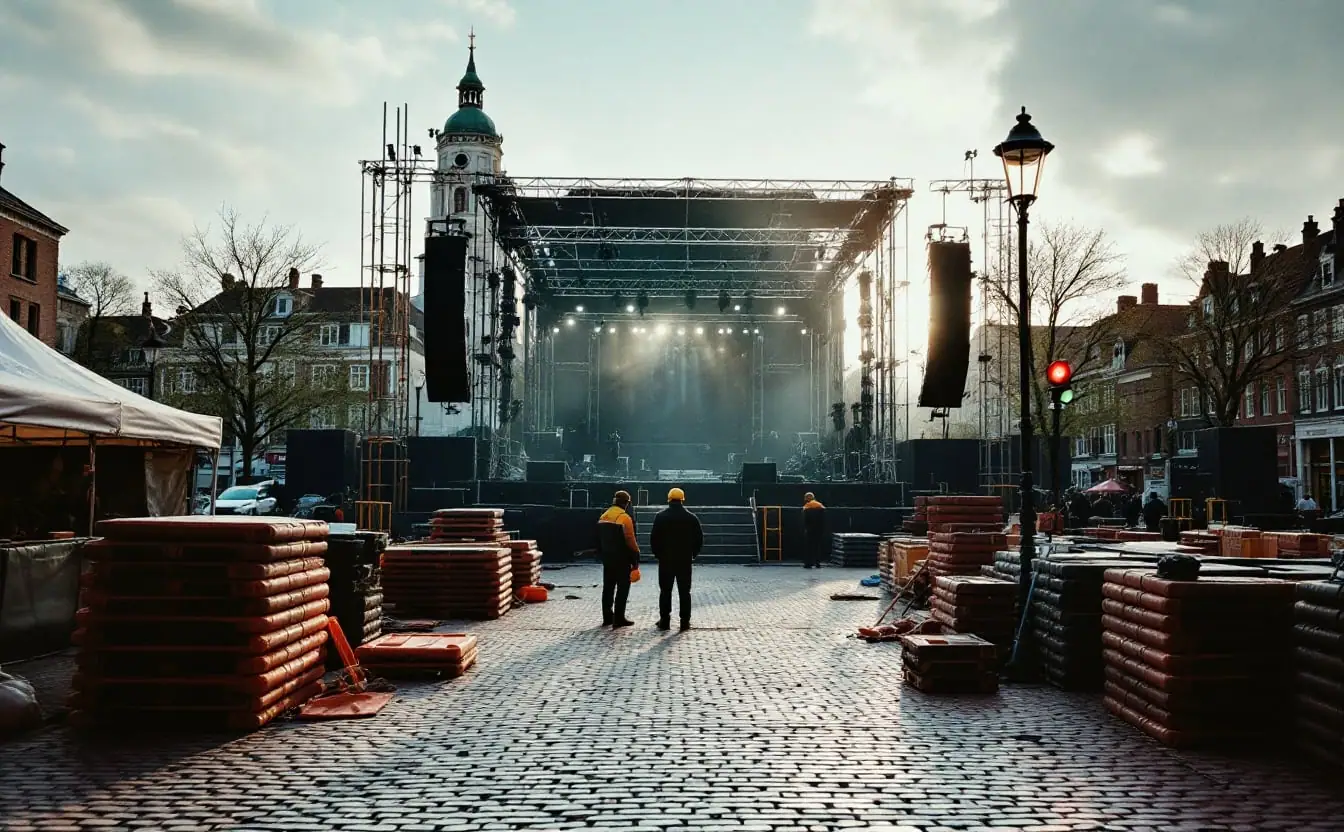
At six in the morning a city square sounds different. Reversing alarms beep, barrier sections clank onto their feet, someone is testing a radio channel, and the bakery on the corner has its shutter half up, watching. By evening there will be a stage, a few thousand people and a great deal of noise. Whether the day goes well was decided months earlier, in emails, site visits and meetings with officials who will never see the show.
I spend a lot of my time in festival back-lots, and the same handful of questions decides almost every event in a square, street or park. This guide is for organisers of small and medium events: a neighbourhood festival, a street music day, a weekend of outdoor theatre. The principles hold for bigger ones. The paperwork is thicker.
Start with the ground, not the line-up
Before you book a single act, find out what the space is and who controls it. A square that looks public may belong to the city, to a church, to a transport company or to a private landlord who lets people walk across it. Ask early, because the owner's answer shapes everything else.
Then look down. Many squares sit on top of an underground car park, a metro station or old cellar vaults, and the load a stage, a truck or a dense crowd puts on that roof is an engineering question, not a guess. Grass hides drains, cables and tree roots. Even a gentle slope towards the stage changes sightlines and decides where rainwater collects.
Visit at the hours your event will run, on the same day of the week. A square at Saturday dusk is not the one you saw on a Tuesday morning: market traders packing up, delivery vans, a taxi rank, skateboarders who have used the steps for years. They are all users of the space, and some of them will still be there on the day.
A first site visit checklist
- Who owns the ground, and whose signature grants permission?
- What lies underneath: a car park roof, vaults, utility chambers, tree roots?
- Where are the nearest hydrant, mains power point and drain?
- How do people arrive: tram and bus stops, bike parking, taxi drop-off, step-free routes?
- Where can an ambulance and a fire engine get in and out with the square full?
- Who lives, sleeps or works within earshot: flats, a hospital, a care home, a hotel?
Permits: who says yes
The names change from country to country, but the questions are much the same, and you should expect several permissions rather than one. In German cities, putting anything on a public street usually needs a special use permit for road space, the Sondernutzungserlaubnis, plus a traffic order if roads close. In England and Wales a small event that sells alcohol or puts on regulated entertainment can run under a Temporary Event Notice, which is limited to fewer than 500 people at any one time; anything larger needs a premises licence.
Then comes the list. Stages, stands and large tents need engineering sign-off. Food traders must be registered for food hygiene. Music usually means the collecting societies: GEMA in Germany, PRS for Music and PPL in the UK. Many British councils convene a Safety Advisory Group, where police, fire, ambulance, highways and licensing officers review an event plan together, and German cities generally want a safety concept for larger events, agreed with the Ordnungsamt, the police and the fire brigade.
Appoint one person on your side to handle every conversation with the authorities, and keep a single file recording what was agreed, by whom and when. Officers move jobs. A note saying who approved the later finish, and in which email, is worth more than any amount of goodwill on the night.
Crowd safety is about movement
In Duisburg on 24 July 2010, 21 people died in a crush at the Love Parade. The festival ground, a former freight yard, was reached through road tunnels and a single ramp that served as both entrance and exit, and the crowd moving in met the crowd trying to leave.
Capacity is not one number. A square may hold a crowd standing still and fail when that crowd tries to move, so planners start from the usable area (minus the stage, bars, toilets, emergency lanes and corners with no view) and then look hard at entrance and exit widths and at the moment everyone leaves. Separate the routes in and out wherever you can, and keep steps and pinch points off them. Know in advance how you will slow or stop people coming in if the front becomes too dense.
Then the people. Stewards should have walked the site and been briefed on it, not been handed a high-visibility vest at the gate. You need a control point with a clear view, one radio channel that everyone uses, first aid sized to the crowd and the heat, and a staffed point for lost children. Agree a show-stop procedure with the performers before they go on, so a stage manager can cut the music and get an announcement out within seconds.
Weather belongs here too. In August 2011 stage structures collapsed in storms at Pukkelpop in Belgium and at the Indiana State Fair in the United States, and people died at both. Every stage and tent comes with a wind rating from its supplier, so name one person who watches the forecast, knows those limits and has the authority to clear an area before the gusts arrive.
Noise and neighbours
Most complaints come from people who found out about the event when the sound check started. Write to everyone within earshot weeks ahead: what is happening, when the music stops, which roads close and for how long, and a phone number that a real person answers during the event. Leave the same information on paper at the bakery and the pharmacy, because not everyone checks a website.
Sound design does most of the rest. Point the speakers away from bedrooms and towards blank walls, open ground or water, and use delay speakers further back so the front need not be deafening for the back to hear. Agree limits with the authority, measured at the nearest homes, and have someone take readings there through the evening. In much of Germany the night period for noise begins at 22:00, so put your loudest act early and your quietest last.
Remember the get-out. A crowd drains away within an hour, but bottle bins tipped into a lorry at two in the morning keep a street awake far longer, so leave the noisy parts of the clear-up until daylight. Give the neighbours something back as well: a reserved space for residents of the closed street, a role in the opening. People are far more patient with an event they feel part of.
Toilets, water, power and waste
These are the parts no one photographs and everyone remembers. How many toilets you need depends on how long people stay, whether alcohol is sold and who is coming; in the UK many organisers work from the Purple Guide, the industry's guidance on health, safety and welfare at events. Urinals shorten queues noticeably. Accessible units belong on hard ground, on the step-free route and under lights, and a servicing schedule matters, because full toilets at nine in the evening are a safety problem as well as a comfort one.
Drinking water should be free and easy to find, from taps fed through a hydrant standpipe agreed with the water utility; on a hot afternoon, a long queue at the refill point means you need a second one. Reusable cups with a deposit, common at German festivals, cut the volume of litter, and sorted bins only work with someone standing beside them. Keep vehicles and heavy kit out from under tree canopies, where compacted soil damages the roots, and lay track mats wherever trucks must cross a lawn.
Accessibility from the first drawing
Access is cheapest when it is in the first site plan and most expensive when someone remembers it the week before. Draw a step-free route from the nearest stops to the viewing area, toilets, bars and first aid, then walk it with a wheelchair user or someone pushing a buggy. Build a raised viewing platform with room for companions. If you can, hire a fully equipped accessible toilet with a hoist and an adult-sized changing bench, known in Britain as a Changing Places toilet.
Publish access information early and make it specific: distances in metres, surfaces, gradients, seating, how loud the main stage gets and where the quiet area sits. Book sign language interpreters for spoken programme. A quiet tent with low light and a few chairs costs little and helps a long list of people, from autistic visitors to parents with an overwhelmed toddler.
A twelve-month timeline
Lead times vary by city and by size. Treat this as a sequence rather than a legal schedule, and ask your authority for its real deadlines on day one.
| When | Permits and paperwork | Site, safety and services | Neighbours and public |
|---|---|---|---|
| 12-9 months before | Ask the landowner; list permits and lead times | Site visits at event hours; rough layout | Map who lives and works nearby |
| 9-6 months | Apply for use of space and road closures; brief your insurer | Draft site plan, routes in and out, emergency access | Meet residents' groups and shops |
| 6-3 months | Licences, music rights, trader registrations | Book stage, barriers, toilets, water, power; safety concept | Agree how residents can take part |
| 3 months-6 weeks | Chase approvals; get conditions in writing | Crowd management plan, stewarding, medical cover, wind limits | Publish access information |
| 6-2 weeks | Final documents; structural certificates | Steward briefings; final site plan; radio channels | Letter to every household within earshot |
| Final week | Keep the agreement file to hand | Build, inspections, sound tests at agreed times | Phone line staffed; notices in shops |
| Event days | Walk-rounds with inspectors | Control point, noise readings, wind checks | Answer complaints the same evening |
| Week after | Close permits; reclaim deposits | Repair grass, check trees | Thank the neighbours; ask what to change |
The same sequence, scaled down, works for an art workshop in a park. On former industrial land, such as the parks on a cultural route across the Ruhr, add old foundations and contaminated ground to the questions. More outdoor events are in the festivals and events section.
The morning after
A festival in public space is judged the next day, when the square goes back to the people who use it all year. Walk the site with someone from the city after the clear-up, photograph the grass and paving, and note what went wrong while you still remember. Next year's application starts with that page.
By eight the following morning the bakery's shutter should be all the way up again. The only sign of the weekend should be a pale rectangle on the grass where the stage stood.