Walls, Permits and Lifts: How a Large Mural Gets Made
From the wall owner's signature to the last coat of varnish, the practical stages behind a large outdoor mural: permits, surface, paint, lifts and upkeep.

We earn a commission on some bookings and books. As an Amazon Associate I earn from qualifying purchases.
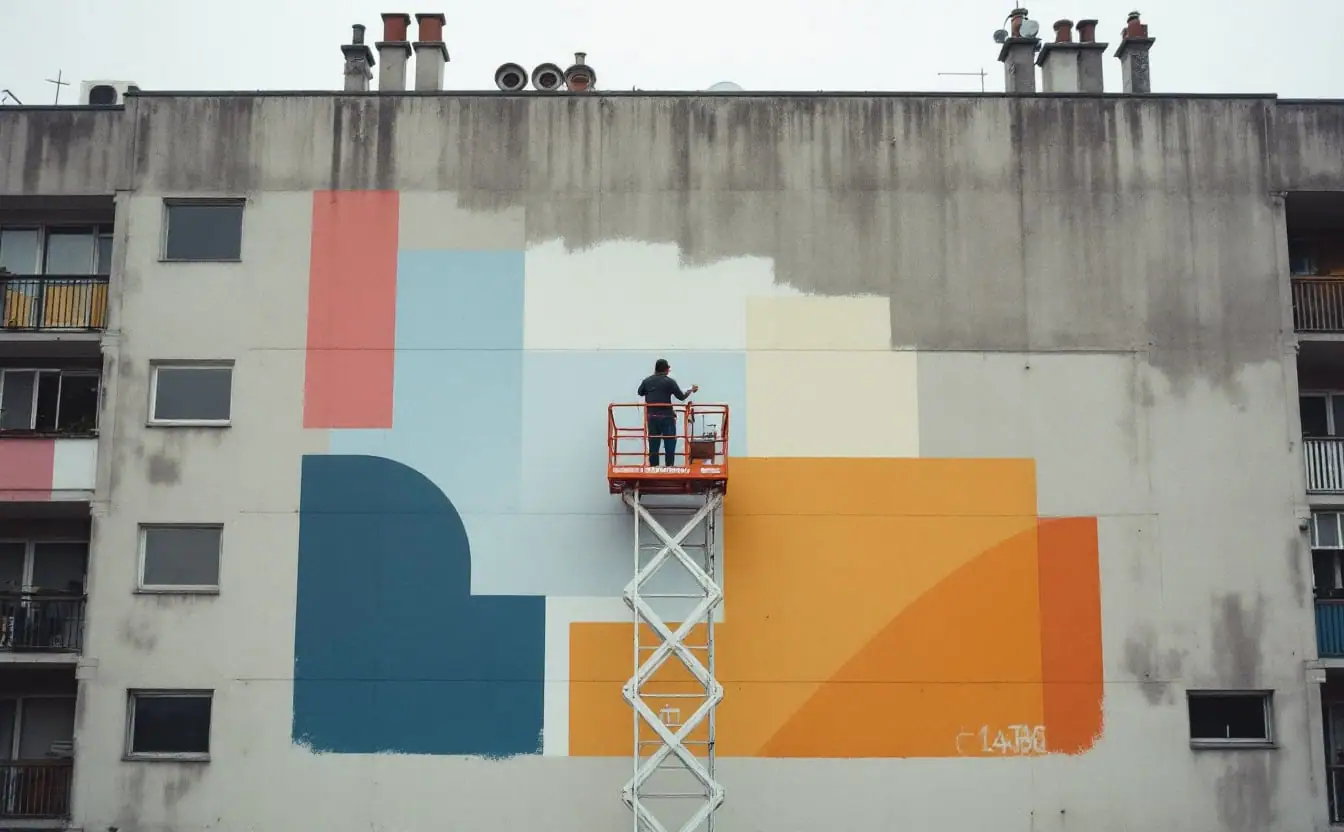
From the pavement, a big mural looks like one long gesture: someone went up on a lift with a lot of paint and came down a week later. The painting is real, hard work, but it is often the shortest stage. Before it come months of signatures, surveys, phone calls about pavements and tram wires, and arguments about a shade of blue seen from forty metres away. After it come the years when the wall has to be looked after by people who were not there on opening day.
The stages below follow a composite job: a blank gable end on a postwar block of flats, eight or nine storeys high and facing a busy road, the kind of wall you find on estates from southern Zagreb to the outer districts of Vienna and Belgrade. The details change from country to country. The order of the problems rarely does, and it is much the same for the other walls, sculptures and squares in the public art strand.
Who owns the wall
Everything starts with a signature from whoever controls the surface. On a block of flats that is rarely one person. The facade usually belongs to all the owners together, which means a building manager, an owners' meeting and often a vote, with rules about majorities that differ between countries. On a public building it is a city department, and on a school it may be an authority other than the one that runs the school.
Get the agreement in writing and make it say more than "yes". It should cover how long the mural is expected to stay, who pays for repairs, whether the owners may paint over it and with how much notice, and what happens when the building is renovated. That last point matters more than it sounds. Energy retrofits that wrap old facades in insulation boards are common across the region, and a mural on a gable end due for insulation in five years has a five-year life, whatever the paint tin promises.
Survey the surface
Before anyone designs anything, someone who knows facades should look at the wall closely, ideally from a lift. Is the render sound, or does it ring hollow when tapped? Are there cracks, damp patches, white salt blooms, green algae on the shaded side? What has the wall been painted with before, and is that layer still holding? A simple tape test, pressing strong tape onto a small cross-cut in the old paint and pulling it off sharply, shows quickly whether the existing coating will take more paint or come away with it.
Map the obstacles while you are up there: windows, vents, drainpipes, satellite dishes, cable runs, the lightning conductor. A design that ignores them gets bent around them on the day, usually badly.
Permits and people with stamps
This is where cities differ most. In some, repainting a facade needs no permission at all. In others, any visible change to a facade goes to the building authority, and in a protected historic zone the heritage office will want to see the design. A few cities have set up simpler procedures meant specifically for murals. Ask the city first, in writing, which permits apply, and keep the answer.
Then there is the ground. A lift or scaffold on a pavement or road needs permission to occupy public space, usually with a plan for pedestrians and traffic. If a tram line or overhead cable runs nearby, its operator will set a safe distance and may insist on supervision. Those requests take weeks, and they fix your painting dates more firmly than the weather does.
Insurance belongs in the same folder. The organiser needs public liability cover for the whole job, the lift hire company will ask who insures its machine, and the artist and assistants need accident cover that actually includes work at height. The building owners should tell their own insurer that work is going on.
Finally, rights. The artist normally keeps the copyright, while the owners own the paint on their wall; the contract should say whether a sponsor, the city or the owners may use images of the mural in advertising. It should also say what happens if the work has to go.
The case of 5Pointz in Queens, New York, where a court awarded substantial damages to artists after the building's owner whitewashed their work without warning in 2013, made property owners in many countries pay attention. Moral rights law differs across Europe, but notice and a chance to photograph the work cost nothing. Commissioned walls are a different animal from the work that appears unasked on empty buildings, which has its own logic and debates, as a piece on Athens walls and empty buildings describes.
Design at the scale of a building
A mural design has a harder job than temporary art in a city square, which only has to hold attention for a season; this one will be looked at by the same people for years. Designs are usually approved as a mock-up laid over a photograph of the wall, and that is the moment to check what a small picture hides. Fine detail disappears at forty metres, and a face that reads well on a screen can turn into a blur from the tram stop. Colours look paler in strong sun and heavier on a north-facing wall. Windows will cut through the image, so either work with them or decide which parts of the composition can lose a square metre.
Keep the approval circle small and clear. The owners decide whether they accept the design. Residents and neighbours can be shown it and listened to, but a design amended line by line by a large meeting tends to lose whatever made it worth commissioning. If the wall faces a school or a small square, an evening with the design on a board in the entrance hall does more good than a questionnaire.
Preparing the wall
Preparation is dull and decides how long the mural lives. The usual sequence is cleaning (low-pressure washing for soft or old render, because a strong jet can strip it), scraping off loose paint, treating algae, filling cracks with a mortar compatible with the render, and letting everything dry properly. Then comes a primer chosen for both the wall and the paint that will go on top. Mixing systems carelessly, for example putting a mineral paint over an old plastic-based coating, is one of the quickest ways to make a new mural flake within a few winters.
Paint and coatings
Most large murals combine materials: rollers and brushes for big fields of colour, spray cans for lines, fades and fine detail. Whatever you choose, read the technical data sheet for every product. It gives the minimum application temperature, drying times and the conditions the manufacturer is prepared to stand behind.
| Material | Good for | Watch out for |
|---|---|---|
| Exterior acrylic masonry paint | Large flat areas, rolled or brushed; wide range of colours | Forms a film on the surface; on a damp wall it can blister and peel |
| Silicate (mineral) paint | Mineral render and stone; bonds with the surface, lets it breathe and holds colour well in sunlight | Narrower palette; needs a mineral surface and careful preparation; poor over old acrylic layers |
| Aerosol spray paint | Quick lines, gradients and detail at height | Overspray onto cars and windows, fumes in still air, lightfastness that varies from colour to colour |
| Anti-graffiti coating | The lowest two or three metres, where tags usually land | Some types seal the wall; sacrificial types wash off with the tag and have to be reapplied |
| Protective clear coat | Slowing fading on a wall that faces the sun | The wrong product can yellow or trap moisture behind the paint |
Turning a measured wall into a shopping list is simple arithmetic, but it is easy to forget a coat or the waste. The mural paint calculator works it out layer by layer, from primer to the last colour, using the coverage printed on your own tins.
Getting up the wall
Access is often one of the largest lines in the budget. A boom lift is the default for a gable end: flexible and quick to reposition, but it needs firm, level ground and room for its outriggers. Check what is under the pavement before you park several tonnes on it, because old cellars and vaults run under many central streets.
Scissor lifts suit lower, wider walls. Scaffolding takes days to put up and costs more, but it gives a stable working platform and protects pedestrians underneath. On tall walls with no ground access, rope access teams or suspended platforms are the remaining option.
Whoever drives a lift needs training, and hire companies in most of Europe will ask to see a recognised operator card. Every machine also has a maximum wind speed for safe use. A gusty corner between two tall blocks can stop work on a day that feels calm at street level.
Getting the image onto the wall
Few painters freehand a whole building. The classic method is a grid, drawn on the design and marked out on the wall with chalk lines. A faster variant, sometimes called a doodle grid, scatters random marks over the wall, photographs them, and uses them as reference points for tracing the design. Some teams project the outline at night and trace it before dawn. Each method has fans, and the choice depends mostly on the artist's habits and how much ambient light the street has after dark.
For the grid method, the mural grid calculator fits the sketch to the wall and gives the size of one square on paper and on the render, which saves an evening with a calculator and a ruler. And for the artist preparing the quote in the first place, the mural price calculator lays out the fee, materials, lift days and contingency line by line.
Weather and the calendar
In Central and Southeast Europe the comfortable painting seasons are late spring and early autumn. High summer brings long days but also heat on dark walls, which makes paint dry too fast to blend, and afternoon storms. Night temperatures matter as much as daytime ones, because paint keeps curing for hours after the brush has moved on, and heavy morning dew on a north wall can delay the start until late morning. Build spare days into the schedule and tell the lift hire company early that the dates may move.
After the opening
The mural now needs an owner in the practical sense: one named person who looks at it once a year and knows whom to call. A light routine keeps most walls in good shape for a long time.
- Photograph the finished work in good light, straight on and in detail, and file the images with the contract.
- Record every product used: paint names, colour codes, primer, coatings and the supplier.
- Agree a response to tags, including who removes them, with what method and how fast.
- Ask the artist to do or approve any retouching, and put a small sum aside each year for it.
- Decide in advance what happens at the end of the mural's life, and give the artist notice before anything is painted over.
The most useful document from the whole process is a single sheet: product names, colour codes, coating, date, and the artist's contact. Keep a copy with the building manager as well as in the commissioner's files. Years later, when someone sprays a tag across the bottom metre on a wet November night, that sheet is what lets the repair match the blue the artist mixed on a ladder in October.