Bucharest beyond the boulevards: a walk through its cultural spaces
A walk through Bucharest's cultural spaces, from contemporary art in the Palace of the Parliament to Lipscani, Cișmigiu, the Athenaeum and interwar villas.

We earn a commission on some bookings and books. As an Amazon Associate I earn from qualifying purchases.
Visitors tend to meet Bucharest at its widest: the boulevard running up to the Palace of the Parliament, the traffic around Piața Unirii, the long straight lines of the 1980s. That is a real part of the city and worth seeing. But the Bucharest people spend their evenings in is narrower and older, and it keeps its cultural life in courtyards, passages, park corners and the ground floors of houses built for families who left long ago.
This walk strings those places together in a day on foot, starting with contemporary art inside the regime's largest building and ending among villas from the first half of the twentieth century. It is planned for July, when the city is hot and the light is long, so the indoor and shady stops fall in the middle of the day. Check each institution's own website before you go, since some close one or two days a week. For more city walks, the travel strand collects them.
The route at a glance
- The National Museum of Contemporary Art, inside the Palace of the Parliament
- Across the Dâmbovița to Manuc's Inn and the old princely court
- Stavropoleos church and its courtyard
- Lipscani street and the Cărturești Carusel bookshop
- The Macca-Vilacrosse passage and Calea Victoriei
- Cișmigiu Gardens in the heat of the afternoon
- Revolution Square and the Romanian Athenaeum
- The villa streets around Grădina Icoanei as the light drops
Izvor metro station is the closest to the start, and Piața Romană is a short walk from the finish. Wear shoes with grip: pavements in the centre are uneven, kerbs are high, and cars parked half on the pavement often leave room for one person at a time. Carry water and a hat.
Contemporary art in the palace
The Palace of the Parliament is usually described in superlatives. A plainer account: it was begun in the 1980s under Nicolae Ceaușescu, to a design led by the architect Anca Petrescu, and a large part of the old Uranus quarter, with its houses, streets and churches, was cleared for it and for the boulevard that runs east from it. A few churches were saved by being moved on rails and tucked behind new apartment blocks. The building now houses both chambers of the Romanian parliament.
The National Museum of Contemporary Art, known as MNAC, opened in one wing in 2004. It has its own entrance, separate from the parliament tours, and its high galleries are a good place to spend a July morning out of the sun.
What makes the visit worth it is the friction. Video, installation and painting, much of it critical, sit inside the most monumental product of a regime the city is still recovering from. Look out of the windows between rooms, because the scale outside is the context for everything on the walls. If the terrace at the top is open, go up for the view before heading into older streets.
Manuc's Inn and the old court
From the museum, cross the Dâmbovița and walk east along the river to the southern edge of the Old Town. Manuc's Inn was built in the early nineteenth century by Manuc Bei, an Armenian merchant, as a lodging house for traders, with wooden galleries running round a wide courtyard. Step inside the gate just to see how an inn of that size was organised around a single open space.
Next to it are the remains of the Curtea Veche, the old princely court. The first known written mention of Bucharest, in a document issued by Vlad III in 1459, is usually linked to a fortress on this site, and the court's church is among the oldest in the city. The ruins are modest, low brick walls and vaults, but they put the medieval town under your feet in a way the boulevards never do.
Stavropoleos
A few streets north, the small church of Stavropoleos dates from the 1720s and was founded by a Greek monk. It is the best place in the city to see the Brâncovenesc style up close: carved stone columns, a painted porch, wooden doors cut in fine relief. Behind the church, a courtyard ringed by a covered gallery holds old carved gravestones and fragments of stonework set against the walls.
Go quietly, because it is a working monastery. If the choir is singing in the Byzantine tradition when you arrive, stay for a while and let the rest of the plan slip.
Lipscani and the Carusel
Lipscani street takes its name from merchants who brought goods from Leipzig, and several street names in the Old Town still recall the trades that once worked them. The area is now largely pedestrian and after dark mostly bars. Freshly restored facades stand next to others held up by scaffolding.
Some buildings carry a red disc by the door. It marks a building assessed as being at high risk in an earthquake, a reminder that Bucharest sits in a seismic zone and has not forgotten the earthquake of March 1977. Look up as you walk, and you will start to see the city's slow argument about repair.
Cărturești Carusel, on Lipscani itself, opened in 2015 in a restored building from the turn of the twentieth century. Inside, everything is white: curving balconies stacked several storeys high around an open centre, with shelves on every level. Climb to the top floor and look down, and you can watch the whole building browse. Then buy something, because a bookshop like this survives on sales, not on photographs.
The passage and Calea Victoriei
Leave the Old Town through the Macca-Vilacrosse passage, a glass-roofed arcade from the late nineteenth century that splits into two branches. Its cafés now smell of hookah tobacco, and the yellowish light under the glass is worth the detour on its own.
It brings you out onto Calea Victoriei, the city's old main street. It was once surfaced with timber beams and called Podul Mogoșoaiei, the Mogoșoaia bridge, before it was renamed for the victory in the War of Independence. Nearby, the CEC Palace, built for the state savings bank and completed around 1900 to a design by the French architect Paul Gottereau, faces the old Post Office Palace, which now holds the National Museum of Romanian History.
Cișmigiu in the afternoon
Walk west along Bulevardul Regina Elisabeta to Cișmigiu Gardens and arrive in the hottest part of the day on purpose. The park was laid out in the mid-nineteenth century by the German landscape gardener Carl Friedrich Wilhelm Meyer, and it is the most central of the city's large parks, with a lake where boats are hired out in summer and paths in deep shade.
Find the Writers' Rotunda, a ring of stone busts of Romanian writers set in a clearing. Then find the tables near the entrances where older men play chess and rummy with a seriousness no museum can match. Cișmigiu is a good lesson in what a park hosts when nobody is organising anything. For anyone planning the other kind of afternoon, an art workshop in a public park takes more preparation than the setting suggests.
Revolution Square and the Athenaeum
From the north side of the park, cut east to Calea Victoriei and Piața Revoluției, where a great deal of recent history sits in a small space. Around the square stand the former Royal Palace, now the National Museum of Art of Romania; the Central University Library, burned during the fighting of December 1989 and rebuilt; and the former Central Committee building, from whose balcony Ceaușescu gave his last speech on 21 December 1989. In front of it rises the Memorial of Rebirth, a tall marble spike pierced by a dark metal crown, which has drawn plenty of jokes since it went up. The small red-brick Kretzulescu Church is close by.
The Romanian Athenaeum is a few steps further. Designed by the French architect Albert Galleron and opened in 1888, it was paid for partly through a public appeal, "Give a leu for the Athenaeum", and it remains the home of the George Enescu Philharmonic. Inside, the round concert hall is wrapped in a long fresco of scenes from Romanian history by Costin Petrescu. A concert is the best way to see it; the George Enescu Festival, held every two years, fills the hall in late summer and early autumn. The small garden in front has benches under the trees and is one of the better places in the centre to wait for the heat to break.
The villa streets
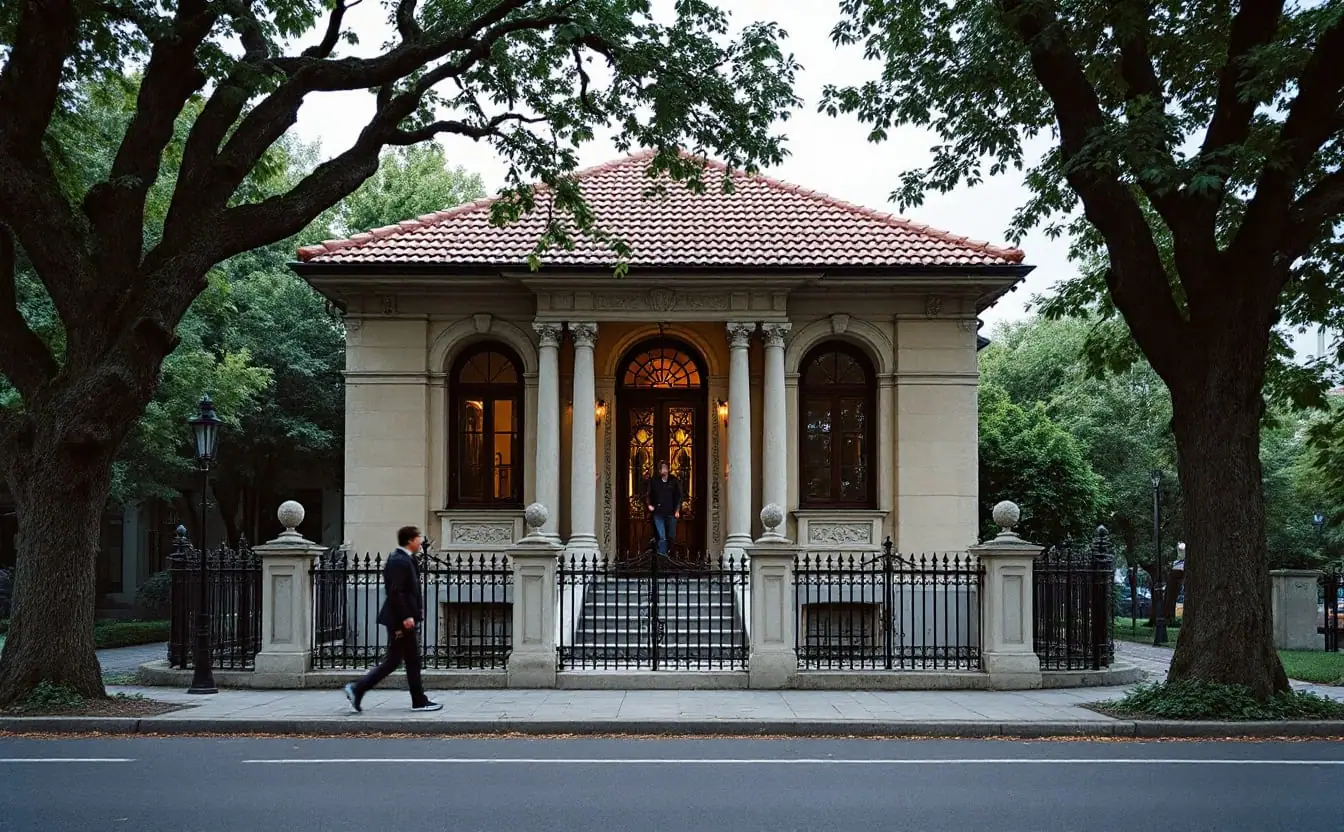
Cross Bulevardul Magheru, lined with interwar apartment blocks and old cinemas, and head into the streets around Grădina Icoanei. This is the Bucharest of the first half of the twentieth century, when the city built for itself rather than for a leader.
There are neo-Romanian villas, a style that Ion Mincu and his followers drew from monasteries and old boyar houses: carved stone arches, deep loggias, glazed ceramic details, wide overhanging roofs. Between them stand the white volumes of interwar modernism, with rounded corners, porthole windows and flat roofs. Marcel Janco, better known as a co-founder of Dada in Zurich, designed several modernist houses in Bucharest after returning to Romania. It is a very different interwar answer to the question of housing from Vienna's council courtyards, private where they were collective, and just as revealing.
Many of these houses are private homes; some are embassies or offices, and some are in poor condition, which tells its own story of nationalisation, restitution and land prices. Photograph from the pavement, keep out of gardens, and do not point a long lens at an embassy gate.
Finish in Grădina Icoanei itself, a small, old park where the neighbourhood comes to sit once the day cools. Take a bench near the railings and watch the last sun climb the upper storey of a villa across the road, its carved stone turning from grey to honey before the light goes.