Atlas walk · Berlin
Berlin street art walk: East Side Gallery to the Kreuzberg murals
Nine stops from the railway sheds of Friedrichshain, across the Spree to the oldest big murals in Kreuzberg. Untick what you want to skip and the planner recalculates the walk.

We earn a commission on some bookings and books. As an Amazon Associate I earn from qualifying purchases.
Start at Warschauer Strasse station (S-Bahn and U1) and walk east along Revaler Strasse.
A former railway repair yard on Revaler Strasse whose brick sheds and courtyards carry layer upon layer of graffiti, murals and paste-ups.
17 min walk · 1.2 km (0.8 mi)
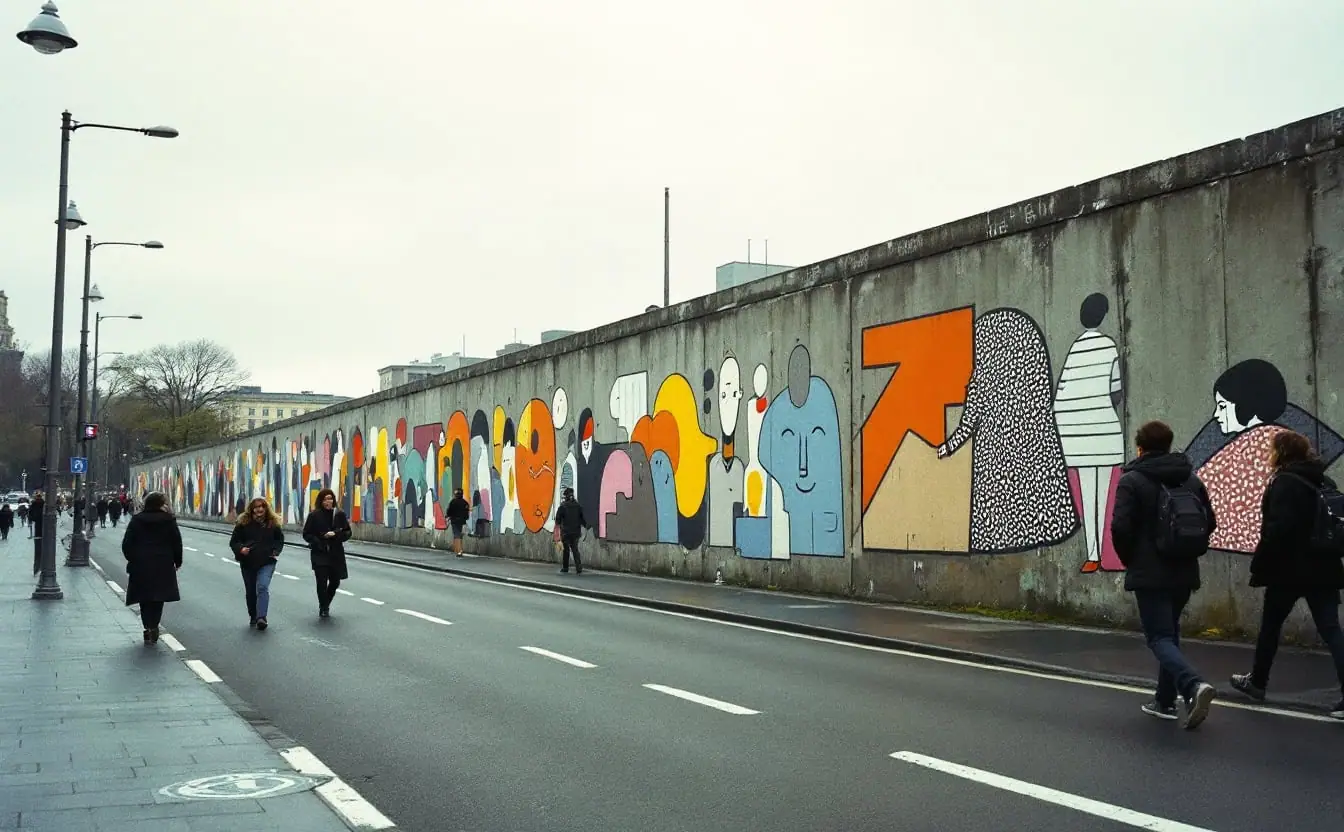
The longest surviving stretch of the Berlin Wall, painted by artists from many countries in 1990 and largely restored in 2009.
9 min walk · 0.7 km (0.4 mi)
Red brick double-deck bridge over the Spree, once a crossing between the two halves of the city, with a view upstream to Molecule Man.
7 min walk · 0.5 km (0.3 mi)
A giant figure painted in 2005 on Oppelner Strasse 3 by the Brazilian twins, faded and partly overpainted but still on its wall.
17 min walk · 1.3 km (0.8 mi)
ROA's black and white still life of hanging animals from 2011, high on a wall at Oranienstrasse and Manteuffelstrasse.
9 min walk · 0.6 km (0.4 mi)
A former hospital from the 1840s, now home to the district's exhibition hall, where the Backjumps shows sent painters onto these streets.
8 min walk · 0.6 km (0.4 mi)
A faceless astronaut 22 metres high, painted freehand in 2007 on a firewall of Oranienstrasse 195 and best seen from Skalitzer Strasse.
6 min walk · 0.4 km (0.3 mi)
The district museum in a 1920s factory building on Adalbertstrasse, with displays on demolition, protest and migration around Kottbusser Tor.
9 min walk · 0.7 km (0.4 mi)
The main street of old SO 36, where stickers, stencils and paste-ups crowd shutters and door frames and change week by week.
Your walk
- Stops
- 9
- Walking
- 6.1 km (3.8 mi), 1 h 21 min
- Looking
- 3 h 25 min
- Altogether
- 4 h 46 min
- Finish around
- 14:46
Distances are straight lines between stops times 1.3, a usual allowance for streets that don’t run where you want them to. Add time for coffee, crossings and the wall you didn’t plan on.
The route planner above opens with all nine stops ticked, in walking order from Warschauer Strasse to Oranienplatz. Untick anything you want to leave out and the planner redraws the line and recalculates the distance and a rough walking time. At an easy pace it is a half-day walk; with the museum and a long lunch it fills a day. Street art changes constantly, so the route is built on places that have held their paint for years, not on single pieces that may be gone by spring.
The route
The walk starts in Friedrichshain, north of the Spree, at the old railway yard on Revaler Strasse, then drops down Warschauer Strasse to the river, where the East Side Gallery runs along Mühlenstrasse. From the gallery you cross the Oberbaumbrücke into Kreuzberg and follow the U1 viaduct west along Skalitzer Strasse. Most of the big murals on this side were painted in the 2000s for Backjumps, a series of urban art exhibitions at the Kunstraum in Bethanien that sent painters out onto the surrounding walls, which is why the route swings north to Mariannenplatz before finishing on Oranienstrasse. One famous pair is missing: the two Blu murals on the firewalls at Cuvrystrasse were painted black in 2014, so there is no reason to detour there. The U1 on its viaduct ties it all together: if your legs give out, Schlesisches Tor, Görlitzer Bahnhof and Kottbusser Tor are never far away.
The stops
RAW-Gelände
The name is short for Reichsbahnausbesserungswerk, a railway repair works, and the brick sheds along Revaler Strasse still look the part. Clubs, bars, a skate hall and studios moved in after the trains left, and almost every surface has since been painted, tagged and pasted over many times. Circulate slowly: the best walls are the backs of the sheds and the yards between them, where large pieces sit beside dense layers of names. The site's future has been argued over for years, so expect fences and building work in places. If old industrial sites turned to culture interest you, the Ruhr does this on a far bigger scale, as our Ruhr itinerary shows.
East Side Gallery
This is the longest surviving stretch of the Berlin Wall, and in 1990 artists from many countries painted its eastern face, which could not be touched while the border stood. Most of it was restored in 2009, many sections by their original painters. The two paintings that draw the crowds are Dmitri Vrubel's fraternal kiss between Brezhnev and Honecker and Birgit Kinder's Trabant breaking through the concrete. Coming down from RAW you reach the eastern end first. Walk west along the street side as far as you like, then come back along the riverside path behind the wall, which collects newer and rougher work.
Oberbaumbrücke
The red brick bridge with its two towers dates from the 1890s and carries the U1 on its upper deck, with road and pavements below. While the city was divided it was a crossing for pedestrians only, and its middle section was rebuilt in steel in the 1990s. Stop halfway across and look upstream. In the river stands Molecule Man, Jonathan Borofsky's tall aluminium sculpture of figures leaning into one another, placed where Friedrichshain, Kreuzberg and Treptow meet.
Yellow Man by Os Gêmeos
At Schlesisches Tor, look at the house at Oppelner Strasse 3, right beside the station. The Brazilian twins Os Gêmeos painted their figure here in 2005 for the second Backjumps exhibition. Two decades of weather and other painters have changed it: the face has faded from green to yellow and the feet have disappeared under newer paint. That is the reason to stop. You are looking at one of the oldest large pieces in Kreuzberg, still holding its wall.
Nature Morte by ROA
Walk west under the viaduct along Skalitzer Strasse. Near Görlitzer Bahnhof, look right towards the corner of Oranienstrasse and Manteuffelstrasse for ROA's black and white animals: a hare, a stork and a roe deer hanging by ropes from the roofline, with a bull and a wild boar below them. The Belgian painter made it in 2011 and, as he usually does, chose species native to the place. It is grim and beautifully drawn, and the only colour is a little red at the boar's neck. It reads best from a distance, so keep to the far pavement.
Bethanien and Mariannenplatz
Walk up Manteuffelstrasse to Mariannenplatz. The long building facing the square opened in the 1840s as a deaconesses' hospital, and the young Theodor Fontane worked in its pharmacy. Today it holds studios, cultural organisations and Kunstraum Kreuzberg/Bethanien, the district's exhibition hall, where the Backjumps shows were staged. Its programme changes, so check before you go. Next door is the Georg-von-Rauch-Haus, occupied in 1971, still a self-managed home for young people and the subject of a well-known Ton Steine Scherben song. Look from the square and leave the residents in peace. The lawn is a good place to rest before the second half.
Cosmonaut by Victor Ash
Walk south down Mariannenstrasse to Skalitzer Strasse, then turn round and look up. The faceless astronaut on the firewall of Oranienstrasse 195 was painted in 2007 by Victor Ash for the third Backjumps exhibition, and it measures 22 by 14 metres. It looks like a giant stencil but was painted freehand. The full title, Astronaut/Cosmonaut, joins the American and Soviet words for the same job, a quiet joke so close to where the Wall ran. Other painters have added to the lower part of the wall over the years. You also get a fine view from a U1 train between Kottbusser Tor and Görlitzer Bahnhof.
FHXB Friedrichshain-Kreuzberg Museum
Walk west along Oranienstrasse to Adalbertstrasse, where the district museum fills a brick factory building from the 1920s at number 95a. Its local history displays have dealt with demolition and protest around Kottbusser Tor and with migration as part of the district's identity, which is exactly the background these walls need: why houses stood empty, who moved in, and how the neighbourhood argued about its future. It is small and local, and a good place to be indoors if the weather turns. Check opening times before you go.
Oranienstrasse
Finish by walking Oranienstrasse west towards Oranienplatz. This is the main street of SO 36, the old postal district: bakeries, bookshops, bars, small galleries and the SO36 club at number 190, a punk venue since 1978. The art here is small and constant rather than monumental. Look for stickers on drainpipes, stencils on shutters and paste-ups around door frames, and expect them to change from week to week. Oranienplatz, at the end, has trees and benches, and Moritzplatz station on the U8 is a short walk further on.
Practical notes
- Light: the painted side of the East Side Gallery faces the street and is out of direct sun for much of the day, which gives even light for photographs. The Cosmonaut faces south-west and is best in the afternoon.
- Opening times: Kunstraum Kreuzberg/Bethanien and the FHXB museum keep their own hours, and the Kunstraum closes between exhibitions, so check before you go.
- Residents: every wall on this walk belongs to somebody's home, club or workplace. Do not climb fences at RAW, block doorways or photograph people on their own steps.
- Painting: none of the walls on this route is a free wall, and painting without permission is an offence. If the walk makes you want to paint, our guide to how a large mural gets made covers the legal and practical route.
- Safety: watch for cyclists on the Oberbaumbrücke and on Skalitzer Strasse, and keep bags closed in the crowd at the East Side Gallery.
Further reading
For the city around the walls, Lonely Planet's Berlin guide covers transport and the districts you cross. Claudia Walde's Graffiti Alphabets helps you read the dense lettering at RAW, and Marc Taro Holmes' The Urban Sketcher is a good companion if you would rather draw the Cosmonaut than photograph it. These picks come from publisher details and published reviews rather than our own testing. More walks and essays on murals live under public art.
Questions
Can I visit the East Side Gallery for free?
Yes. It is an outdoor wall along a public street, and you can walk the painted side at any time without a ticket. Early morning is the quietest time to see the best-known panels.
How long does the Berlin street art walk take?
Allow two to four hours with stops, and longer if you go into the museum. The planner above shows the distance and a walking time for the stops you keep, so untick a few if you are short of time.
Are the Kreuzberg murals on this walk permanent?
None of them is protected in the way the East Side Gallery is. The Yellow Man, the Cosmonaut and ROA's animals have survived for well over a decade, but walls get repainted and buildings change hands, so treat every piece as on loan.
Can I walk the route the other way round?
Yes. Start at Moritzplatz or Kottbusser Tor and finish at Warschauer Strasse, which has S-Bahn and U-Bahn connections for the journey on. The only thing you give up is the early-morning quiet at the East Side Gallery.