Atlas walk · Budapest
Budapest street art map: a walk through the Jewish Quarter walls
Twelve stops through Erzsébetváros, from the Dohány Street Synagogue to a wall designed by homeless artists, with the painted firewalls of the old Jewish Quarter in between.

We earn a commission on some bookings.
Start at Astoria metro station (M2) and walk a few steps along Dohány utca to the synagogue.
Europe's largest synagogue, finished in 1859; from Wesselényi utca you can see Imre Varga's metal weeping willow for Holocaust victims.
2 min walk · 0.2 km (0.1 mi)
Okuda's faceted, many-coloured portrait of the Spanish diplomat who protected thousands of Budapest Jews in 1944, unveiled in 2016.
2 min walk · 0.1 km (0.1 mi)
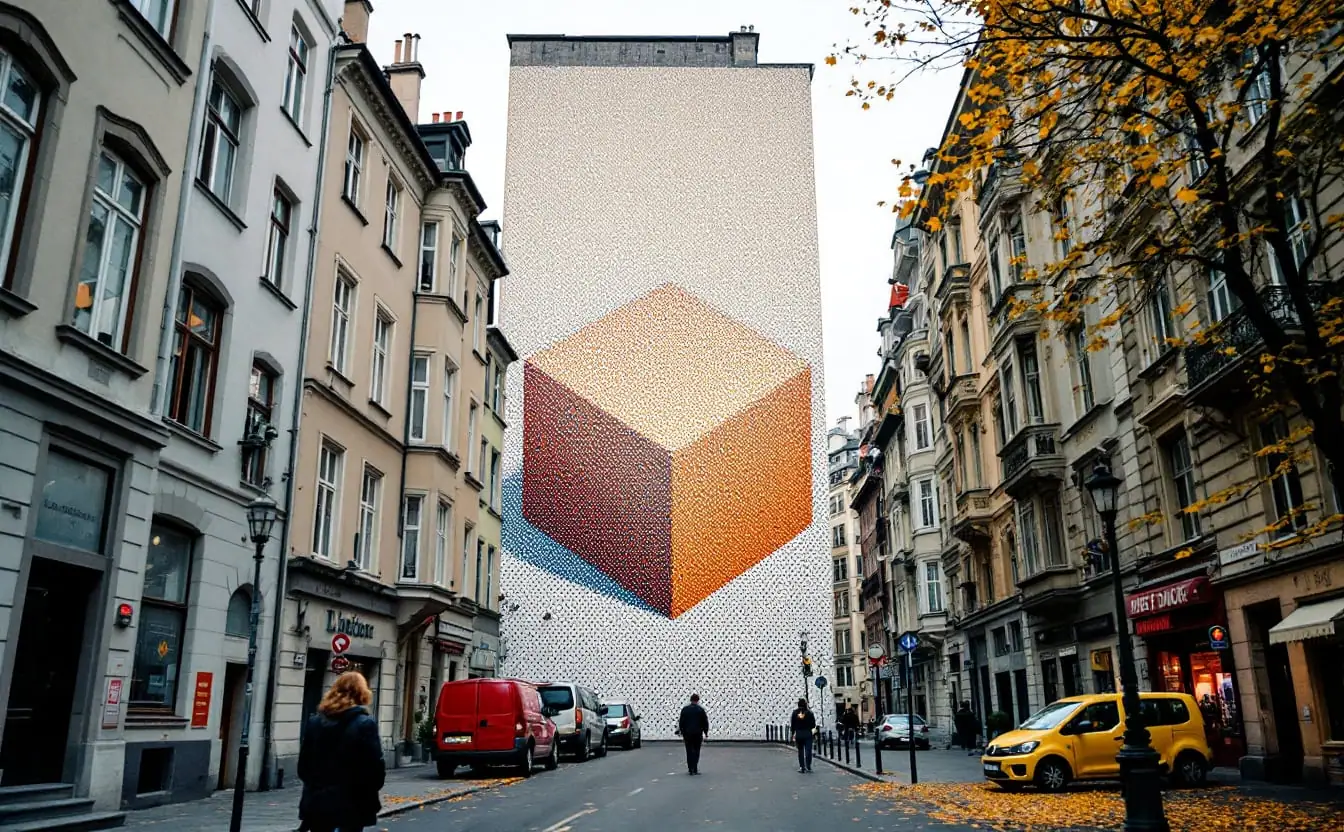
Neopaint Works' giant cube made of painted dots, from 2014, the puzzle's fortieth year; step back and it snaps into focus.
1 min walk · 0.1 km (0.0 mi)
A car park firewall painted in 2013 with Hungary's 6:3 win at Wembley in 1953, frozen a moment before the fifth goal.
2 min walk · 0.1 km (0.1 mi)
Tamás Szabó's 1991 bronze for the Swiss vice-consul who sheltered Budapest Jews: a figure on the wall reaching down to one who has fallen.
4 min walk · 0.3 km (0.2 mi)
The ruin bar that set the pattern, in former flats and a stove factory since 2004, with painted walls and a Sunday farmers' market.
6 min walk · 0.4 km (0.3 mi)
Past the 1913 Art Nouveau synagogue to a purple Hungarian Grey dining with knife and fork, and a hand-painted map of the bars.
4 min walk · 0.3 km (0.2 mi)
The quarter's one real square, with its 1897 market hall; along Klauzál utca, a crystal tree of triangles and a refugee mural.
4 min walk · 0.3 km (0.2 mi)
FINER's playful 2025 'urban wilderness' linking Budapest and Warsaw, and a few doors north, Neopaint's 2014 seamstress honouring the district's tailors.
1 min walk · 0.1 km (0.1 mi)
Portraits of Katalin Karikó and Ferenc Krausz, the 2023 Nobel laureates in medicine and physics, painted on a corner firewall in 2024.
2 min walk · 0.1 km (0.1 mi)
Walls round a car park: Dan Ferrer's 2017 Alice in Wonderland mural and Richárd Orosz's answers to what being Hungarian means.
4 min walk · 0.3 km (0.2 mi)
A 2015 firewall chosen through a competition for homeless artists, run by the Menhely Foundation and Színes Város, about breaking down prejudice.
Your walk
- Stops
- 12
- Walking
- 2.4 km (1.5 mi), 32 min
- Looking
- 2 h 55 min
- Altogether
- 3 h 27 min
- Finish around
- 13:27
Distances are straight lines between stops times 1.3, a usual allowance for streets that don’t run where you want them to. Add time for coffee, crossings and the wall you didn’t plan on.
Untick any stop you want to skip and the planner redraws the route and its timing. The stops run in walking order from the Dohány Street Synagogue, by Astoria metro, to Kürt utca near the Grand Boulevard. Painted walls here change: buildings get insulated, walls are leased for advertising, a new commission goes over an old one. Every wall below was checked against dated photographs and map records before publication, but look out for newer work on the way.
The route
Erzsébetváros, District VII, is the old Jewish quarter of Pest, between the Small Boulevard and the Grand Boulevard. In the winter of 1944 to 1945 it held the Budapest ghetto. Its streets are full of firewalls, the blank side walls left where a neighbouring building was never built or was pulled down, and since 2010 teams such as Neopaint Works and the Színes Város (Colourful City) group have painted dozens of them. For what goes into a wall that size, from the owner's consent to the lift, read how a large mural gets made.
The route mixes murals with memorials to the war and to those who saved lives in it, running up Kazinczy utca to Klauzál tér and then east to Akácfa, Kertész and Kürt utca.
The stops
Dohány Street Synagogue and the Tree of Life
Built from 1854 to 1859 to designs by Ludwig Förster, the Dohány Street Synagogue is the largest in Europe, striped brick with two onion-domed towers in the Moorish Revival style. Walk round to Wesselényi utca at the back. Through the railings of the Raoul Wallenberg Memorial Park you can see Imre Varga's weeping willow, a metal tree whose leaves carry the names of Holocaust victims. The garden, the interior and the Jewish Museum are part of a paid visit; check before you go.
Ángel Sanz Briz mural by Okuda San Miguel
At Dob utca 4 the Spanish artist Okuda San Miguel painted the diplomat Ángel Sanz Briz in his usual manner, a face built from coloured triangles and stripes on a geometric field. It was unveiled in October 2016 in a Spanish embassy programme honouring diplomats who saved Jews during the Holocaust. In 1944 Sanz Briz, in charge of the Spanish legation, issued protective papers to thousands of people. The street is narrow, so stand on the opposite pavement.
Rubik's Cube mural
A minute north on Rumbach Sebestyén utca, Neopaint Works painted a Rubik's Cube in 2014, forty years after Ernő Rubik invented the puzzle in this city, and Rubik himself supported the project. Up close the wall is a field of coloured dots; from further back they resolve into the cube. Stand on the far side of the street to take in the whole firewall and watch the dots turn into a solid object.
6:3, the Match of the Century mural
Across the street, the firewall over a car park carries Hungary's most famous football result, the 6:3 win over England at Wembley in November 1953. Neopaint Works painted it in 2013 for the sixtieth anniversary, across roughly a thousand square metres. The scene is the moment before the fifth goal, when Sándor Kocsis's header struck the post and József Bozsik scored from the rebound, with goalkeeper Gyula Grosics on the left and the old match ticket below.
Carl Lutz Memorial
Back on Dob utca is the memorial to Carl Lutz, the Swiss vice-consul who in 1944 issued protective letters and set up protected houses that saved tens of thousands of Budapest Jews. Tamás Szabó's bronze, unveiled in 1991, has two figures: a body lying on the ground and, high on the wall above, a figure reaching down towards it. The inscription quotes the teaching that whoever saves one life saves the whole world.
Szimpla Kert
Continue along Dob utca to Kazinczy utca. Szimpla Kert opened in 2002 and moved to Kazinczy utca 14 in 2004, into former flats and a stove factory that its founders saved from demolition. It is usually named as the first of the ruin bars: courtyards of mismatched furniture, with paint and scrawl on almost every surface. On Sundays it hosts a farmers' market, which is when I would go, because the building then feels like a neighbourhood room. Check opening times before you go.
Kazinczy utca walls and synagogue
Walk up Kazinczy utca towards Király utca, past the Kazinczy Street Synagogue, built for the Orthodox community in 1913 by Sándor and Béla Löffler, an Art Nouveau front squeezed into a narrow street. On the pedestrian stretch near Király utca, two Színes Város walls from 2015 take over. Ádám Kirsch and TransOne painted a giant purple Hungarian Grey, the long-horned cattle of the Great Plain, eating from a plate with knife and fork. Above the playground, a hand-painted map by Petyka shows the bars around you.
Klauzál tér and Klauzál utca walls
A short walk east, past a 2025 mural for the novelist Mór Jókai's two hundredth birthday on Kis Diófa utca, is Klauzál tér, the quarter's one real square, with a playground, benches and a market hall of 1897 on its edge. Leave by Klauzál utca. At its corner with Wesselényi utca is the Crystal Tree, a tree of tiny triangles painted in 2014 for the Polish Institute's seventy-fifth anniversary, and at number 32 a 2022 wall made for the UN refugee agency.
Akácfa utca walls
At Akácfa utca 27 to 29 the Polish artist FINER painted a wall in 2025 that shows the "urban wilderness" in simple, playful forms, with a nod to both Budapest and Warsaw. A few doors north, at number 41, is Neopaint Works' seamstress of 2014, painted in honour of the master tailors of Budapest on a house where a tailor's shop had worked in the basement since 1926. Of all the walls here, it is the one most about its own street.
Hungarian Nobel laureates mural
The firewall of Wesselényi utca 40, facing Kertész utca, carries portraits of Katalin Karikó and Ferenc Krausz, who both won Nobel prizes in 2023: she in medicine, for work that made mRNA vaccines possible, he in physics, for pulses of light measured in attoseconds. The portraits went up in 2024. They are the newest large faces on the route, and a reminder that the walls of this quarter keep taking on new subjects.
Kertész utca car park walls
A few steps north, the walls around a car park at Kertész utca 23 make a small open-air gallery. The Spanish artist Dan Ferrer painted his Alice in Wonderland mural here in 2017, about 170 square metres of it, built on the idea of the potential in every child. Beside it, Richárd Orosz's wall asks what being Hungarian means and answers with national symbols, a Hungarian Grey among them. Stay on the pavement: it is a working car park.
Wall of Acceptance
End on Kürt utca, a short walk north. In 2015 the Menhely Foundation, which works with homeless people, and Színes Város ran a competition for homeless artists on the theme of acceptance. The joint winners were Attila Székely's graphic calling for the wall of prejudice to come down and János Baranyecz's poem, and homeless artists painted the wall with street artists. Most commissions start with a sponsor and a theme. This one started with the people a city least often asks, which is what real participation looks like.
Practical notes
- Go in the morning or early afternoon; some walls are in shade by late afternoon.
- Kazinczy utca is loud at night, especially at weekends, and people live above every bar.
- The synagogues are working places of worship. Dress modestly and check visiting days before you go.
- None of these walls is a free wall. Photograph and sketch, but add nothing.
- Keep out of private courtyards and ask before photographing people. The benches on Klauzál tér are the best place to sit and draw.
- To build a route like this in another city, see how to plan a self-guided street art walk.
Further reading
Rick Steves Central Europe covers Budapest alongside Prague, Ljubljana and their neighbours. Rafael Schacter's World Atlas of Street Art and Graffiti puts walls like these into a wider picture, and Gabriel Campanario's The Art of Urban Sketching is good company if you would rather draw the Rubik's Cube than photograph it. These picks come from publisher details and published reviews rather than our own testing.
Questions
Where is the street art in Budapest's Jewish Quarter?
Mostly in District VII between Károly körút and Erzsébet körút, on the firewalls of streets such as Dob, Rumbach Sebestyén, Kazinczy and Akácfa utca. The densest cluster is around the Rubik's Cube and the 6:3 mural.
Are the murals free to see?
Yes. They are on outside walls and can be seen from the street at any hour. Only the synagogue interiors and the museum need a ticket.
Do Budapest's murals disappear?
Some do. Walls are insulated, leased for advertising or repainted with new commissions, so a wall on this route may have changed by the time you arrive. Untick it in the planner and look for whatever replaced it.
When is the best time for this walk?
A weekday morning, when the light reaches the narrow streets and the night crowds have gone home. On a Sunday you can add the farmers' market at Szimpla Kert.