Atlas walk · Prague
Prague street art and sculpture walk: Lennon Wall to Lucerna
Eleven stops across the river, from a memorial at the foot of Petřín to a saint on a dead horse, taking in the Lennon Wall, Charles Bridge and five works by David Černý.
We earn a commission on some bookings.
Start at the Újezd tram stop at the foot of Petřín, in Malá Strana.
Olbram Zoubek's bronze figures on steps at the foot of Petřín, unveiled in 2002, growing more broken the higher they stand.
8 min walk · 0.6 km (0.4 mi)
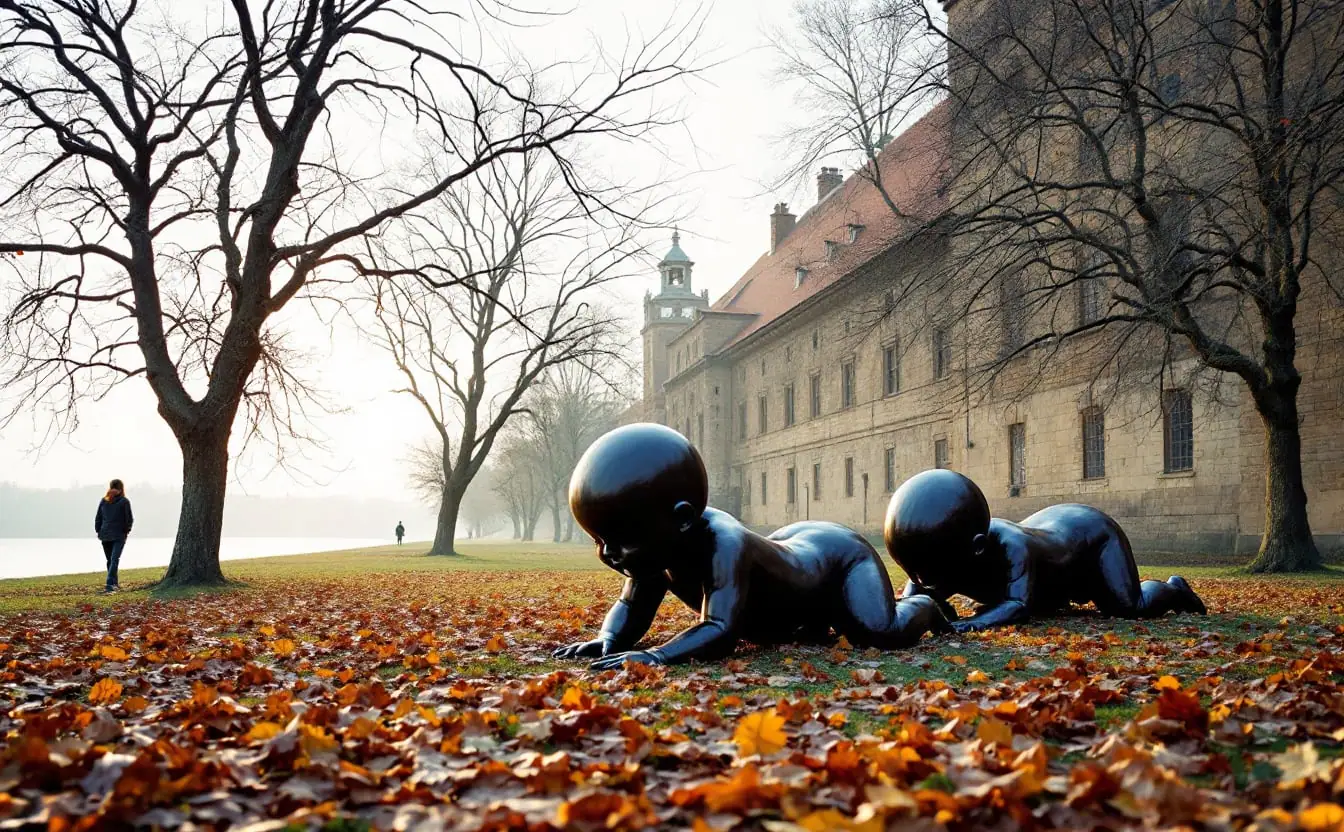
Three giant bronze crawling infants with flat, slotted faces, on the grass beside Museum Kampa since 2008.
5 min walk · 0.3 km (0.2 mi)
The painted wall on Velkopřevorské náměstí, a free-speech board since the 1980s, repainted by artists in 2019 with rules for visitors.
5 min walk · 0.4 km (0.3 mi)
Two bronze men turning at the hips over a pool shaped like the Czech Republic, outside the Franz Kafka Museum since 2004.
3 min walk · 0.3 km (0.2 mi)
The medieval stone bridge lined with baroque saints, most of them now copies; the bronze St John of Nepomuk of 1683 is the oldest.
5 min walk · 0.4 km (0.2 mi)
A small form clinging to a drainpipe on the Theatre on the Balustrade, made in 1996, fixed there in 2008, glowing after dark.
7 min walk · 0.6 km (0.3 mi)
John Hejduk's two tall houses for Jan Palach and his mother, unveiled in 2016 beside the faculty where Palach studied.
9 min walk · 0.6 km (0.4 mi)
Róna's 2003 bronze of a small Kafka riding on the shoulders of an empty suit, beside the Spanish Synagogue on Dušní.
5 min walk · 0.3 km (0.2 mi)
Ladislav Šaloun's great Art Nouveau group, unveiled in 1915, five hundred years after the reformer was burned at Constance.
12 min walk · 0.9 km (0.5 mi)
Forty-two stainless steel layers that turn on their own motors to break up and rebuild Kafka's face, outside Quadrio since 2014.
6 min walk · 0.5 km (0.3 mi)
Saint Wenceslas astride the belly of his dead horse, which hangs upside down by its legs; made in 1999, now under the Lucerna dome.
Your walk
- Stops
- 11
- Walking
- 4.9 km (3.0 mi), 1 h 05 min
- Looking
- 2 h 30 min
- Altogether
- 3 h 35 min
- Finish around
- 13:35
Distances are straight lines between stops times 1.3, a usual allowance for streets that don’t run where you want them to. Add time for coffee, crossings and the wall you didn’t plan on.
Untick any stop you want to skip and the planner redraws the route and its timing. The stops run in walking order from the foot of Petřín in Malá Strana, across Charles Bridge and through the Old Town and Josefov, to the Lucerna passage off Wenceslas Square. Central Prague has little street painting compared with Berlin or Lisbon. Its public art mostly lives in bronze and steel, plus one painted wall that everyone knows. That wall changes constantly and sculptures are sometimes removed for repair, so treat this as a plan, not a promise.
The route
The walk crosses the Vltava once. The Malá Strana half is short and level: a memorial, Kampa island, the Lennon Wall and a courtyard by the river. Charles Bridge carries you into the Old Town, where the route heads north to Jan Palach Square, east into Josefov and back through Old Town Square, then south to the New Town.
Five of the stops are by David Černý, the Prague sculptor whose work turns up all over the centre; the rest span six centuries. If you have walked our Budapest route, the contrast is instructive: there, painted firewalls; here, figures in the street.
The stops
Memorial to the Victims of Communism
Start at the Újezd tram stop. Olbram Zoubek's memorial, unveiled in 2002, sets bronze figures on a flight of steps cut into the slope of Petřín. The lowest figure is whole; the ones further up lose limbs and break open, as if worn away. A bronze strip down the centre records the numbers of people arrested, executed, killed at the border and driven into exile. The design works because of the hill: you look up at the figures, and they look down at the street.
Babies by David Černý
Walk north along Újezd and cut through to Kampa, the island between the Vltava and the Čertovka millstream. On the grass beside Museum Kampa, in the old Sova mills, three giant bronze babies have been crawling since 2008. Where their faces should be there are flat, slotted panels, closer to a barcode than a nose. Their relatives climb the Žižkov television tower across the city. Museum Kampa's collection of Central European modern art makes a good indoor break; check before you go.
Lennon Wall
Cross the Čertovka by the small bridge to Velkopřevorské náměstí. The wall belongs to the Order of Malta and faces the French Embassy. After John Lennon's murder in 1980 a portrait of him appeared here, and through the 1980s it became a board for messages the communist authorities kept painting over. Since an artists' repainting in 2019, spray paint is banned and visitors may write only in marked areas, in chalk, pencil or marker. My longer guide to the Lennon Wall has the full story.
Piss (Proudění) by David Černý
Walk north through Malá Strana to Cihelná, the lane along the river. In the courtyard of Hergetova cihelna, a former brickworks, outside the Franz Kafka Museum, two bronze men a little over two metres tall stand in a pool shaped like the Czech Republic and relieve themselves into it. Motors swivel their hips so that the streams trace letters on the water. Černý installed them in 2004. It is a joke at the expense of national symbols, and also a working fountain.
Charles Bridge and its statues
Building began in 1357 under Charles IV, and the bridge was finished early in the fifteenth century. Thirty statues and groups line its parapets, most added from the 1680s to the 1710s, and much of what you see now are copies, with originals moved indoors for protection. The bronze St John of Nepomuk, cast in 1683, is the oldest. I admire the bridge most for its width and its slight rise: it behaves like a long square stretched across a river, the kind of structure I wrote about in stairs, bridges and shortcuts. Cross early or late; at midday it is a slow queue.
Embryo by David Černý
A few minutes south of the bridge's Old Town end, on Anenské náměstí, look up at a drainpipe on the Theatre on the Balustrade (Divadlo Na zábradlí), where Václav Havel worked in the 1960s. Clinging to it is Embryo, a small, soft-looking form that Černý made in 1996 and fixed here in 2008 for the theatre's fiftieth anniversary. By day it is easy to walk past. After dark it glows from inside, and the curled shape of a foetus shows through.
House of the Son and House of the Mother
Walk north along the river to Jan Palach Square. On 16 January 1969 Palach, a student at the Faculty of Arts here, set himself on fire on Wenceslas Square in protest at the occupation of Czechoslovakia and the resignation that followed it; he died three days later. John Hejduk's memorial, unveiled on the anniversary in 2016, is a pair of narrow houses almost seven metres tall, a pale one for the son and a darker, rust-coloured one for his mother. Their axes meet at Palach's death mask on the corner of the faculty building.
Franz Kafka monument by Jaroslav Róna
Head east into Josefov to Dušní, where Jaroslav Róna's bronze stands between the Spanish Synagogue and the Church of the Holy Spirit. Unveiled in 2003, it shows a small Kafka sitting on the shoulders of an empty suit, an image taken from his early story Description of a Struggle, in which one character rides another like a horse. Kafka lived in a house on Dušní that no longer stands. The bronze is almost four metres tall, so step back for the best view.
Jan Hus Memorial
Walk south to Old Town Square. Ladislav Šaloun's memorial to the church reformer Jan Hus was unveiled in July 1915, five hundred years after Hus was burned at the stake at the Council of Constance. It is Art Nouveau at full stretch, a dark mass of figures, the faithful and the exiled, gathered beneath a tall, gaunt Hus. It gives a vast, irregular square a centre, and its base is where people sit to wait for each other.
Head of Franz Kafka by David Černý
Walk south through the Old Town to Národní třída and the open space beside the Quadrio building, above the metro station. Černý's head of Kafka, unveiled on 31 October 2014, is about eleven metres tall and made of forty-two stainless steel layers that turn independently, breaking the face apart and putting it back together. Its mechanism was overhauled and it returned to regular running in February 2024. It moves in short sessions rather than all day, so if it is still, wait a while.
Horse by David Černý
Finish a short walk east in the Lucerna passage, part of the palace that Václav Havel's grandfather built in the early twentieth century. Hanging from the dome, Saint Wenceslas sits astride the belly of his dead horse, which hangs upside down by its legs. Černý made it in 1999 as a reply to Josef Václav Myslbek's equestrian statue of the saint at the top of Wenceslas Square, a short walk away. See both, in that order, and decide for yourself which one says more about the country.
Practical notes
- Start early: Charles Bridge and the Lennon Wall fill up from late morning.
- Expect cobbles, kerbs and a few steps. Trams run near the start, the bridge and Národní třída.
- Museum Kampa and the Franz Kafka Museum have their own opening times: check before you go.
- At the Lennon Wall, no spray paint; write only in the marked areas.
- The Palach memorial and the memorial on Újezd are places of mourning as well as art. Keep your voice down and do not climb on them.
- The Lucerna passage is a working building with shops and a cinema; do not block it.
Further reading
Rick Steves Pocket Prague is a slim guide to the centre, Malá Strana included. For drawing on the move, Marc Taro Holmes's The Urban Sketcher teaches quick location sketching, useful on a bridge full of saints, and Rafael Schacter's World Atlas of Street Art and Graffiti puts the Lennon Wall among the painted walls of other cities. These picks come from publisher details and published reviews rather than our own testing.
Questions
Where can you see street art in Prague?
In the historic centre, the Lennon Wall in Malá Strana is the main painted wall. Most contemporary public art in the centre takes the form of sculpture, much of it by David Černý.
Can you still write on the Lennon Wall?
Yes, within the rules introduced in 2019. Spray paint is banned, and writing is allowed only in marked areas with chalk, pencil or marker. Read the notice at the wall on the day.
Which David Černý sculptures are in central Prague?
On this route: Babies on Kampa, Piss outside the Franz Kafka Museum, Embryo on the Theatre on the Balustrade, the Head of Franz Kafka at Národní třída and Horse in the Lucerna passage.
Is the public art on this walk free to see?
Yes. Every stop is on a street, a square, a bridge or a public passage. Only Museum Kampa and the Franz Kafka Museum charge for their indoor collections.