The Lennon Wall in Prague: its history and how to visit it well
How a wall in Prague's Malá Strana went from a tribute to John Lennon to a protest board and a painted gallery, and how to visit it without spoiling it.

We earn a commission on some bookings.
Most walls in Prague are there to hold something up or keep someone out. The one on Velkopřevorské náměstí, a small cobbled square in Malá Strana, has spent more than four decades doing something else: holding other people's words. It belongs to the Sovereign Military Order of Malta, whose Grand Priory gives the square its name, and it faces the French Embassy across the cobbles. Since the early 1980s it has carried a changing coat of portraits, lyrics, slogans, names and hearts, painted over and filled in again more times than anyone has counted.
Visitors call it the Lennon Wall. It is an odd sort of monument: no plinth, no inscription chosen by a committee, no fixed design. Its value lies in the layers, and in the long argument about who may add to them. What follows is the history I am confident of, what you find there today, and how to visit without making the square worse for the people who live and work around it.
A portrait after a murder
John Lennon was shot dead in New York in December 1980. Not long afterwards an unknown painter put a portrait of him and some of his lyrics on this wall. In Czechoslovakia at the time, Western pop music was tolerated in some forms and distrusted in others, and Lennon, with his songs about peace and about imagining a different world, was an easy figure to gather around.
The authorities did not see a harmless tribute. The wall was painted over, and the portrait and messages came back. It was painted over again, and they came back again. Through the 1980s it turned into a notice board for things that could not be said elsewhere: complaints, hopes, lines from songs, small jokes at the expense of the state. By the late 1980s young people were meeting there, and the wall had become a focus for a youth culture that the government watched closely.
In November 1989 the Velvet Revolution ended communist rule in Czechoslovakia. The wall lost its opponent overnight.
A wall without an opponent
What becomes of a protest wall when the thing it protested has gone? In Prague the answer was tourism. Through the 1990s and 2000s the Lennon Wall became one of the most photographed spots in the city, and the messages changed with the visitors: names, dates, hearts and greetings in dozens of languages, layered so thickly that the first portrait was long buried. The East Side Gallery in Berlin went through a similar shift, from political frontier to painted wall to a stop on every itinerary, and the comparison is worth making if you have seen both.
On 17 November 2014, twenty-five years after the student demonstration that started the Velvet Revolution, a group of art students painted the whole wall white, leaving only a short message announcing that the wall was over. It did not stay white. The surface filled up again, which tells you something about how much people want to write where everyone else has written.
The reset of 2019
By the late 2010s the wall had problems that had little to do with politics. The paint had built up into a thick, shapeless crust, the little square was crowded and messy, and some tour operators had begun organising spray painting sessions as part of a visit. In October 2019 the Order of Malta, working with the Prague 1 district, began a reconstruction. The wall was cleaned and repainted by a group of professional artists, and it reopened in November 2019, around the thirtieth anniversary of the Velvet Revolution, as an open-air gallery.
The rules changed with it. Spray paint was banned. Visitors could still write, but only in designated zones and in materials that do not last, such as pencil, chalk or marker, and cameras were installed to watch over the wall. Arrangements like these get adjusted, so read whatever notice is posted at the wall on the day and follow it.
Whether this was a rescue or a taming is still argued over. A wall that anyone could paint had become a wall that nobody could read; a wall with rules is easier to look at, but the free-for-all was part of its meaning. Both views have something to them, and the same quarrel runs through the debate over street art and graffiti in every city with painted walls.
What you see today
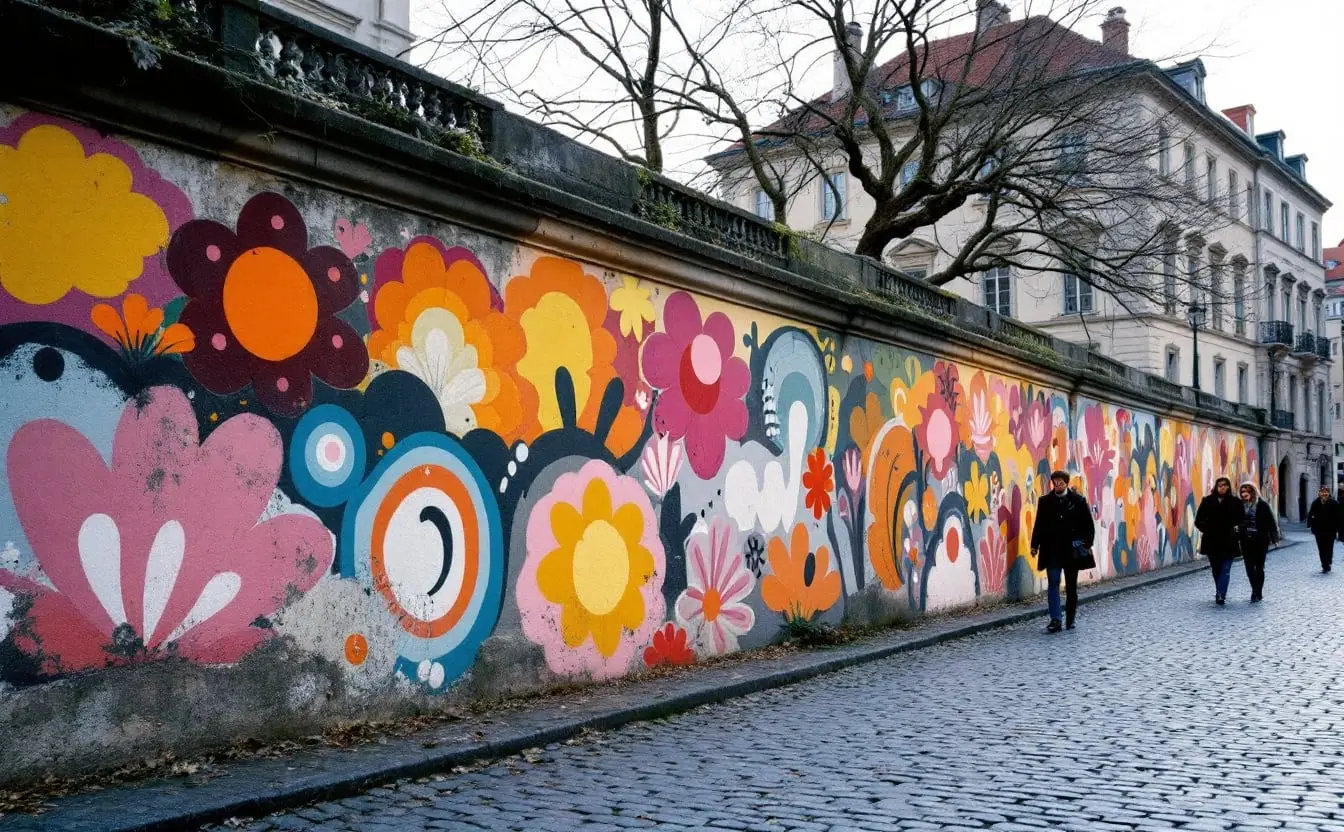
Expect a mix. Long painted sections, made by artists since the 2019 reset, sit beside areas where visitors have added names and short messages in pen and chalk. Lennon's face still appears, though not always in the same place or the same style, because the painted sections are renewed from time to time. On many days a busker sets up nearby with a guitar and a repertoire you can probably guess.
Look at the square as well as the wall. Velkopřevorské náměstí is one of the quieter corners of Malá Strana, with baroque palaces around it and the embassy opposite, and a few steps away a small footbridge crosses the Čertovka, the narrow millstream that cuts Kampa off from the rest of the district. The space is small. The wall was never planned as a sight, and a single large tour group fills it.
As someone who writes about streets and buildings, I find the wall interesting less for any one painting than for the way it works. It is a long, flat, reachable surface along a pedestrian space, with something already written on it. Those are the conditions under which people write on walls everywhere. The difference here is a story that gave them a reason, and a political moment that made the act of writing matter.
How to visit well
- Go early in the morning or in the evening. Late morning and early afternoon, especially in summer, are when the square is fullest.
- Keep groups small, and step aside so others can pass along the wall.
- Leave spray cans at home. Write only where writing is permitted, with pencil, chalk or marker, and never over a painted section.
- Keep clear of the embassy entrance and do not lean on its gates or railings. It is a working diplomatic building.
- Photograph the wall rather than strangers posing in front of it, and wait your turn for a clear frame.
- If you stop to listen to the busker, pay for the songs.
- Take your rubbish with you, including the cap of your pen.
The wall is a short walk from the Malá Strana end of Charles Bridge, and trams stop at Malostranské náměstí, a few minutes further on. It is a wall on a public square, so there is nothing to book. The cobbles are uneven, which matters if you use a wheelchair or push a pram, and they turn slippery in rain and frost. Fold the visit into a longer walk across Kampa and along the river rather than making a separate trip of it. If you want to build your own route through Malá Strana and the Old Town, the method in how to plan a self-guided street art walk works well here.
Questions people ask
Can I still write on the Lennon Wall?
Under the rules introduced in 2019, yes, in the designated areas and with materials that do not last. Spray paint is banned. Check the notice at the wall for the current arrangement before you start.
Is it the same wall as in old photographs?
It is the same wall with a different skin. The surface has been painted over and cleaned many times, and what you see now dates from after the 2019 reset.
When is it quietest?
Early on a weekday morning, and late in the evening. Winter is far quieter than summer.
Is it worth the detour?
If you are interested in how people use walls, yes. If you expect one famous painting, you may be disappointed: the point is the layers and the story behind them.
Further reading
For the visit itself, Rick Steves Pocket Prague is a slim guide to central Prague that covers Malá Strana as well as the Old Town, the sort of book that fits a short trip. If Prague is one stop on a longer rail journey, Rick Steves Central Europe puts it in one volume with Budapest, Ljubljana and other cities in the region. For the wider world of painted walls, Rafael Schacter's World Atlas of Street Art and Graffiti surveys artists and walls continent by continent, which helps you see the Lennon Wall as one case among many. These picks come from publisher details and published reviews rather than our own testing.
A last look
Before you leave, find the oldest-looking patch you can, where marker has bled into older paint, and read a few lines slowly. Most will be names and dates. One or two may be the kind of sentence people once walked here to write because they could not write it anywhere else.