Who looks after a public sculpture once the opening is over
Bronze, weathering steel, stone and concrete all age outdoors. Who should care for public sculpture, what the work involves, and a yearly care checklist.

The speeches last twenty minutes. Someone cuts a ribbon, the sculptor shakes hands with the mayor, and a photographer from the local paper asks everyone to step a little to the left. Then the crowd goes off for a drink and the sculpture begins the longest part of its life: decades outdoors, in rain, frost, pigeon droppings, road salt and the attention of teenagers with marker pens.
Nobody photographs the second day. Yet that is where public art succeeds or quietly fails. A bronze that gets washed and waxed every year can look better at eighty than at eight. A steel piece that collects water in a hollow can rust through in a fraction of that time. The difference is rarely the artist's talent. It is whether someone has the job of looking after the work, and a line in a budget that pays for it.
Late autumn is the right moment to think about this. The leaves are down, the first frosts are coming, and anything that holds water is about to start cracking.
The opening is the easy day
Ask who owns a sculpture on a square and you will usually get an answer. Ask who maintains it and the room goes quiet. In many cities the work belongs to the municipality on paper, but the knowledge sits in three places that rarely talk to each other: the culture department that commissioned it, the parks or roads department that sweeps and mows around it, and the artist, who knows exactly which alloy, which welds and which coating went into it.
When those three never meet, you get a familiar sequence. A tag appears. A well-meaning crew arrives with a pressure washer or a tin of grey paint. The tag goes, and so does the patina, the surface texture or the artist's careful finish. I have seen bronzes scrubbed back to raw, pinkish metal that took years to dull down again.
The fix is unglamorous: a named person or department, a condition record, and a small, steady sum of money every year rather than a large emergency sum every twenty. When I wrote about commissioning public art in a small town, the maintenance plan was the part people most wanted to skip. It is the part the sculpture depends on.
Bronze: wax, water and patience
Outdoor bronze is tough, but it is not inert. Rain, pollution and bird droppings react with the copper in the alloy. On exposed, rain-washed surfaces you get the streaky green that most people associate with old statues; in sheltered folds, under an arm or the hem of a coat, a black crust builds up. Green run-off then stains the stone plinth below. None of this is fatal, but left alone, the surface turns blotchy and the modelling the sculptor spent months on becomes hard to read.
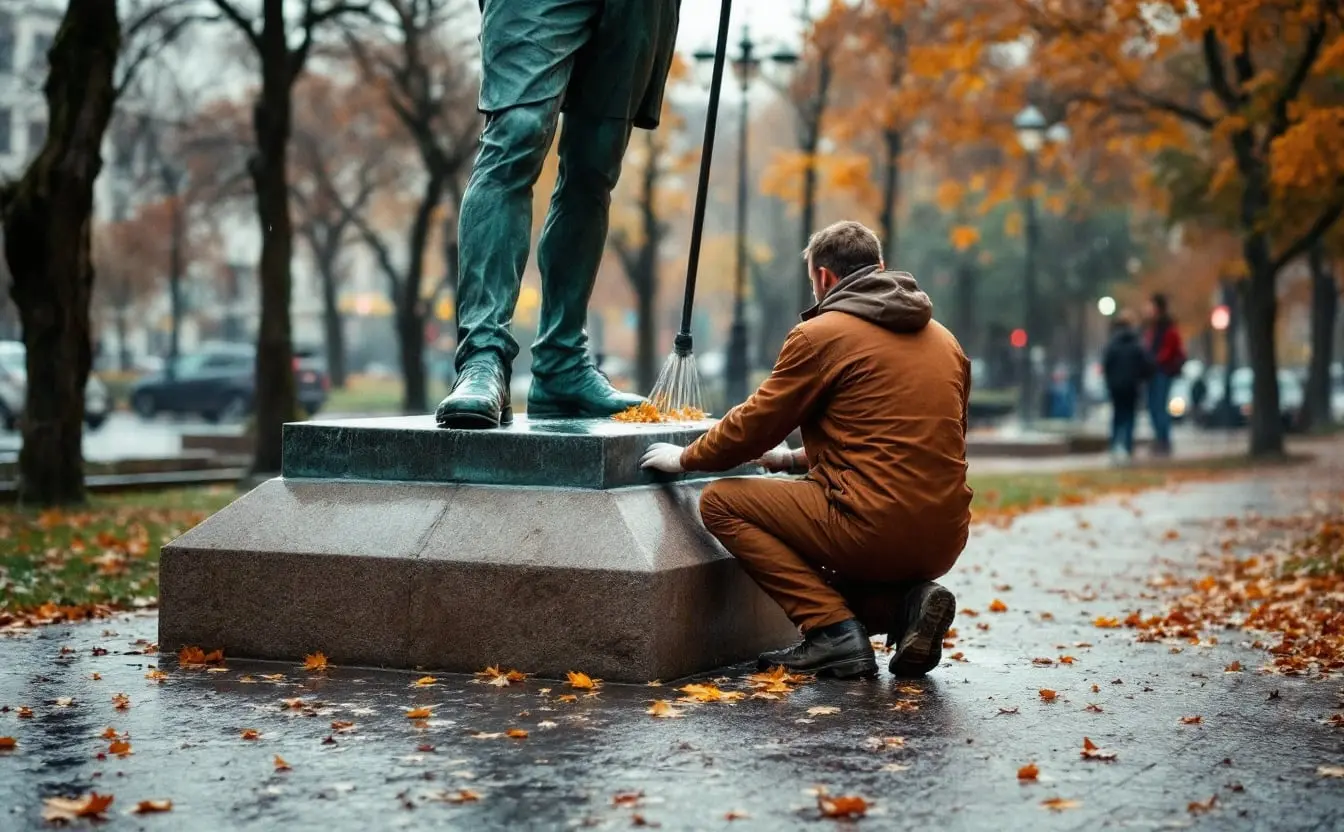
The routine most conservators follow is gentle and repetitive. Wash with water and a neutral, non-ionic detergent, using soft brushes. Rinse. Let the metal dry. Then protect it with a layer of microcrystalline wax, either brushed onto bronze warmed with a torch (the hot wax method) or applied cold and buffed. The wax keeps water off and makes the next wash easier. It also wears away, which is why a regular visit matters more than any single heroic restoration.
Two things deserve attention. One is so-called bronze disease, a corrosion driven by chlorides that shows up as powdery, pale green spots and keeps working inward. It needs a conservator, not a scrub. The other is touch. Ivan Meštrović's Gregory of Nin in Split has a big toe rubbed to a bright shine by visitors who touch it for luck. That is a charming tradition and a conservation problem at once, because polished bronze has lost its protective layer. If a piece is going to be touched, plan for it.
Weathering steel: the rust that is meant to be there
Weathering steel, often called Corten after its best-known brand, is designed to rust. A dense oxide layer, dark orange at first and later a deep brown, forms on the surface and slows further corrosion. Antony Gormley's Angel of the North in Gateshead is the famous large example, and plenty of smaller pieces in parks and on roundabouts use the same material because it looks good and promises low upkeep.
The promise holds only if the steel can dry out. Weathering steel needs cycles of wetting and drying. Where water sits in a hollow, against soil, under a mat of wet leaves or in constant spray, the protective layer never settles and corrosion simply carries on. Salty sea air and de-icing salt near roads are both bad news.
The other issue is the neighbours. Rust runs off, especially in the first years, and stains whatever lies underneath: pale paving, a limestone base, a white rendered wall. Good designs include a gravel bed or a drainage channel. Bad ones produce a brown halo that the paving contractor blames on the artist and the artist blames on the paving contractor.
Care for weathering steel is mostly about keeping things away from it. Clear leaves out of joints and hollows in autumn. Check that drain holes are open. Do not paint over rust spots, do not wax it like bronze, and do not let anyone pressure-wash the surface.
Stone and concrete: water is the enemy
Stone suffers quieter damage. Acid rain dissolves marble and limestone, leaving a sugary surface and softened features. Moss and lichen hold moisture against the stone. In a Central European winter, water gets into cracks, freezes, expands and widens them a little more each year. Older monuments often hide iron dowels and cramps inside the stone; when those rust they swell, and they can split a block from within.
Concrete, the material of so much Yugoslav memorial sculpture, has its own way of failing. Over time the outer layer carbonates, the steel reinforcement inside begins to corrode, and pieces of the surface spall off to expose rusty bars. Anyone who has read my notes on visiting the spomeniks will know what this looks like in the hills: magnificent forms with reinforcement showing through like bones.
For stone and concrete, the yearly job is more inspection than cleaning. Look for new cracks, loose fragments, blocked drainage and plants rooting in joints. Cleaning methods and biocides should be chosen by someone who knows that particular stone. Whatever happens, keep aggressive blasting away from it. Blasting removes the dirt together with the skin of the stone.
Graffiti: speed beats chemistry
A tag on a statue is an invitation to the next tag. The most effective response is fast removal, within days rather than months. A clean surface tends to stay clean for longer; a tagged one collects company.
How the paint comes off depends on the material. On stone, conservators use solvent gels and poultices that draw paint out of the pores without scrubbing, and laser cleaning has become a tool for some stone surfaces. On bronze, the difficulty is removing spray paint without taking the wax and patina with it. That is one more reason to keep a good wax layer: the paint sits on the wax instead of biting into the metal.
Many cities apply anti-graffiti coatings to vulnerable surfaces. Sacrificial coatings come off together with the paint and are then reapplied; permanent ones resist paint but can change how the surface looks. Neither belongs on an artwork without the agreement of a conservator and, where possible, the artist. In many European legal systems artists keep moral rights over the integrity of their work, and a glossy coating on a matt sculpture is exactly the kind of change those rights exist to prevent.
Who pays, and who answers the phone
Maintenance money is boring money. Nobody cuts a ribbon for it. That is why the best moment to settle it is at the commissioning stage: a written maintenance manual from the artist (materials, finishes, suppliers, how to clean the work, what never to do to it), a named department in charge, and a yearly allocation, however modest. Some commissioning bodies set aside part of the original budget for upkeep. Whatever the figure, it is better written into the contract than promised in a speech.
Beyond money, a sculpture needs a file. A condition report at handover. Photographs taken from the same fixed points every year, so that change becomes visible. A log of every intervention: who did it, with what product, on what date. When the next person inherits the job, the file is what stops them guessing.
It also needs a contact on the city side. Residents are often the first to notice damage. A clear route for reporting it, whether a council app, an email address on the city website or a phone line at the parks department, turns neighbours into an early warning system at no cost at all.
A yearly care checklist
This is the list I would pin to the wall of any municipal office responsible for public sculpture. It assumes an autumn visit, before the frost.
- Find the file: commissioning documents, the artist's maintenance notes, the previous condition report.
- Photograph the work from the agreed fixed points, in similar light if possible.
- Check for new cracks, loose parts, missing elements and signs of theft (bronze plaques and small parts get taken for scrap).
- Clear leaves, soil and debris from hollows, joints and drain holes, above all on weathering steel.
- Wash bronze with water and a neutral detergent, let it dry, and renew the wax.
- Look for pale green powdery spots on bronze and call a conservator if you find any.
- Check stone and concrete for frost damage, plant growth and rust stains seeping from inside.
- Inspect the plinth, the fixings and the surrounding paving for staining and drainage problems.
- Record any graffiti and how it was removed; check that anti-graffiti coatings are intact where they are used.
- Test the lighting, if the work is lit, and look over any information panel nearby.
- Update the log and send a short note to the artist or their estate if anything has changed.
- Confirm the coming year's budget line before the city's budget is closed.
None of this needs a large team. Two people with a ladder, soft brushes, a bucket and a notebook can cover most of it in a morning. The rest is calling the right specialist when the notebook says so. For more on how works reach public space in the first place, the public art strand gathers everything we have written on the subject.
Next time you pass a sculpture you like, look closely at the base before you look at the face. The first sign of trouble is almost always down there, in a brown stain on the paving or a thin green trickle across the stone.