The East Side Gallery in Berlin: its history and how to see it well
How the East Side Gallery became the longest painted stretch of the Berlin Wall, which paintings to look for, and how to walk it from Ostbahnhof to the river.

We earn a commission on some bookings and books. As an Amazon Associate I earn from qualifying purchases.
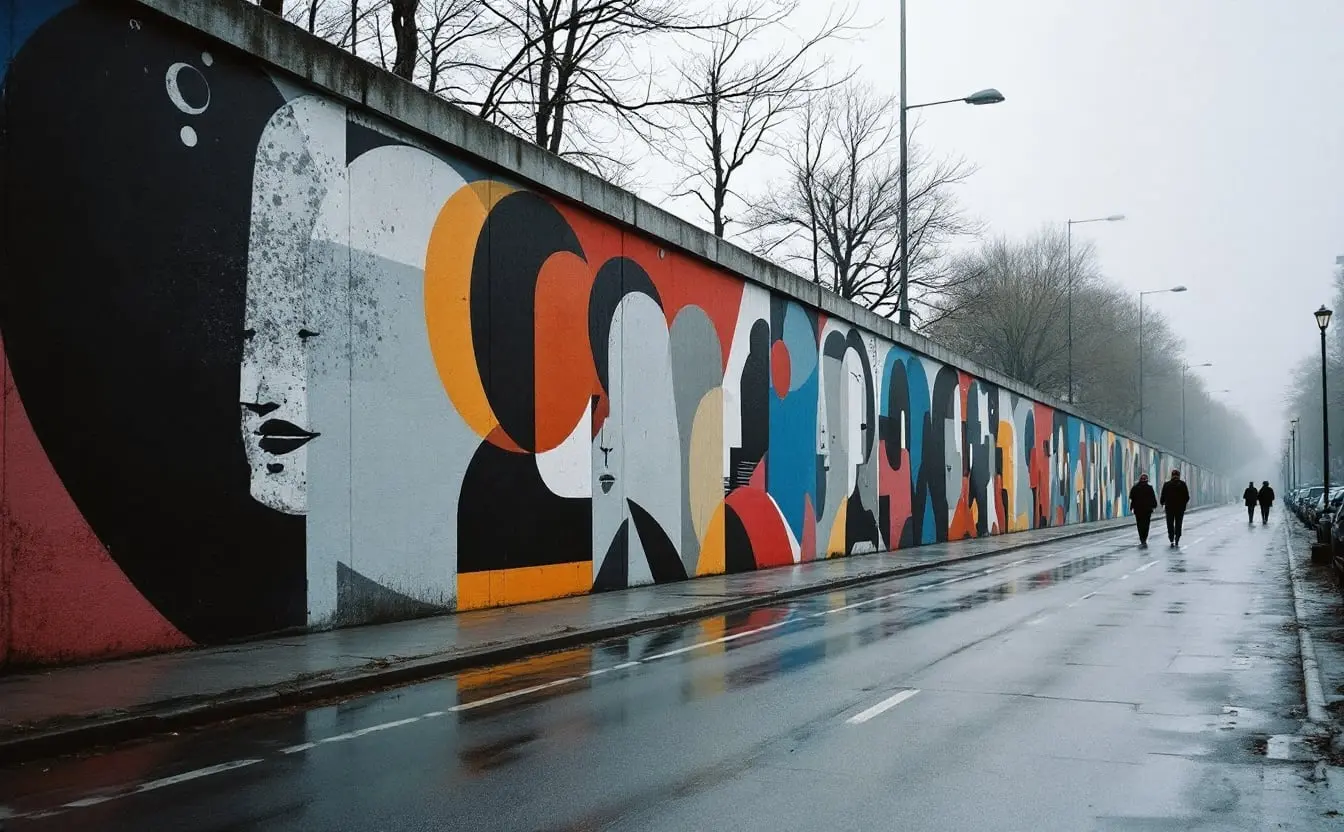
Most people meet the East Side Gallery the same way. They come out of Ostbahnhof, or down the steps at Warschauer Strasse, onto a wide road with traffic on one side and a long concrete wall on the other. Then the colour starts. For a little over a kilometre along Mühlenstrasse in Friedrichshain the wall carries more than a hundred paintings, each filling its own run of slabs. It is the longest surviving stretch of the Berlin Wall, and it has now been a gallery for far longer than it was ever a border.
I come up to Berlin from Essen often enough to have walked it in sleet and in August heat, and it changes more than the postcards suggest. Paint fades, names get scratched in, sections are restored, and the crowds bunch at the same three panels while long stretches stay almost empty. This guide covers what the wall was, how the paintings got there, which ones repay a slow look, and how to walk it so that you see the whole thing rather than the back of somebody's phone. If you have the rest of the day free, it hands you on to our Berlin street art walk, which covers the walls of Friedrichshain and Kreuzberg.
A border wall that faced the wrong way
Along this part of the city the border did not follow the wall at all. It ran down the River Spree. The concrete along Mühlenstrasse was the inner barrier, often called the hinterland wall, built to keep East Berliners away from the riverbank and the guarded strip behind it. West Berliners looking across the water from Kreuzberg saw only its back. The smooth face you walk past today looked onto an ordinary East Berlin street, and nobody was allowed near it with a brush.
That changed in 1990, in the strange months between the opening of the Wall in November 1989 and German reunification in October 1990. Artists from many countries came to paint the street side, each taking a section, and the result opened as an open-air gallery that same year. It was placed under heritage protection soon afterwards. The name is literal. The well-known graffiti of the 1980s had covered the western face of the Wall, the side West Berliners could reach, while this was painting on the eastern face, made only once the guards had gone.
The orientation still shapes a visit. The river is behind the wall rather than in front of it, so the paintings face the road and the traffic, and the calmer views are on the far side. Keep that in mind for the end of the walk.
Restored, defended, handed over
The first paintings were made quickly, with whatever paint was to hand, on concrete that had never been meant to hold it. By the late 2000s much of the wall was flaking, and visitors had covered whole panels with tags and scratched names. In 2009, ahead of the twentieth anniversary of the fall of the Wall, most of the gallery was restored: the concrete was repaired and many of the original artists came back to repaint their own works. Not everyone agreed to take part, and not everyone liked how it was done, which is one reason a few sections look rather different from photographs taken in the early 1990s. If you have ever wondered what it takes to keep paint on a big outdoor surface for decades, our guide to how a large mural gets made covers primers, paints and maintenance from the painter's end.
The next fight was over land. The strip between the wall and the river had become some of the most valuable ground in the district, and in 2013 sections were removed to open access for a residential building on the riverbank. Large protests gathered on Mühlenstrasse. Every heritage site in a growing city learns the same lesson sooner or later: protection on paper does not settle who gets to use the ground beside it.
Athens has the same argument in a different key, between walls, empty buildings and tourism, as our piece on Athens street art and empty buildings describes. Since 2018 the East Side Gallery has been in the care of the Berlin Wall Foundation, which also runs the Wall memorial on Bernauer Strasse.
The paintings people come for
The famous bays sit fairly close together, which is why the crowds do too. These five are the ones visitors ask about most, and they deserve the attention, but give the rest of the wall a share of it.
| Painting | Artist | What you see |
|---|---|---|
| My God, Help Me to Survive This Deadly Love | Dmitri Vrubel | Leonid Brezhnev and Erich Honecker in the socialist fraternal kiss |
| Test the Best | Birgit Kinder | A Trabant, the small East German car, breaking out through the Wall |
| It Happened in November | Kani Alavi | A packed crowd of faces pushing through a gap in the concrete |
| Homage to the Young Generation | Thierry Noir | Rows of flat, brightly coloured cartoon heads in profile |
| The Wall Jumper | Gabriel Heimler | A figure caught in mid-leap over the Wall |
The kiss
Vrubel's painting is the one on every postcard, and the reason a small crowd stands at the same spot from morning to night. He worked from a photograph of Brezhnev and Honecker greeting each other in 1979, at the celebrations for the thirtieth anniversary of the East German state. The fraternal kiss was a real piece of socialist protocol. Painted large on the Wall a decade later, it turned into a dark joke about power and loyalty, and about how the whole arrangement ended. Vrubel repainted it during the 2009 restoration, so for a clean photograph of his own second version, come early: around midday you will be waiting for a gap in the crowd.
The Trabant and the crowd
Kinder's Trabant seems to burst out of the concrete towards you, and it suits the place. The car was the everyday object of East German life, and in the nights after the border opened long lines of them crossed into the West. Alavi's painting works the other way round. Instead of one object he paints dozens of faces squeezed into a narrow opening, which conveys the press of those November nights better than any single figure could. Alavi was also long active in the artists' association that campaigned for the gallery.
Noir, Heimler and the quieter bays
Thierry Noir links the two sides of the story. He had been painting the western face of the Wall in West Berlin since the mid-1980s, and his flat, cheerful heads are a style many visitors recognise without knowing his name. Heimler's wall jumper is a simple image of a man in mid-leap, half escape and half dance. Between and beyond these, the less famous bays carry colour fields, doves, maps, faces, lines of verse in several languages, and some paintings that have weathered badly. Walk slowly, because the best moments on this wall are often at the panels nobody is queuing for.
How to walk it
The wall runs in a long, gentle line, so there is no way to get lost, only ways to see it badly. This is the order I use.
- Start at the Ostbahnhof end. The paintings begin close to the station and run south-east along Mühlenstrasse towards the Oberbaum Bridge, so you walk with the sequence rather than against it.
- Keep to the wall side of the pavement with the road behind you, and step back towards the kerb for wide shots only when the cycle lane is clear.
- Stop properly at each famous bay, then deliberately slow down between them. Pick two or three paintings you have never heard of and give each a full minute.
- Use one of the gaps to cross to the river side. The back of the wall faces the Spree, the light is softer, and the far bank is Kreuzberg, where West Berliners once looked at this concrete from the other side.
- Finish at the Oberbaum Bridge, the brick double-deck bridge with the U-Bahn running across its upper level, and cross it into Kreuzberg if you want to keep going.
Practical notes
- There is no ticket for the wall itself. It stands on a public street, and the paintings face the pavement.
- Early morning is the quietest time at the famous bays. Groups arrive as the day goes on, and summer evenings fill up again.
- Overcast days are kind to paint. Flat light shows the colours evenly and softens the shadows in the joints between slabs.
- Do not write, scratch or stick anything on the paintings, and do not climb the wall. Names scrawled across the art are one of the main reasons it keeps needing restoration.
- Mühlenstrasse is a busy road with a cycle lane. Look both ways before you step back for a photograph.
- The pavement is level for most of the length, which makes this one of the easier art walks in the city for pushchairs and wheelchairs.
Berlin is large and its sights are spread out: the wall in Friedrichshain, the museums in Mitte, Charlottenburg Palace far to the west. If you would rather not spend a short trip working out U-Bahn changes, a hop-on hop-off bus is a simple way to stitch the districts together and save your legs for the walking.
Further reading
Two books earn a place in the bag. The Lonely Planet guide to Berlin is the practical one, with neighbourhood maps, transport and the museums, food and evenings that fill the rest of a trip. That matters, because the wall takes a morning and Berlin takes a week. For the wider picture, Rafael Schacter's World Atlas of Street Art and Graffiti surveys walls and artists across several continents, which helps place what you see in Friedrichshain and Kreuzberg inside a much larger story. These picks come from publisher details and published reviews rather than any testing of our own.
The view from the bridge
Before you leave, stop halfway across the Oberbaum Bridge and look back along the river, with the trains rattling over your head. From here the wall is a thin pale line above the water, its colour turned away from you towards the street. That is roughly how it looked from the West for as long as the Wall stood: a blank edge, with a city on the other side. Take your last photograph from here, then walk down into Kreuzberg.