Small museums in big cities: house museums and studios for autumn
House museums, artists' studios and collectors' homes in Athens, Vienna and Bucharest, with a table for pairing each one with a walk on an autumn afternoon.

We earn a commission on some bookings and books. As an Amazon Associate I earn from qualifying purchases.
The big museums of a capital ask for a day, a plan and good shoes. The small ones ask for an hour. Once October cools the pavements in Athens and the summer crowds around the Acropolis begin to thin, I go looking for the second kind: a painter's studio with the view he painted still in the window, an Ottoman bathhouse with its warm rooms intact, a composer's flat two floors above a courtyard.
Small museums reward a particular kind of attention. You stand where the owner stood. You notice the worn step, the light switch, the height of the desk. What follows is a starting list for three cities that are unusually well stocked with such places, Athens, Vienna and Bucharest, and it is not a ranking. Small institutions close for repairs, change their opening days and rewrite their labels, so check each one before you set out.
What counts as small
I use the word loosely. Four kinds of place fit:
- House museums: the home of an artist, writer or composer, kept close to how it was or put back together from photographs and inventories.
- Studios: the rooms where the work was made, often with easels, tools and the light the artist chose.
- Collectors' houses: one person's taste, hung in rooms built for living rather than for display.
- Annexes: a single building that a larger museum looks after, usually with one theme.
What they share is scale. A room built for a family puts objects back at the height of a chair and the distance of a conversation. Nobody needs to explain how the painter lived when you are standing in his kitchen. And because these places are easy to miss, they are rarely crowded, which in autumn means you may have a room, and its window, to yourself.
Athens: painters, instruments and a bathhouse
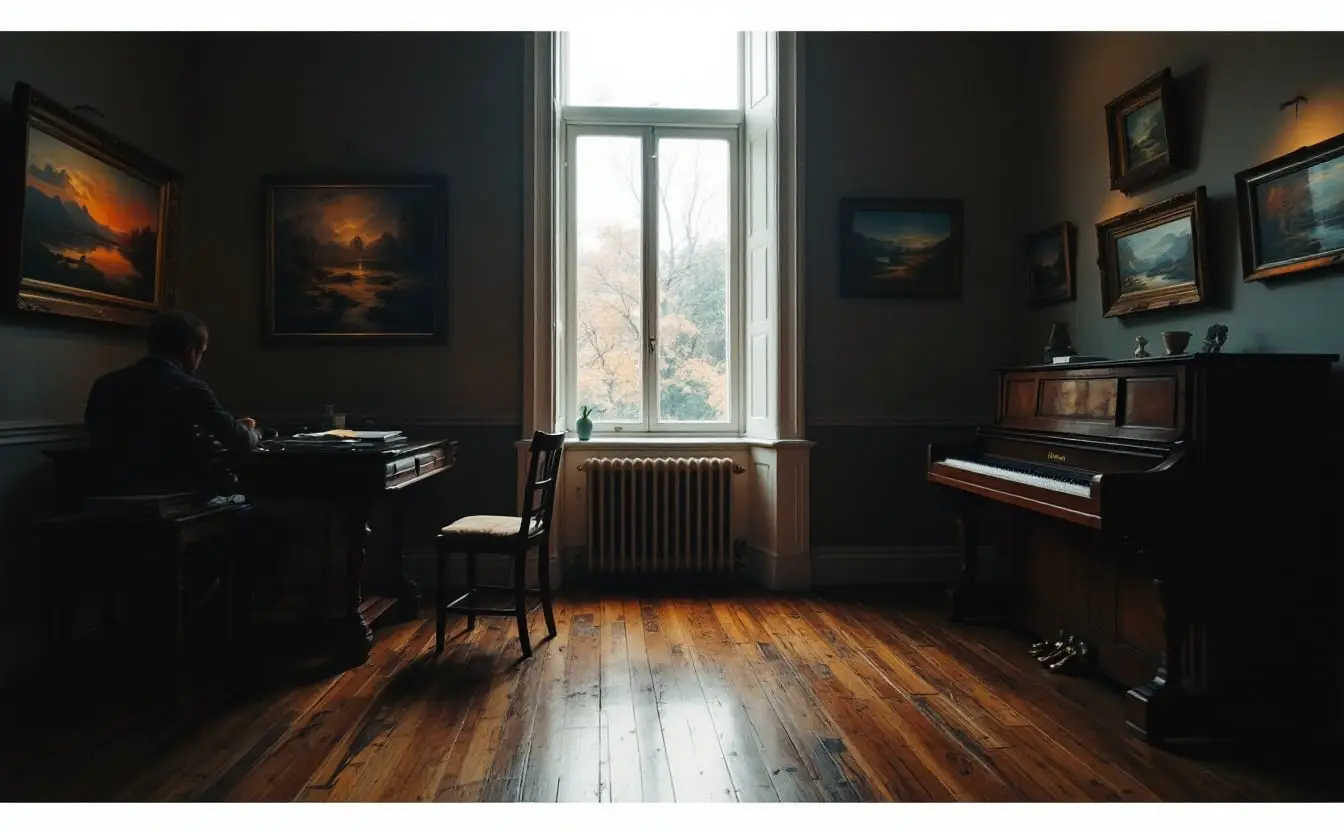
Start south of the Acropolis in Makrygianni, at the Atelier Spyros Vassiliou. Vassiliou painted Athens for much of the twentieth century and also designed sets for theatre and film, which may explain why his rooms feel so carefully composed. The studio faces the Acropolis, and the view is as much a part of the collection as anything on the walls.
In Kolonaki, the Benaki Museum looks after the home of Nikos Hadjikyriakos-Ghika on Kriezotou Street. Ghika belonged to the generation of the 1930s that tried to make Greek art modern without making it foreign, and the house shows his painting in the setting where he lived, worked and received friends.
In Plaka, two small places sit a few minutes apart near the Roman Agora. The Museum of Greek Popular Musical Instruments, built around the collection of the musicologist Fivos Anoyanakis, fills an old mansion with lyres, lutes, drums and bagpipes made from whole goatskins. Round the corner, the Bath House of the Winds, a branch of the Museum of Greek Folk Art, is an Ottoman-era public bath where you can walk from the changing hall into the warm rooms and picture the steam. The same museum keeps ceramics in the Tzisdarakis Mosque on Monastiraki Square, an eighteenth-century building that most people photograph from outside and never enter.
On the north slope of the Acropolis, the Kanellopoulos Museum shows a family collection in a nineteenth-century house: Cycladic figures, painted vases, jewellery, Byzantine icons. It is several thousand years of Greek material culture in rooms the size of an apartment.
If you have a spare afternoon, take the metro north to Marousi for the Spathario Museum of Shadow Theatre. It holds the flat, jointed figures of Karagiozis and his neighbours, made and played by the Spatharis family of shadow puppeteers. It is the only museum I know that is funny on purpose.
Vienna: rooms where music was written
Vienna does the composer's flat better than anywhere. The Mozarthaus on Domgasse, a short walk behind St Stephen's Cathedral, is the only one of Mozart's Vienna homes that survives, and he wrote Le nozze di Figaro there. Beethoven moved so often that the city can offer several of his addresses, among them the Pasqualatihaus on the Mölker Bastei, reached by a stone staircase on an old stretch of the city wall, and the house in Heiligenstadt where in 1802 he wrote the despairing letter to his brothers that was found among his papers after his death. Haydn spent the final decade of his life in the house on Haydngasse, which also keeps a small room for Brahms. Schubert was born in a modest house on Nussdorfer Strasse.
Then there is Berggasse 19. The Sigmund Freud Museum occupies the flat and practice that Freud left in 1938 when he fled to London. The famous couch went with him and stayed there. The waiting room furniture came back to Vienna, and it may be the most closely studied set of ordinary chairs in Europe.
For a rainy day, two more. The Theatermuseum in Palais Lobkowitz shows stage models, costumes and puppets in a baroque palace whose main hall heard the first, private performance of Beethoven's Eroica. And the Globe Museum, run by the Austrian National Library in Palais Mollard on Herrengasse, lines up centuries of terrestrial and celestial globes in glass cases. The Esperanto Museum shares the building, which is a pleasing thing to discover by accident.
Bucharest: collectors' houses
Bucharest's small museums are often houses that belonged to people who collected, and they tell you as much about the city's ambitions in the first half of the twentieth century as about art. If you have already followed the walk through Bucharest's cultural spaces, these make a second, quieter itinerary.
On Calea Victoriei, the Cantacuzino Palace, with its shell-shaped glass canopy over the entrance, houses the George Enescu National Museum. Walk through to the courtyard and you reach the smaller house where the composer lived with Maruca Cantacuzino. It is far plainer than the palace in front, and that contrast is worth the visit on its own.
North of the centre, the Zambaccian Museum is the house that the collector Krikor Zambaccian built around his paintings: Nicolae Grigorescu, Ștefan Luchian, Theodor Pallady and other Romanian painters, with a few French pictures for company. Pallady has his own museum in Casa Melik, an eighteenth-century house that is one of the oldest dwellings left in the city. The Storck house on Vasile Alecsandri Street was home and studio to the sculptor Frederic Storck and the painter Cecilia Cuțescu-Storck, whose murals still cover parts of its walls. And the Minovici villa in the north, built in the Romanian revival style early in the twentieth century, holds the folk art collection of the forensic doctor Nicolae Minovici in a house that looks like a fairy tale someone took seriously.
Planning an afternoon
One small museum and a walk make a better afternoon than three museums and a taxi. The pairings below are suggestions, not routes.
| City | Museum | Kind of place | Pair it with |
|---|---|---|---|
| Athens | Atelier Spyros Vassiliou | Painter's studio and home | Dionysiou Areopagitou at dusk |
| Athens | Museum of Greek Popular Musical Instruments | Single collection in a mansion | The Bath House of the Winds nearby |
| Athens | Kanellopoulos Museum | Family collection in a house | The lanes of Anafiotika above it |
| Athens | Spathario Museum of Shadow Theatre | Puppet collection | An unhurried ride north on metro Line 1 |
| Vienna | Mozarthaus | Composer's flat | St Stephen's Cathedral, round the corner |
| Vienna | Sigmund Freud Museum | Flat and practice | A café in Alsergrund |
| Vienna | Beethoven Museum, Heiligenstadt | Composer's lodgings | The vineyard paths at the city's northern edge |
| Bucharest | George Enescu National Museum | Palace and courtyard house | Calea Victoriei on foot |
| Bucharest | Zambaccian Museum | Collector's house | The villa streets of Dorobanți |
| Bucharest | Minovici villa | Folk art in a revival villa | A walk in the big park to the north |
Getting the most from an hour
A few habits help. Look at the building before the objects: floors, door handles, stoves, the view from each window. In a house museum, the house is the main exhibit. Talk to the person at the desk, who in a small museum may also be the guard, the shop and the archive, and who often knows which drawer is worth opening. Sit down where you are allowed to.
Go in the late afternoon if you can, when the low autumn sun comes in at the angle these rooms were built for. Leave time to stay until closing rather than racing to a second address. If there is a guest book, write something specific in it. Visitor numbers and comments are among the few arguments a small museum can put to whoever funds it, so your hour counts for more than it would in a building that sees thousands a day.
Why they matter to a city
Small museums keep addresses alive. They pull visitors into streets that would otherwise be passed through: a lane in Plaka behind the souvenir shops, a residential block in Alsergrund, a quiet corner of Dorobanți. They keep the domestic side of culture visible, the place where the work met the washing-up. The same curiosity about how people actually lived that draws me to Vienna's council housing courtyards is what these rooms feed.
They also teach you to see the big museums differently. After an afternoon in a composer's two rooms, the grand concert hall makes more sense. After Ghika's house, the modern galleries of the National Gallery feel less like a catalogue and more like a conversation among people who knew each other.
For more journeys of this kind, the travel strand collects city pieces from all five of our writers. But start with one house, on one afternoon. In Vassiliou's studio, leave the window until last.