Stairs, bridges and shortcuts: small structures that change a walk
From Zagreb's tiny funicular to Lisbon's lifts and Plečnik's bridges in Ljubljana, why some stairs, bridges and shortcuts make a city walk so much better.

We earn a commission on some bookings and books. As an Amazon Associate I earn from qualifying purchases.
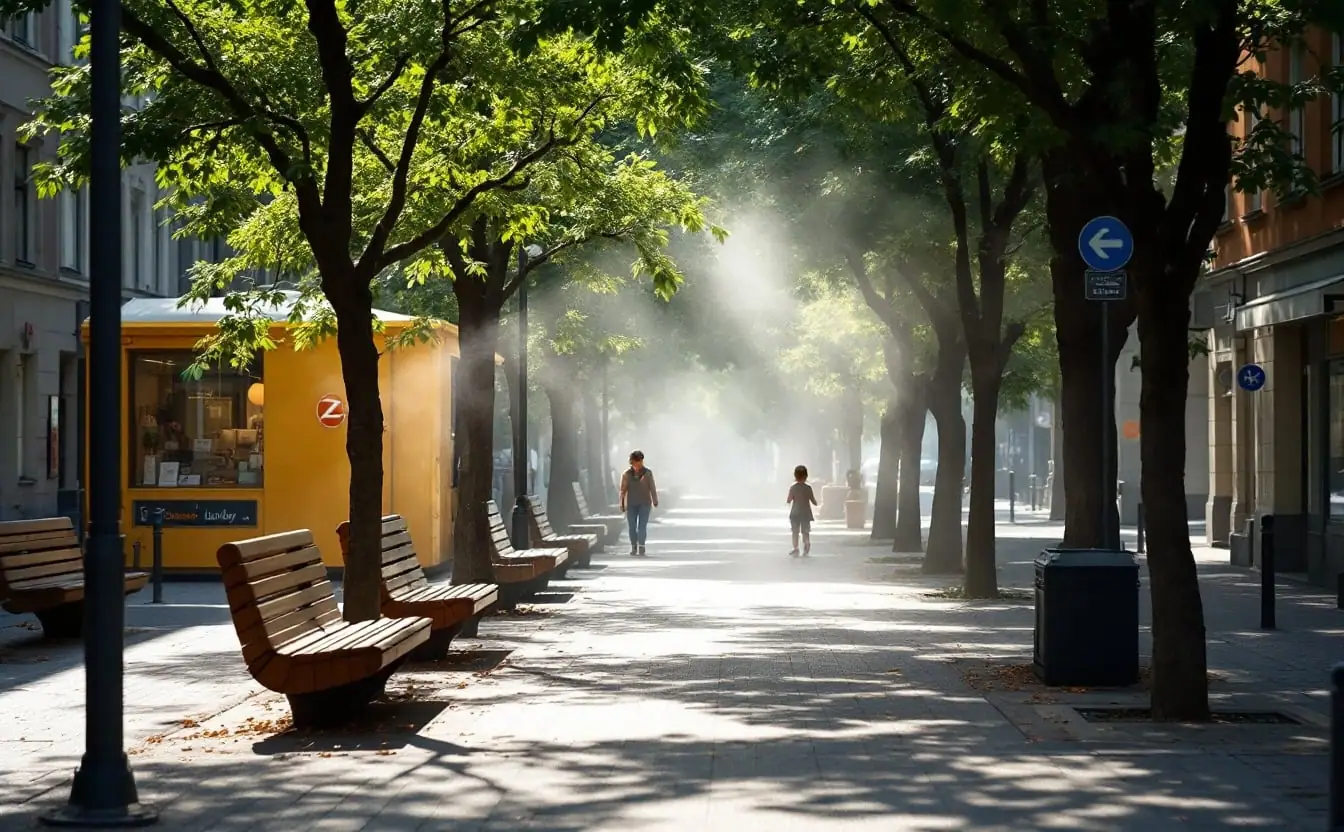
In Zagreb there is a funicular whose track is only about 66 metres long. It has run since 1890 between Tomićeva Street in the Lower Town and the Strossmayer promenade at the edge of the Upper Town, and it regularly turns up on lists of the shortest public funiculars anywhere. You could walk up the slope beside it in a couple of minutes, and plenty of people do. Yet the little car keeps climbing, and the city would be poorer without it.
Stairs, footbridges, lifts, passages and the paths people wear across grass are the small print of urban design. They rarely make the postcards, but they decide which routes get used, which neighbourhoods feel close and which feel cut off. This piece looks at a few that work, in cities I keep returning to, and tries to say why.
A minute of ceremony in Zagreb
The funicular's upper station stands beside the Lotrščak Tower, the medieval tower from which a cannon is fired every day at noon. Step out and the promenade opens along the old edge of the hill, with the roofs of the Lower Town spread out below. The ride itself is so short that it is almost a joke. That is part of its charm, and part of its use. It is run by the city's public transport company as an ordinary line, not as a fairground ride, and that status matters: it treats the climb as a public duty.
The Upper Town sits on its hill like a separate village, and the Lower Town, with its nineteenth-century grid and squares, spreads out beneath it. The funicular is a visible stitch between the two. It turns a climb into a small event, and it gives both halves of the city a shared object you can point at from either end.
Short connections matter most where a change of level separates two districts that belong together. The distance is trivial. The threshold is not.
Lisbon, where the city goes vertical
Lisbon is built over steep hills on either side of the flat Baixa, the grid of streets rebuilt after the earthquake of 1755. For well over a century the city has used machines to deal with that: street funiculars on the steepest slopes, such as the Glória, the Bica and the Lavra, and the Elevador de Santa Justa, an iron lift tower opened in 1902 that carries passengers up from the streets of the Baixa to a walkway leading towards Largo do Carmo.
These machines are loved, photographed and queued for, and that success brings its own problem. When a shortcut becomes a sight, it can stop working as a shortcut. A resident carrying shopping does not want to stand in line behind a tour group to get home. The city has also added plainer public lifts on the slopes below the castle, built for daily use rather than photographs, and those modest boxes may do more for the people who live on the hill.
The harder lesson came with the fatal crash of the Glória funicular in September 2025. Machines that make a hilly city walkable are still machines. They need inspection, spare parts, trained staff and maintenance budgets, and affection is no substitute for any of those.
Plečnik's bridges in Ljubljana
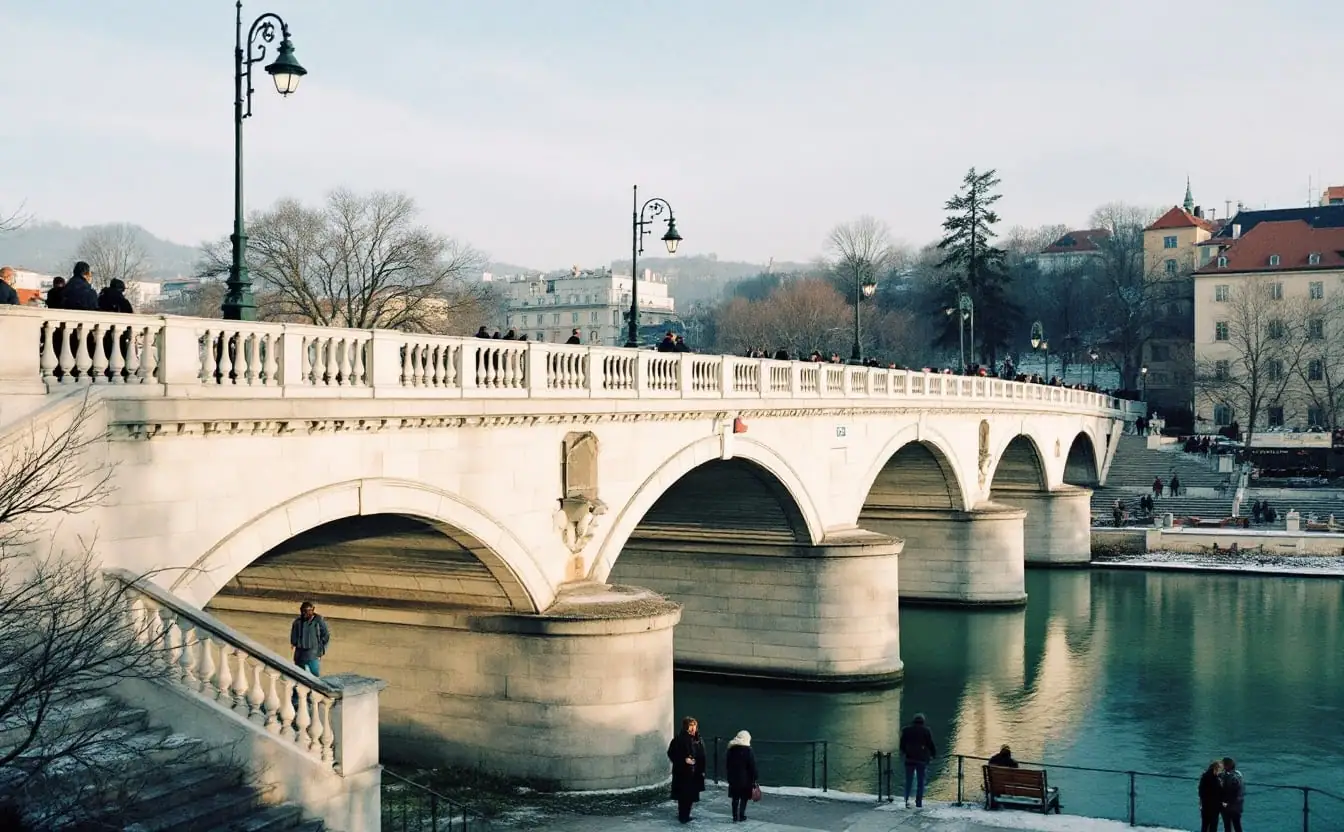
If one architect understood small crossings, it was Jože Plečnik. Between 1929 and 1932 he added two footbridges on either side of an older stone bridge from 1842 over the Ljubljanica, so that a single crossing became a fan of three opening onto Prešeren Square. The Triple Bridge is wider than any traffic count would justify, and that is exactly why it works. People stop on it, lean on the balustrades, meet friends, watch the river. Steps lead down from it to terraces at the water's edge, so the bridge connects not only two banks but two levels.
A short walk upstream, Plečnik rebuilt the Cobblers' Bridge as something closer to a small square than a bridge, broad and paved, with columns along its edges. Further south the Trnovo Bridge carries a row of birch trees, which is a strange thing for a bridge to do and a lovely one. In 2021 his works in Ljubljana were inscribed on the UNESCO World Heritage List, and the bridges are the most used part of that legacy. A newer footbridge, the Butchers' Bridge, opened in 2010 on a site where he had planned one.
The lesson from Ljubljana is that a bridge can be a place to stay, not only a line to cross. Give it width beyond what the footfall needs, a parapet at a comfortable height for leaning, light at night and a way down to the water, and it becomes part of the city's public life.
Stairs as a sequence of rooms in Vienna
In my own city the best known stair is the Strudlhofstiege in Alsergrund, an Art Nouveau stair completed in 1910 to designs by the architect Theodor Jaeger, which links Liechtensteinstraße below with Strudlhofgasse above. Its flights split and rejoin around landings, with lamps and balustrades that make the climb feel like a walk through a series of small terraces. Heimito von Doderer named a novel after it, and it deserves the attention.
What the Strudlhofstiege does well is pacing. No flight is long enough to tire you, every landing is big enough to stop without blocking anyone, and each turn gives you a new view. It is a stair you can use slowly.
Vienna's other shortcuts are less famous. The Durchhäuser, passages through the ground floors of buildings that connect two streets, cut corners in the old centre and in the inner districts. Many council housing courtyards work the same way, letting residents cross a large block instead of walking round it. None of these appears on a tourist map, and all of them shape how people actually move.
When a shortcut is really a detour
Not every small structure helps. The classic failure is the pedestrian bridge over a busy road, reached by long zigzag ramps or two tall flights of stairs, built so that traffic can keep moving at ground level while people on foot go up and over. It looks like a gift to pedestrians and works as a toll on them. Many people ignore it and cross at street level, and then get blamed for doing so.
Underpasses have the same problem with less light. A crossing at street level, with a signal that gives people enough time, is almost always the better shortcut, even if it is less photogenic. The test is simple: does the structure shorten the walk, or does it only clear the road?
Desire lines: the shortcuts nobody designed
Then there are the informal routes. A worn brown track across a lawn, cutting a corner that the designer drew square, is called a desire line, and it is the most honest survey a city ever gets. Nobody fills in a form. People simply walk where they want to go.
Cities respond in three ways: they fence the track off, plant a hedge across it, or pave it. The wiser ones wait a season, watch, and then put the path where the feet have already put it. In February a fresh fall of snow does the survey for you. Go to a park on the first morning after snow and the footprints will show the routes people want, which rarely match the ones on the plan. The same habit of noticing what people do with the scraps of a city runs through this piece on tactical urbanism and leftover spaces.
What makes a small connection work
Looking across these examples, the same conditions keep appearing. When I judge a stair, a bridge or a passage, I go through them in this order.
- It joins two places people already want to connect. A footbridge to nowhere stays empty however elegant it is.
- The climb is comfortable. Steps with low, even risers and generous treads are easier on every body; an old rule of thumb, often credited to the French architect François Blondel, says two risers plus one tread should add up to roughly the length of a stride.
- Landings come often enough to rest and are big enough to stop on without blocking anyone else.
- There is something to look at: a view, a tree, a lamp, a change of light at the turn.
- It is lit and overlooked at night. A stair nobody can see from a window is a stair people avoid after dark.
- There is a step-free alternative close by, such as a ramp, a lift or a gentler street. Stairs exclude wheelchair users, parents with prams, people with heavy shopping and many older people.
- Someone maintains it, with grit and snow clearing in winter, handrails on both sides and repairs that arrive before the complaints do.
The best examples manage all seven. The Triple Bridge has width, views and level access. The Strudlhofstiege has pacing and light but is no help to a wheelchair user, which is why the streets around it matter as much as the stair itself.
Ride up, then wait
More of these structures, and the streets and squares they serve, are collected in the architecture and space strand. But the best way to understand them is in person, and preferably in the cold, when a shortcut really counts.
If you are in Zagreb, take the funicular up rather than walking, step out onto the promenade, and wait there for noon. When the cannon fires from the Lotrščak Tower, half the Lower Town seems to glance up at the hill for a second, and you will see why a ride of about 66 metres is worth keeping.