Winter light festivals and projection mapping: how to see them well
How light art and projection mapping work on winter streets, what they cost in energy and darkness, and how to visit a light festival without the crush.

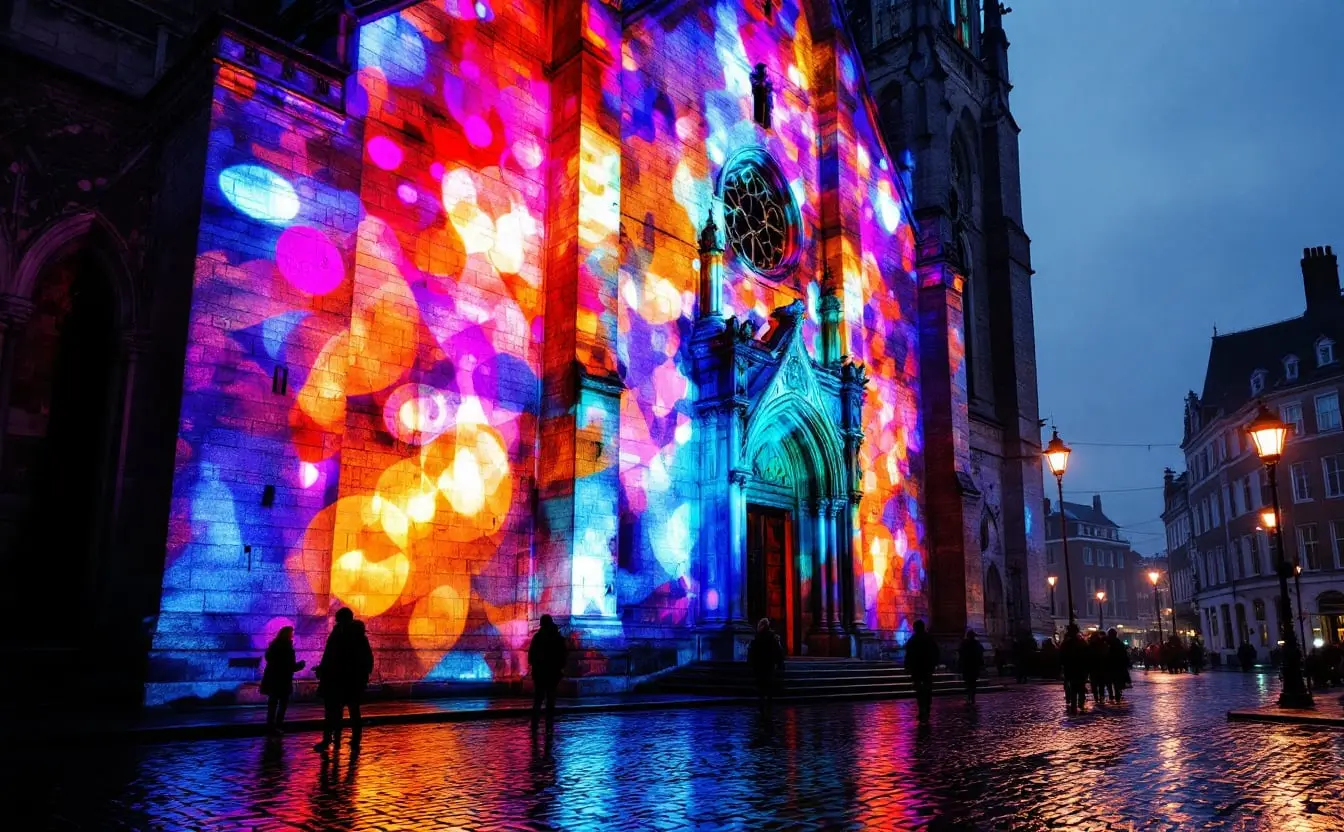
In the Ruhr the season of light arrives well before the snow does. By the middle of November the afternoons give up before five, the shopping streets of Essen are strung with lamps from one roofline to the next, and out in Duisburg the old blast furnaces of the Landschaftspark glow red, green and blue under the lighting the British artist Jonathan Park designed for them. Further afield, the winter light festivals are building their routes: cables taped over cobbles, scaffold towers wrapped in black cloth, projectors tested against church fronts long after the last tram.
Light festivals have become one of the regular reasons to go out into a European city in winter, and they are among the least examined forms of art in public space. They are meant to look effortless. What follows is a guide to what you are looking at, how a projection is made to fit a building, the energy question that hangs over every bulb, and how to visit one without spending the evening behind somebody's raised phone.
Why light works on a winter street
Light art changes a place without touching it. A projection on a cathedral front leaves no mark on the stone once the projectors are packed away, yet for ten minutes it can make a building that thousands of people walk past every day look strange, fragile or alive. Good temporary sculpture plays the same trick on a square, and the questions I ask of both are similar; there is more on those in what temporary art does to a city square.
Winter does half the work. The nights are long, the dark comes early enough for families, and people are already looking for a reason to stay out after work. The oldest of the big festivals grew out of something very simple. Lyon's Fête des Lumières traces its origin to December 1852, when residents set candles on their windowsills for the inauguration of a statue of the Virgin on the hill of Fourvière, and small candles in glasses still appear on Lyon windowsills in early December. Eindhoven's Glow plays on a city long tied to the lighting industry. Amsterdam's light festival places its works along the canals, so you see them from a boat or a bridge. In Essen, the Lichtwochen decorations over the city centre streets are a habit that goes back to the years after the war.
There is a line between decoration and light art, and it is about intention. Decoration says it is the season, come and shop. Light art asks you to look again at the place you are standing in.
The main kinds of light art, compared
Most festivals mix several forms along one route. They make different demands on the city, and on you.
| Form | What you see | What it needs | What to watch for |
|---|---|---|---|
| Projection mapping | Moving images fitted to a facade's windows, columns and cornices | A measured model of the building, powerful projectors in covered towers, a dark street | Whether the content uses the architecture or simply covers it |
| LED sculpture | Objects drawn in light, often in squares, parks or over water | Power, weatherproof housings, barriers or a fence | How it looks from the back and in the rain |
| Neon and cold cathode | Bent glass tubes glowing in pure colour | Specialist glass benders, transformers, careful mounting | The craft at the bends, and the faint hum up close |
| Fire and lanterns | Candles, braziers, paper or glass lanterns | Fire safety staff, sand, distance from crowds | Smoke, wind and how near you are allowed to stand |
| Interactive pieces | Light that responds to movement, sound or touch | Sensors, software, staff to keep it running | Queues, and sensors that give up by the second hour |
| Beams and searchlights | Shafts of light into the sky | Clear air and, in many places, aviation approval | Light spilling where it is not wanted, and birds |
The table is a rough guide, not a ranking. Some of the most moving pieces I have seen were a few hundred candles on a pavement; some of the dullest were very expensive projections.
How a projection is made to fit a building
Projection mapping starts long before the first evening. The facade is measured, usually by laser scanning or photogrammetry, so the designers have a precise digital model of every window frame, pilaster and broken ornament. The animation is built on that model. That is why a well mapped show can make columns seem to tip forward, or a Baroque front seem to melt and set again.
On site, several projectors usually share the job. Their images overlap, and software on a media server warps each one to the geometry and blends the overlaps so the joins disappear. The projectors sit in towers or containers, sometimes on a roof opposite, protected from rain and kept at a steady temperature. Streetlights in front of the facade may need to be dimmed or switched off by the city, because a projection is only as bright as the darkness around it allows. Tests happen late at night, when the square is empty and the neighbours are, with luck, asleep.
Then there is sound. Most mapping shows run with a soundtrack, and the speakers are a negotiation with everyone who lives on the square and hears the same ten minutes on a loop all evening. Since sound is half of what I write about, I listen for it closely. The best shows treat it as part of the place, with the echo of the square left in, rather than a film score pushed through a rental rig.
A simple test for any projection: would the content make just as much sense on a blank white wall? If the answer is yes, the building is being used as a screen, and you are watching a film outdoors.
The energy question
Light festivals use electricity in the season when grids are under most strain and households are asked to save. Germany felt this sharply in the winter of 2022 to 2023, when short-term energy saving rules switched off the decorative floodlighting of public buildings and monuments, and many towns cut back their seasonal street lights. For a few months the cathedral fronts went dark, and plenty of people found they missed them.
Festivals have answered in several ways. LED fittings draw far less power than the old incandescent and discharge lamps, and projectors have become more efficient too. Some events have shortened their evenings, swapped diesel generators for grid connections, or bought renewable electricity. Others reuse fittings and structures from one edition to the next. For many events, the largest part of the footprint is how visitors travel to them, which is a better argument for routes you can reach by tram than for any particular bulb.
There is also the question of darkness itself. Light aimed at the sky or spilling into trees affects insects, bats and birds, and some sky beams have been switched off for spells when migrating birds gathered in them. A festival that respects the night points its light at surfaces, not upwards, keeps parks and riverbanks darker, and switches off at a sensible hour. When I judge a festival, I count that as part of the art.
How to visit a light festival well
You do not need a ticket or a plan for most of these events, but a few habits help.
- Go on a weeknight, as early or as late as the programme allows. Weekend evenings around nine are when routes fill shoulder to shoulder.
- If the route is not one way, start at the far end and walk against the flow of the crowd.
- Watch each projection twice: once for the whole, once for the edges, where you see how the image meets the stone.
- Stand near the line of the projectors. Mapping is drawn from their position, so that is where the distortions vanish.
- Dress for standing still. The cold comes up through your soles, so thick shoes matter more than a warm hat.
- Leave the tripod at home in a crowd. Take one photograph, then put the phone away.
- Check whether the festival publishes a step-free route; old towns mean cobbles, kerbs and steps in the dark.
- Know your last train or tram before you set out. At the end of the evening, the nearest stops fill first.
If you are curious how events like these are organised behind the barriers, from permits to toilets, the practical side is in planning a festival in public space.
Go back in daylight
The next morning is worth a short walk along the same route. In daylight you see the scaffold towers, the cable ramps, the black cloth taped over a shop window to stop reflections, a technician asleep in a van with the engine off. You see how much work it takes to make a building look as if it is breathing for ten minutes. In the Ruhr, the permanent version of all this is a winter evening at Duisburg-Nord, where the furnaces carry their coloured light without a festival around them; the region's other industrial sites are in a cultural itinerary across the Ruhr.
And during the show itself, watch for the moment just after the loop ends. The projectors go to black, the music stops, and for a few seconds the crowd sees the real facade again, a little older and more familiar than it was a minute before. That pause belongs to the work too.