Where to stay in Lisbon for first timers who want art on foot
Where to stay in Lisbon on a first visit if you want murals, tiles and viewpoints on foot: five neighbourhoods compared, hills and night noise included.

We earn a commission on some bookings.
Lisbon punishes a bad choice of base more than most cities. Two addresses can be fifteen minutes apart on the map and a hard climb apart on the ground, and the tram that looked so convenient may arrive full. For a first visit built around walking, where you sleep decides what you see before breakfast and how much you have left by the evening.
So this is a guide to where to stay in Lisbon if your days will be spent on murals, tiles, painted pavements and viewpoints rather than on beaches. I have judged each neighbourhood by one test: what can you reach on foot from your door, and what will annoy you about it by the third night? Hotels are not named, because the right street matters more than the right lobby, and prices change too often to print. If you have not yet planned the walking, our Lisbon street art walk runs from the Baixa through Mouraria and Graça to Alfama, and it is the route most of the advice below is measured against.
The short answer
| Neighbourhood | Art and tiles on foot | Watch out for |
|---|---|---|
| Baixa and Chiado | Rossio's wave pavement, Mouraria's portraits, the Glória panels | Crowds by day, very quiet after the shops close |
| Alfama, Mouraria and Graça | Most of the city's best known murals, tile panels, viewpoints | Steep lanes, slippery stone, luggage on steps |
| Bairro Alto and Príncipe Real | The Glória panels, layered walls, a garden square | Loud nights in Bairro Alto, hills both ways |
| Cais do Sodré | Flat riverside, a quick train to LX Factory | Late night noise around Pink Street |
| Alcântara | LX Factory on your doorstep, Belém close by | A long way from the old hills |
Baixa and Chiado
If you are unsure, start here. The Baixa is the flat grid between Rossio and the river, rebuilt after the 1755 earthquake under the Marquis of Pombal, and it is the one part of central Lisbon where walking is easy. Rossio's black and white waves, laid in 1848 and 1849, became the model for the stone paving you will cross all week. Mouraria's alleys, where Camilla Watson's photographic portraits of older residents hang at eye level, start a few minutes uphill. Chiado, on the slope to the west, adds bookshops, cafés and the walk up towards Bairro Alto.
The downsides are crowds and a curious emptiness. By day the main streets are full of tour groups. Once the shops shut, much of the Baixa goes quiet, which is good for sleep and less good if you like a neighbourhood with life in it at night. One practical warning: the Glória funicular, which used to carry people from Restauradores up to Bairro Alto, has been out of service since its fatal derailment in September 2025. The city's other historic lifts were stopped for inspection afterwards, so check what is running before you plan a day around them.
Alfama, Mouraria and Graça
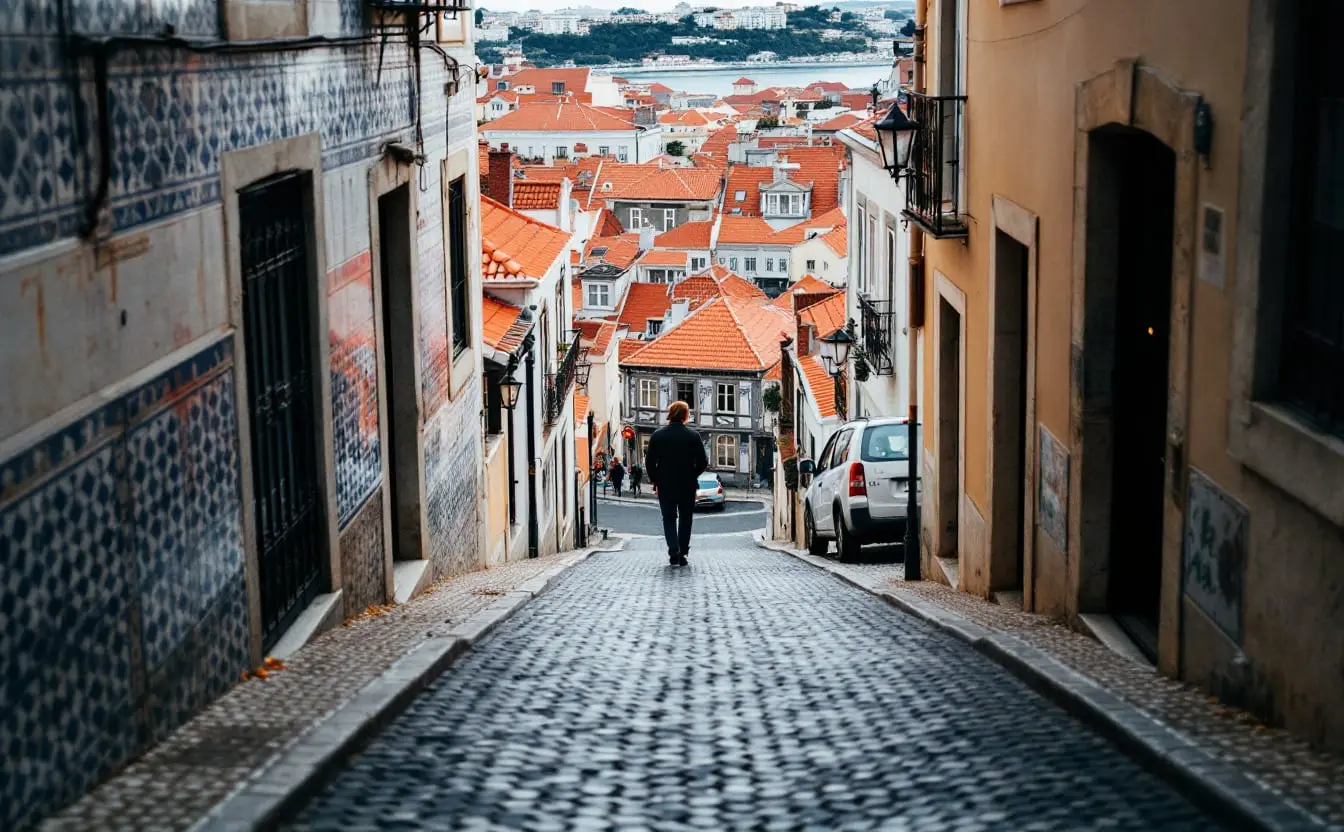
This is where the art is densest, and the hills are steepest. Alfama is the oldest quarter, a knot of lanes and stairways that largely came through the 1755 earthquake, and fado still drifts out of doorways in the evening. Above it, Graça has the two walls Shepard Fairey painted in 2017, one of them shared with Vhils, who carved his half of a woman's face into the render. In Alfama, Vhils also designed a portrait of the singer Amália Rodrigues that the city's pavers set stone by stone. Along the edge of Campo de Santa Clara, where the Feira da Ladra flea market sets up, André Saraiva's tile panel runs for 188 metres.
Stay here and you wake up inside the walk. You can be at the Miradouro da Senhora do Monte, one of the highest viewpoints in the centre, before the tuk-tuks arrive, and at the Graça murals while the light is still low. A short funicular between Rua dos Lagares in Mouraria and the viewpoint by Graça church opened in 2024 and was running again from the end of April 2026, which takes the edge off one climb.
The costs are physical. Lanes are steep and stepped, the polished paving is slippery after rain, and dragging a suitcase up a stairway at the end of a flight is a poor start to any trip. The trams through these streets fill up early. Pick a place near a road a taxi can reach, ask about stairs inside the building, and pack shoes with grip.
Bairro Alto and Príncipe Real
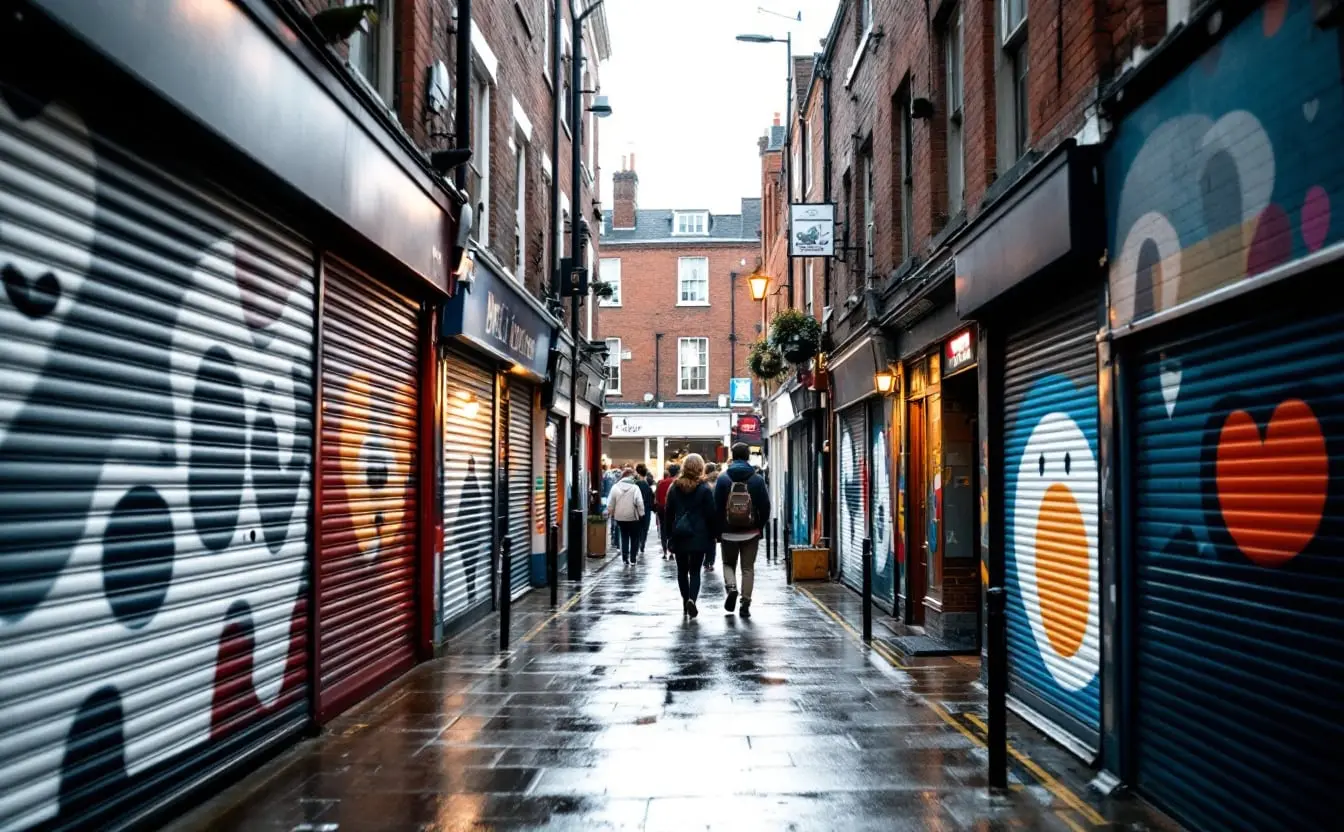
Bairro Alto is two neighbourhoods in one. By day it is a grid of narrow streets with layered walls, most shutters and doorframes tagged, pasted and repainted many times over. At night it is the city's main drinking district, and on weekends the noise runs late. If you sleep lightly, this is the one area I would rule out, or at least insist on a room at the back. The Calçada da Glória, where the city's urban art office has invited painters to fill large panels since 2008, is on its eastern edge, and the panels change every year or two.
Príncipe Real, just to the north, is the calmer alternative: boutiques, restaurants and a shady garden square at its centre. It suits a second visit, or a first one where good sleep matters more than being close to the river. Both sit on a ridge, which means a climb home from almost anywhere, and with the Glória funicular closed the climb from Restauradores is on foot.
Cais do Sodré
Cais do Sodré, on the river west of the Baixa, is the transport choice. The train for Cascais leaves from its station, the green metro line stops here, ferries cross the Tagus to Cacilhas, and the market hall, Mercado da Ribeira, has housed the Time Out food hall since 2014. For an art visitor the train matters most: Alcântara-Mar, the stop for LX Factory, is a few minutes down the line. The walk east to the Baixa is flat.
The catch is Rua Nova do Carvalho, painted pink in an urban renewal scheme and known since as Pink Street. It is a nightlife strip, and residents have complained for years about noise and rubbish after the late parties. A room two streets away can be perfectly quiet. A room above the bars will not be.
Alcântara, for LX Factory
LX Factory occupies a former textile works under the 25 de Abril Bridge, a mid nineteenth century industrial site that reopened in 2008 as a cluster of studios, shops and restaurants. Its walls carry murals by many artists, some obvious and some tucked into corners, and entry to the site itself is free. Tram 15E stops at Calvário, a few minutes away, and runs on towards Belém and its riverside museums.
Alcântara makes sense if LX Factory and Belém are the heart of your trip, or if you like being somewhere locals actually live. For a first visit built around the Atlas walk, it is the wrong side of town: Mouraria and Graça are a long tram or metro journey away, and you will spend your mornings getting there rather than being there.
And Marvila, for an afternoon
Further east along the river, Marvila is where old warehouses have turned into galleries, studios and breweries. Underdogs, the gallery and public art platform founded by Vhils and Pauline Foessel, has its exhibition space in a warehouse here, and the district once hosted MURO, the urban art festival organised by the city's Galeria de Arte Urbana. It is a fine half-day, especially in the afternoon, when the galleries open. It is not a first-time base: things are spread out, evenings are quiet in the wrong way, and the old centre is a train ride away.
Before you book, check five things
- Look at the street, not the district. A quiet lane in Alfama and a room above a bar in Bairro Alto are both "central".
- Ask about stairs, both outside and inside. Many old buildings have no lift.
- Find the nearest metro stop or tram stop and walk the route on a map with the terrain switched on.
- Read recent guest comments for the words "noise", "steps" and "hill".
- Match the base to the walk. For the east side murals, sleep in the Baixa or Graça; for LX Factory and Belém, sleep west.
Once you have chosen an area, compare rooms across the city street by street, and keep the map open while you do. If you are arriving early or leaving late, the card below also lists luggage storage, which saves carrying a bag up a hill to a room that is not ready. And if you would rather build your own route than follow ours, our guide to planning a self-guided street art walk works well in a city this steep.
Further reading
Rick Steves Portugal covers Lisbon in depth, with neighbourhood walks and transport, and the rest of the country if you are travelling on. Rafael Schacter's World Atlas of Street Art and Graffiti shows how Lisbon's commissioned walls fit into a much wider scene. These picks come from publisher details and published reviews rather than our own testing.
The first evening
Whichever neighbourhood you choose, spend the first evening finding the nearest viewpoint and the nearest staircase down from it. Lisbon's stairs and shortcuts are how locals beat the hills, and once you know yours, the next morning's walk starts from the top rather than the bottom.