The case for concrete: brutalist buildings, repair and demolition
Brutalist buildings in Vienna, Belgrade, Skopje and Ljubljana divide opinion. Why they matter, what the critics get right, and why repair usually wins.

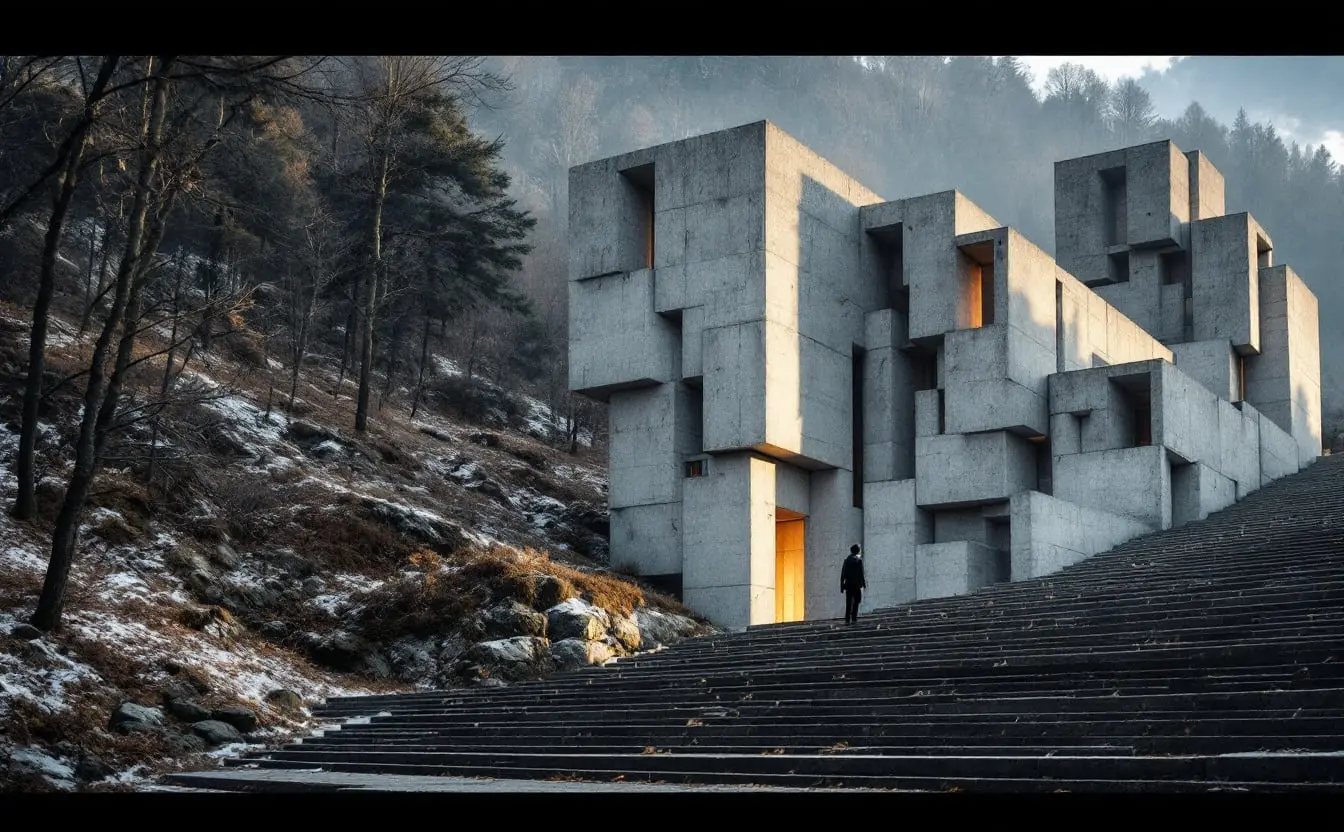
On a clear November afternoon the Wotruba Church in Mauer, at the south-western edge of Vienna, looks like a heap of grey boulders that someone arranged with great care and then left out in the weather. The sculptor Fritz Wotruba designed it, the architect Fritz Gerhard Mayr saw it through, and it was finished in 1976, after Wotruba had died. It is made of 152 concrete blocks of different sizes, none of them quite lined up with its neighbour, with clear glass filling the gaps between. Visitors either walk round it twice in silence or say it looks like a bunker.
That split is the whole story of brutalism in miniature. Few styles produce such loyal fans and such cheerful contempt, often from people standing on the same pavement. And because so many concrete buildings from the 1960s and 1970s need serious repair at roughly the same moment, the argument is no longer only about taste. It is about whether a city keeps them at all.
Where the word came from
The name is less brutal than it sounds. Le Corbusier spoke of béton brut, raw concrete, for a surface left as it came out of the formwork, carrying the grain of the timber boards it was poured against. In Britain, Alison and Peter Smithson took up the idea of a "New Brutalism", and the critic Reyner Banham gave it something like a manifesto in an essay of 1955. For Banham the point was honesty: show the structure, show the materials, let the building be what it is.
That honesty was easy to admire on paper and harder to love in the rain. Board-marked concrete is handsome when it is new and clean. After forty winters of exhaust, run-off and indifferent maintenance it streaks, darkens and grows moss on the north side. A good deal of the hostility to brutalism is really hostility to buildings that nobody looked after.
The case against, taken seriously
It would be lazy to pretend the critics have nothing. Some large concrete estates of the period were badly built, with thin insulation, leaking joints and access decks that felt unsafe after dark. Raised plazas, designed to lift pedestrians away from traffic, often ended up as windswept terraces that nobody needed to cross. In Central and Eastern Europe the style also carries political weight. For many people it is the look of the ministry, the party headquarters, the block you were allocated rather than the flat you chose.
There are practical objections as well. Concrete is hard to adapt. You cannot casually cut a new window into a load-bearing wall, and wrapping the outside in insulation hides the very surface that made the building worth keeping. Repairing spalled concrete properly is slow, skilled work, and an owner facing a large bill can find demolition the simpler line on a spreadsheet.
The case for, and why it has grown louder
The defence has gathered strength over the past decade or so, and nostalgia explains only part of it. Photographers and enthusiasts began documenting these buildings at the moment many of them were threatened. The Deutsches Architekturmuseum in Frankfurt ran a campaign under the name SOS Brutalism, built around a database of endangered buildings worldwide. In 2018 the Museum of Modern Art in New York opened Toward a Concrete Utopia, an exhibition on architecture in socialist Yugoslavia, which persuaded plenty of people abroad to look again at towers and memorials they had only known as pictures of decay.
The stronger argument concerns what the buildings were for. Much brutalist architecture was public: universities, libraries, theatres, churches, post offices, social housing with shared terraces. Vienna's Wohnpark Alterlaa, designed by Harry Glück and built through the 1970s and early 1980s, put swimming pools on the roofs of a large housing estate, and its residents have tended to defend it with real loyalty. If you know the older council courtyards I described in the piece on Gemeindebau courtyards, Alterlaa reads as the same promise pushed upwards in concrete: generous shared space as part of the rent.
A short regional itinerary
The region holds some of the most ambitious concrete architecture anywhere. Most of it sits in ordinary city districts rather than on a tourist trail, so you will share it with commuters and residents rather than tour groups.
In Belgrade, the Western City Gate, better known as the Genex Tower, was designed by Mihajlo Mitrović and completed in 1977. Two towers are joined high up by a bridge, with a round crown on the taller one, and the whole thing greets you on the motorway in from the airport. It is one of those buildings that locals argue about at dinner.
Skopje is the textbook case. After the earthquake of 1963 destroyed much of the city, a team led by the Japanese architect Kenzo Tange was chosen to plan the new centre, and Macedonian and Yugoslav architects filled it with concrete. Janko Konstantinov's post office and telecommunications centre is the one to seek out. Several modernist buildings in the centre were later wrapped in classical façades under the government programme known as Skopje 2014, which teaches its own lesson: a building can be lost without being knocked down.
In Ljubljana, Edvard Ravnikar's Republic Square, with its two angular office towers and the Cankarjev dom cultural centre, was built over two decades from the 1960s. It is concrete and stone used with a precision you rarely see, and it makes a fine counterpoint to the older city if you are there for the river and the bridges. In Bratislava, the Slovak Radio building, an inverted pyramid completed in 1983, is usually filed under brutalism even though its cladding is not raw concrete. Zagreb has Mamutica, the enormous housing block in Travno, which is less a monument than a small town stood on end.
Further into the countryside, the memorial sculptures of the former Yugoslavia belong to the same story of concrete as public expression. Our guide to visiting the spomeniks covers how to see them with care.
When they go
Prague offers the warning. The Transgas complex near Wenceslas Square, three buildings put up between 1972 and 1978 for the gas transit company and the federal energy ministry, was a striking mix of brutalist mass and high-tech pipework. Art historians appealed for its protection, but it was never declared a cultural monument, and it was demolished in 2019. Many people who had walked past it for years only noticed it as it came down.
London has a similar case in Robin Hood Gardens, the Smithsons' housing estate in Poplar, which was demolished after a long fight. The Victoria and Albert Museum acquired a three-storey section of the façade, so a fragment of social housing now lives as a museum object. Preston's bus station went the other way: it was listed in 2013 and refurbished, and the town kept a building that had once been on the demolition list.
Repair versus demolition
Most concrete problems have names and known treatments. Carbonation, the slow chemical change that creeps in from the surface, eventually reaches the steel reinforcement, which then rusts, swells and pushes off pieces of concrete. A careful repair cuts back to sound material, treats or replaces the steel, and patches with a mortar matched to the original in colour and aggregate, sometimes with timber boards pressed in to reproduce the grain. Electrochemical methods can slow corrosion across a whole façade. None of this is cheap, but none of it is mysterious.
Energy is the harder question. Insulating a board-marked building from the outside destroys its character, so the work usually moves inside, with new windows, internal insulation where the rooms allow it, and better heating and ventilation. The results are rarely perfect. They are still worth comparing honestly with the alternative, because cement is one of the largest industrial sources of carbon dioxide, and a demolished building throws away all the carbon already spent on it before its replacement adds more.
Five questions to ask before the wrecking ball
When a concrete building in your city is under threat, the debate tends to turn on slogans. These questions sort the serious cases from the convenient ones:
- Has the structure been properly surveyed, with cores and measured carbonation depth, or is "beyond repair" just a phrase in a press release?
- What will the replacement cost in carbon as well as money, and who has done that sum?
- Who used the building, and will the same people be able to use whatever replaces it?
- Can the public parts, a hall, a terrace, a stair, a forecourt, survive even if the use changes?
- Did a heritage body review it before the sale or the planning decision, rather than after?
If the answers are vague, push for them in the public consultation. Planning departments respond to residents who ask precise questions, and the architecture and space strand collects more pieces on how these decisions are made.
Then go and look at the building itself, on a dry day after rain, when the concrete has darkened unevenly and the board marks show. At the Wotruba Church, stand on the lowest step late on a November afternoon, when the sun comes in low across the hill and the grey blocks warm, for a short while, towards the colour of sand.