Books about cities and public space for curious walkers
Jane Jacobs, Jan Gehl and a guide to drawing on location: three books that change how you see streets and squares, plus four more worth borrowing.


Walking teaches you a city, but slowly. You notice that one street is always full and the next, just as pretty, is always empty. You notice that people perch on a low wall and ignore the bench beside it, or that a square feels right and you cannot say why. A handful of books give you words for those things, and once you have the words you start seeing the patterns everywhere.
This is a short reading list for people who walk cities for pleasure, not for planners with a deadline. Three books make up the shelf: two classics about how streets and squares work, and one about drawing them, which is the most reliable way I know to make yourself look properly. Four more follow that are worth borrowing from a library.
Jane Jacobs: the street as a working system
The Death and Life of Great American Cities came out in 1961, and it was written as an attack. Jacobs, a writer living in Greenwich Village in New York, argued against the planning orthodoxy of her day: clearing old neighbourhoods, separating homes from shops and work, putting towers in open parkland. She looked instead at what happened on ordinary streets, including her own, Hudson Street, and described the daily comings and goings there as a kind of ballet, with shopkeepers opening up, children heading to school and people drifting home in the evening.
Her best-known idea is "eyes on the street". A street feels safe, she argued, when buildings face it, when shops and homes give people reasons to be there at different hours, and when someone is always, casually, watching. She also set out the conditions she thought a lively district needs: a mix of primary uses, short blocks, buildings of different ages, and enough people living close together.
Read as a walker, the book turns into a set of questions. How many doors are there on this block? Are the ground floors shops, offices or blank walls? Is there an old building with low rent holding a repair shop or a bar that a new building could never afford? It is an American book about American cities, and some of its arguments have dated, but the habit of watching a street closely before judging it has not. Jacobs later campaigned against a planned expressway through Lower Manhattan, and that fight is a large part of her fame. The book is the better reason to know her name.
Jan Gehl: architecture at walking speed
Jan Gehl, the Danish architect, built his career on counting people. His early book, Life Between Buildings, first appeared in Danish in 1971; Cities for People, published in 2010, gathers decades of that observation into a broader case. Copenhagen is his home ground. Its main shopping street, Strøget, was closed to cars in 1962, and Gehl and his colleagues went back again and again to record how people used it.
The idea most worth carrying around is speed. A building designed to be seen from a car can get away with large, plain surfaces, because the driver passes it in seconds. A building seen at walking pace needs detail at eye level, doors close together, things to look at and touch. Gehl also writes about the edges of spaces: people like to stand and sit where their backs are covered and they can look out. Watch any square at lunchtime and you will see it happen.
Cities for People is generously illustrated and easy to dip into. It is also a book with a point of view, written by a designer whose practice has worked for many cities, so read it as an argument rather than a neutral survey. In Vienna, where Mariahilfer Straße and many smaller streets have been reshaped around walking, you can test it on almost any block. The same instincts drive small, cheap interventions like parklets and pop-up seating, which I looked at in a piece on tactical urbanism and leftover spaces.
Drawing as a way of reading a street
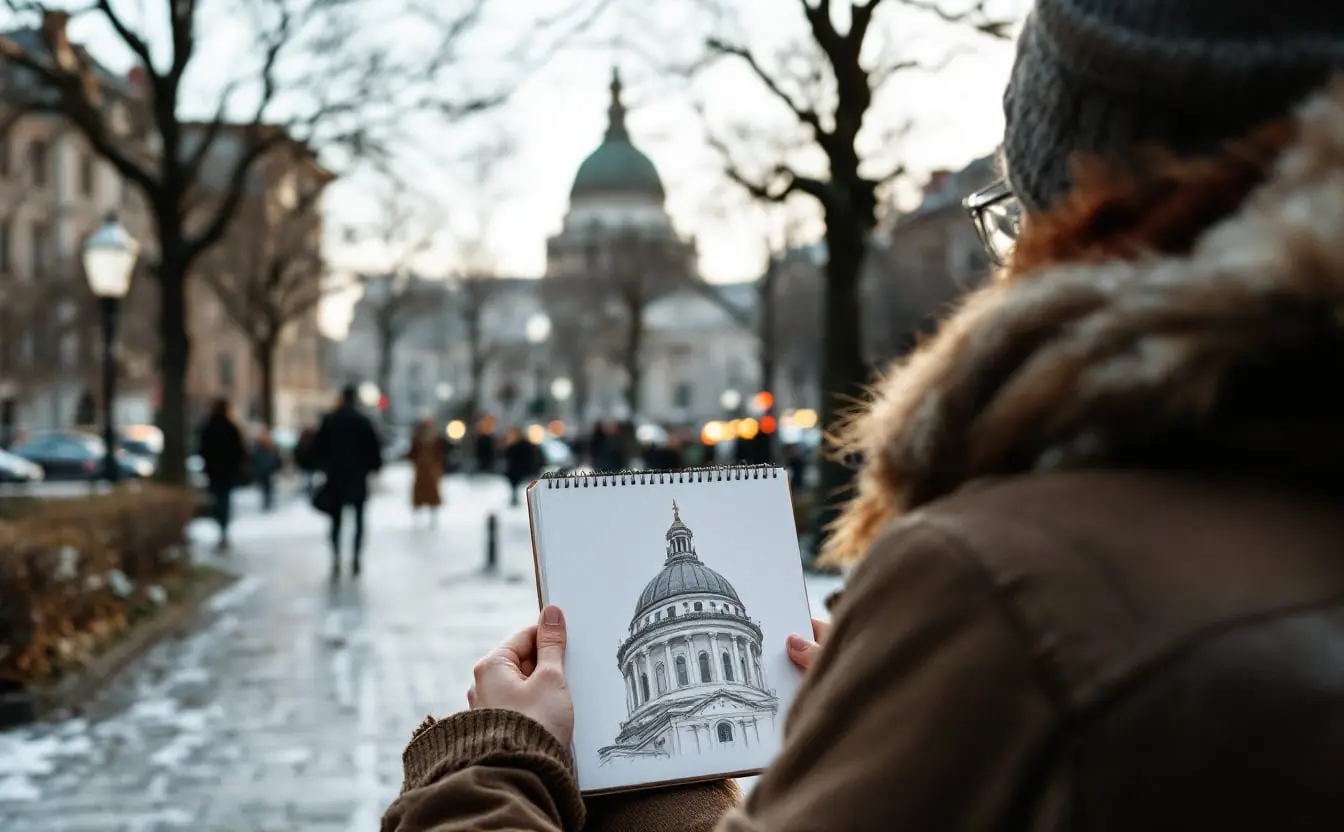
The third book on the shelf is about drawing, and it belongs here because drawing is the slowest way to look. Marc Taro Holmes's The Urban Sketcher is a practical course in sketching on location: how to start a page quickly, how to handle line and wash, how to finish before the light or the weather turns. It is written for people who want to draw, not for theorists.
Take it to a street that Jacobs or Gehl has made you curious about, and something happens. To draw a façade you have to count its windows. To draw a square you have to decide where its edges are. To put people into a sketch you have to watch where they actually stand, which is rarely where the architect expected. You come away knowing the place better than a photograph could tell you. Urban sketching has also grown into a loose international movement, with local groups in many cities that meet to draw together in squares, markets and stations. Joining one for a morning is a gentle way into the habit, and the company stops you giving up after the first bad page. If you want the kit to go with the book, the guide to urban sketching supplies keeps it to what fits in a coat pocket.
Four more to borrow
These are not on the shelf, but a good library will have most of them.
- Kevin Lynch, The Image of the City (1960). Lynch asked people in three American cities to describe and sketch their cities from memory, and found they relied on five kinds of element: paths, edges, districts, nodes and landmarks. Once you know the five, you will use them to describe every city you walk.
- William H. Whyte, The Social Life of Small Urban Spaces (1980). Whyte and his team filmed plazas in New York to find out why some were used and others stayed empty. The answers are practical: places to sit, sun, water, food, and a street running right past.
- Jan Gehl, Life Between Buildings. The earlier, shorter book behind Cities for People, close to a field manual.
- Camillo Sitte, City Planning According to Artistic Principles (1889). A Viennese architect's case for enclosed, irregular squares, written while the Ringstraße was being completed around him. It reads as a quarrel with my own city, and a good one.
A table for your next walk
| Book | What it trains you to notice | Try it on |
|---|---|---|
| The Death and Life of Great American Cities | doors, ground floors, mixed uses, who watches the street | one block, walked at eight in the morning and again at eight in the evening |
| Cities for People | eye-level detail, edges, where people stop and sit | a square at lunchtime, from a seat at its edge |
| The Urban Sketcher | proportion, outlines, how people actually stand | a single façade, drawn in twenty minutes |
| The Image of the City | paths, edges, districts, nodes, landmarks | a district you know, drawn as a map from memory |
| The Social Life of Small Urban Spaces | sun, seating, water, food, the street | one plaza that is always empty and one that is always full |
How to read them on foot
- Take one book and one idea at a time: eyes on the street, or edges, or landmarks, not all three at once.
- Choose a small area you already know, ideally near home.
- Walk it twice, at different times of day, and note only what that idea asks you to notice.
- Draw or map one thing from each walk, however rough.
- Then go somewhere new and see whether the idea still holds.
The same approach works on holiday. A street art route planned with the method for a self-guided walk is a good place to try Gehl's eye-level test, because the walls are already asking you to look up and around.
The shelf
The two classics turn up on reading lists in architecture and planning courses, and the sketching book is the practical companion that gets you out of the chair. These picks come from publisher details and published reviews rather than our own testing.
More pieces on streets, squares and buildings are gathered in the architecture and space strand. The books themselves work best away from a desk: carry one to a bench at the edge of a busy square on a weekday lunchtime, read a chapter, then put it down and watch the square do exactly what Gehl said it would.