Archives of the temporary: how to document art that does not last
A practical checklist for recording performances and temporary installations: photos, video, written scores, consent, and where the archive should live.

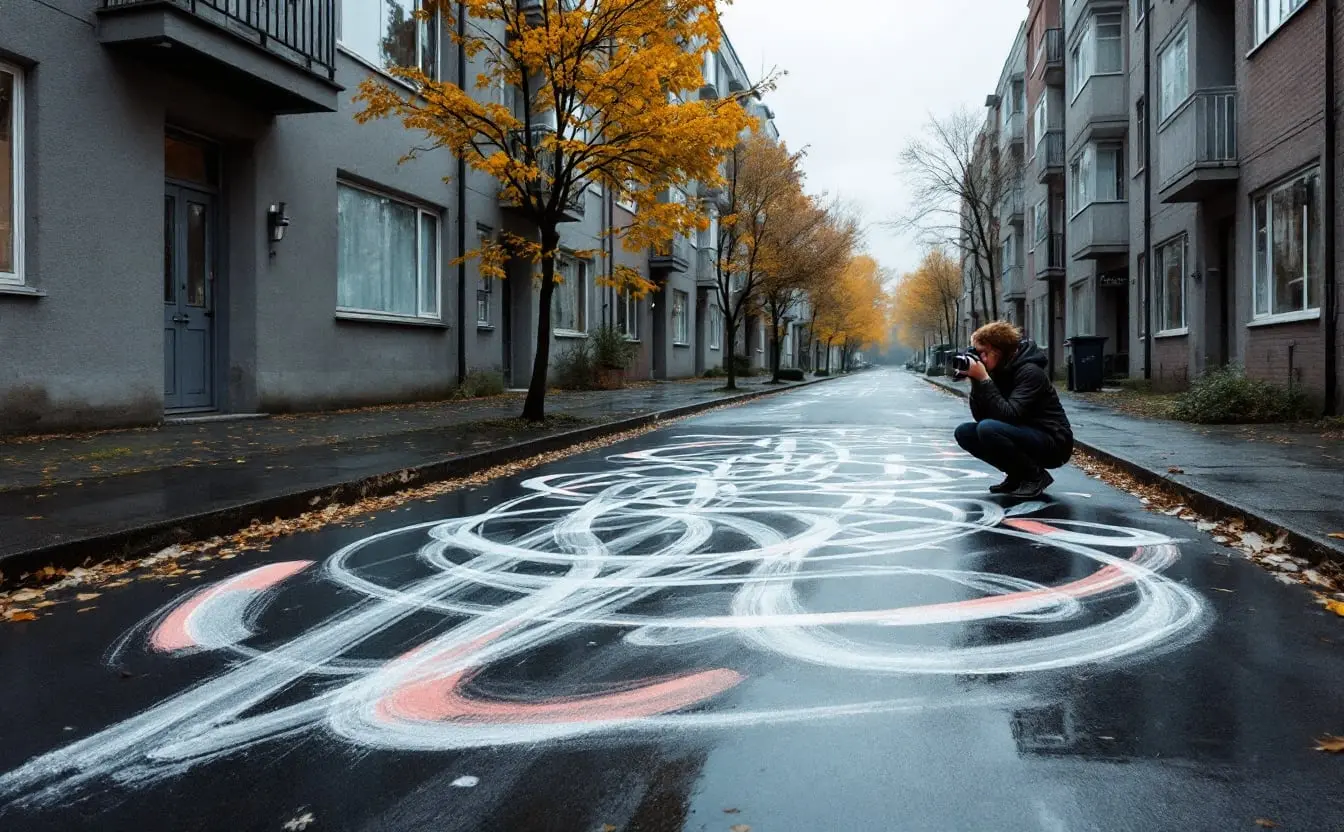
A chalk map lasts as long as the weather lets it. In the courtyards between Bucharest's big housing blocks I have watched children draw their whole estate on the asphalt, every entrance and bench and the corner where the older boys stand, and by the next rain it is a grey smear running towards the drain. What survives is usually a handful of phone photographs and, if somebody thought ahead, a sheet of paper explaining how the drawing was made. For anyone who was not in that courtyard, those two things are the work.
Ephemeral art has always lived this double life. Performances, street actions, installations built for a festival weekend, projections on a facade, a choir singing in an underpass: they are made to end, and their afterlife depends on whoever held the camera and wrote things down. The quality of that record decides whether a piece can be studied, argued about, staged again or simply remembered correctly. What follows is a working guide for small teams with no archivist on staff, built around a checklist you can print and take with you.
The old argument, in brief
Critics have argued about this for decades. In her book Unmarked, published in 1993, Peggy Phelan wrote that performance lives only in the present, and that once it is saved or recorded it becomes something other than performance. It is a serious position. Anyone who has watched a video of a performance they attended knows the flattening she meant: the camera keeps the picture and loses the room.
Philip Auslander answered in a 2006 essay on the performativity of performance documentation. His point, roughly, was that much of the performance art we think we know has reached us only through photographs, and that some famous actions were staged for the camera in the first place. Christo and Jeanne-Claude's wrapping of the Reichstag in Berlin in 1995 stood for two weeks, yet far more people know it from Wolfgang Volz's photographs than ever saw it in person, and the couple paid for their projects partly by selling preparatory drawings and collages. There, the record was never an afterthought. It was part of how the work reached most of its public.
For most of us the practical lesson sits somewhere between the two. Accept that the record is not the work, then make the record as honest and as useful as you can.
Decide what the record is for
Before anyone charges a battery, agree on what the documentation has to do. There are usually four jobs, and they need different material.
Evidence is what funders, landlords and the city want: proof that the thing happened, roughly as promised, without damage. A few wide photographs with the date and a short written report usually cover it. Memory is for the participants and the neighbourhood. People want to see themselves and their friends, they want it soon, and they want it in a form they can send to their families.
Study is for the researcher, curator or critic who arrives five or fifteen years later and needs to know what actually happened, in what order, with which materials. Re-staging is the most demanding job of all: instructions precise enough that someone else could make the work again, with a clear statement of what may change and what must not.
A small team cannot do all four perfectly. Pick the two that matter most for this project and say so out loud at the planning meeting, so the person holding the camera knows what to look for.
The checklist
Before the day
- Name one person responsible for documentation who is not also performing, stewarding or serving tea. Documentation done in the gaps is documentation with gaps.
- Write a shot list of half a page: the site empty, the set-up, the whole duration from one fixed point, close details of materials, the audience, the clearing up.
- Agree in writing with the artists who owns the images, who may use them, and for what. An exchange of emails is enough. A vague promise is not.
- Check the rules of the place. Railway stations, shopping centres and privately owned squares often restrict filming, and flying a drone over a city centre needs authorisation almost everywhere in Europe.
- Prepare for consent: a notice at each entrance saying that filming takes place, a clearly marked area for people who prefer not to appear, and coloured stickers or wristbands for participants who have asked not to be photographed.
- Charge everything, empty the memory cards and bring a separate sound recorder. A lot of ephemeral work lives in its sound.
On the day
- Photograph the empty site before anything arrives.
- Set one wide camera on a tripod and leave it running for the whole piece. This witness shot is dull to watch and priceless later, because it shows duration, scale and the movement of the crowd.
- Use a second, moving camera for close shots: faces only with consent, hands and materials as often as you like.
- At the start of every recording, film a clock or say the time aloud. It makes matching sound and pictures much easier later.
- Collect the paper: the running order, hand-outs, sketches, the sheet taped to the back of a speaker. Paper outlives most hard drives.
- Note the weather, the number of performers, anything that went wrong and anything that changed from the plan.
- Photograph the empty site again after the get-out.
Afterwards
- Copy everything on the same day. Keep three copies on two kinds of storage, one of them outside the building.
- Never edit the originals. Work on copies, and keep the camera files exactly as they came off the card.
- Rename files with date, place and content. A folder of numbered camera files is a folder nobody will open in ten years.
- Within a week, write a one-page account of what happened, in order: who made it, how long it lasted, what it was made of, how the audience moved. Memory goes faster than you expect.
- Keep a simple spreadsheet next to the files with the credits, rights and consent for each image or clip.
- Send participants the pictures you promised, and ask again before any close-up appears in public.
Consent belongs in the archive
Across the European Union, a photograph in which a person can be recognised counts as personal data, and data protection rules apply to how it is stored and shared. That does not stop you photographing a crowd in a square. It does mean that when people are the material of the work, as they are in most participatory projects, consent has to be asked for, recorded and kept with the images. Children need the agreement of a parent or guardian, and it is good practice to ask the children as well.
I have written before about the difference between real participation and decoration in what participatory art is and what it isn't. Documentation is where that difference becomes concrete, because the photographs outlive the goodwill of the afternoon. For activities with children in particular, the checklist for a workshop in a park covers consent routines that transfer well to performances: ask at the start, mark who said no, and keep the forms with the files.
Copyright has its own surprises with temporary work. Many European countries allow photographs of works placed permanently in public space, a rule usually called freedom of panorama. A two-week installation is, by definition, not permanent. In 2002 Germany's Federal Court of Justice ruled that commercial postcards of the wrapped Reichstag were not covered by that exception for exactly this reason. If you plan to sell prints, postcards or a book, the artist's permission is not optional.
Scores, instructions and other paper
Some of the most durable records of ephemeral art are not pictures at all. The Fluxus artists of the 1960s wrote event scores, short instructions that anyone could perform, and Yoko Ono's book Grapefruit, first published in 1964, is full of them. Many of Allan Kaprow's happenings survive mainly as written plans and photographs, and have been made again from those papers. Choreographers have used notation systems such as Labanotation to keep dances that would otherwise live only in dancers' bodies.
When Marina Abramović re-performed works by other artists at the Guggenheim in New York in 2005, in a series called Seven Easy Pieces that included actions first made by Bruce Nauman and VALIE EXPORT, she had to work from photographs, film and written accounts, because that was what remained. The series was also an argument about how thin the record of some very famous actions had become.
For a small project, a written score does not need to be clever. A single page with these headings will do more for the future of a piece than another hundred photographs:
- Title, makers and date
- Duration and time of day
- Space needed, and how the audience stands or moves
- Materials, with quantities and where they came from
- The sequence of actions, numbered
- What may change from one staging to the next
- What must never change
- Who to ask before staging it again
Where the archive should live
The weakest archive is a single laptop belonging to the artist. The second weakest is a social media account. Platforms change their terms, compress files and close, and they were never designed to keep anything for twenty years. Use them for sharing copies, never as the place where the record lives.
Better homes exist in most cities. Contemporary art museums, university art departments, municipal libraries and local history archives sometimes accept documentation of work made in their area, usually with conditions about formats and rights. In London, the Live Art Development Agency keeps a public study room of material on performance and live art, a model worth describing if you are trying to persuade an institution closer to home. Ask early, before the project, because an archive that has agreed in advance will tell you which file formats and paperwork it needs.
Then make the package easy to accept: the originals plus a small set of chosen images, the written account, the score, the consent records and the rights spreadsheet, all in one folder with a plain text note explaining what is inside. For more on what short-lived works do to a square while they are standing in it, the essay on temporary art in public squares makes a good companion, and the public art strand gathers the rest.
One more photograph
There is one habit almost everybody skips. Before you go home, photograph the site once more: the bare asphalt, the swept square, the wall with pale rectangles where the tape was. It is the final frame of the work, and in ten years it may be the picture that tells a stranger most clearly that something was there.